Columbia University's Master of Science in Enterprise Risk Management (ERM) is a top choice for many business students, but because it is offered by the School of Professional Studies (SPS), it does stir some controversy. However, the Chinese Service Center for Scholarly Exchange clearly states: first, as long as it is not a branch campus, it will be certified. Second, the certification only lists three items: university name, degree name, and major name; the school or college is not included on the certificate. So if you have concerns in this regard, there is absolutely no need to worry. Moreover, the career prospects for ERM graduates are very promising, making it an excellent program overall. Today, a CheersYou(清柚教育) advisor will walk you through Columbia's ERM. If you have any questions, feel free to scan the QR code below for a one-on-one consultation~

1. Location
Located in Morningside Heights, Manhattan, New York City, it's just a 5-6 minute walk to the NYC Subway's 1 line and the B, C lines. Midtown is about a 25-minute subway ride, and downtown about 40 minutes. Finding internships is very convenient, especially friendly for business students.
2. Teaching Focus
Returning to the concern we emphasized at the start, most students' apprehension about Columbia's ERM stems from the program being housed in the SPS. Indeed, many ERM classes are in the evening, because instructors are often industry professionals or business owners from firms like UBS, Morgan Stanley, BOA, Moody's, Credit Suisse, Deutsche Bank, HSBC, and other major investment banks. They integrate their practical work experience with classroom content, conveying the most relevant practical information in real time to better apply theory to practice. Moreover, instructors frequently engage with students via email or Zoom meetings after class; any questions can be asked, and they patiently answer. If you are bold and skilled at networking, securing internship opportunities comes easily.
3. Curriculum
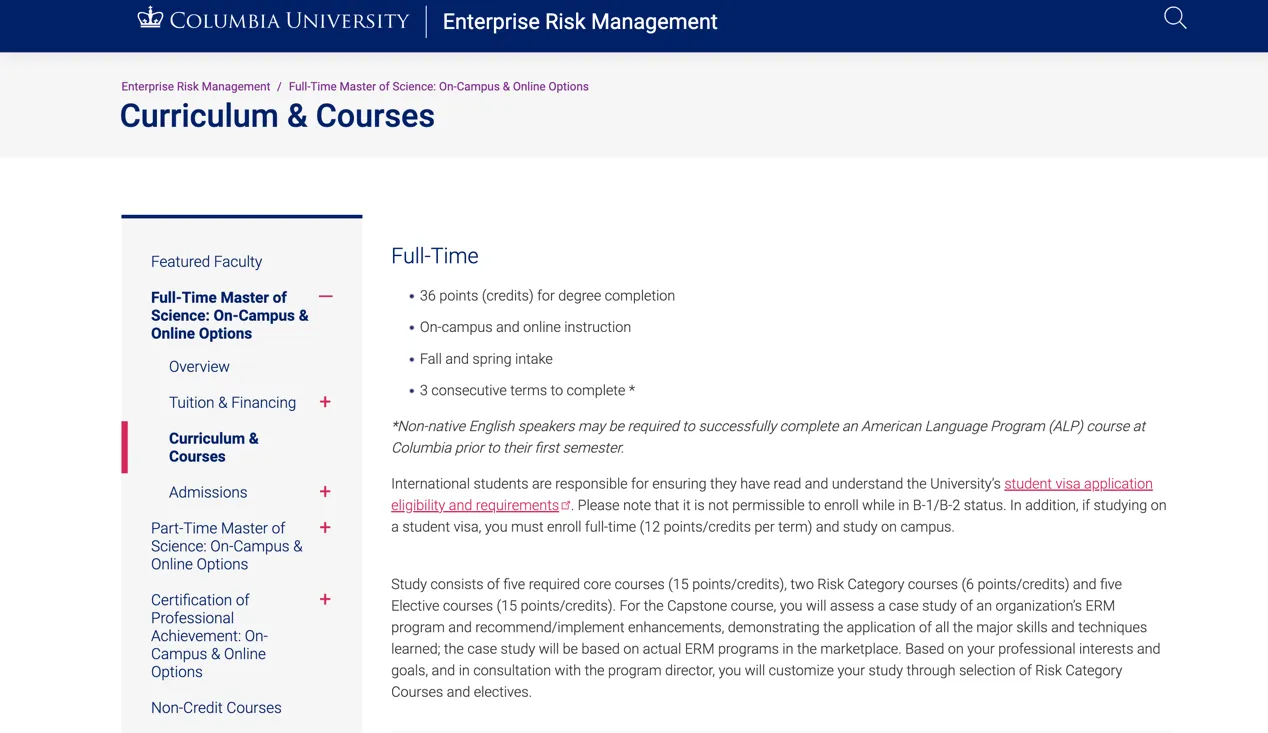
Web Link:
5 Core Courses:
· Traditional Risk and ERM Practices
· Strategic Communication for ERM Professionals (a bit like criminal psychology, covering negotiation/interview skills/observing micro-expressions).
· Value-Based Enterprise Risk Management (learns how to build VB ERM models)
· External Stakeholder Requirements
· Capstone (practice-oriented, case studies every class)
2 Core Courses That Can Be Waived:
· Introduction to Finance
· Managing Human Behavior in the Organization
At least 2 risk elective courses:
· Strategic Risk Management (suitable for those aiming for consulting; each class requires reading mini cases beforehand, and after a semester of practice, consulting interviews become a breeze)
· Operational Risk Management
· Financial Risk Management
· Insurance Risk Management
Other Electives:
· FRM Practices (provides insights into how the business divisions of investment banks operate)
· Company Failures (involves many case studies, ideal for those targeting consulting)
· Systemic Risk: digraphs, fault trees, probabilistic risk assessment, HAZOP, FMEA
· ERM Modeling (primarily uses Excel add-ins to simulate the probability and severity of various risks)
· Information Technology Risk Management (provides a comprehensive overview of core IT risk management concepts, including information security, cybersecurity, and data privacy)
· Enterprise Information Security: Threats and Defense
· Cognitive Bias & ERM (behavioral economics, examining how people make decisions)
· Coding for Risk Management (learns to use different programming languages to solve computational FRM problems, such as using programming to calculate VaR returns, etc. The course covers Excel VBA, R, and Python.)
· Financial Accounting (students preparing for CFA can benefit from this course in tandem)
Regarding course difficulty, note that grades are curved and a score above 80 is required to pass, not 60, so effort is still needed. If you aim just for a pass, a little time investment will keep you from failing. But if you want an A, you must pull yourself together—no grade comes without effort. Some courses have quizzes before each class, homework after class, midterms, finals, and 1-2 case studies.
4. Employment Prospects
1. Job Directions
ERM graduates hold key positions in various organizations in New York City, across the country, and around the world, including risk analysts, risk consultants, credit risk analysts, and more.

2. Popular Choices
First, let's list some popular choices:
Bank of China / Morgan Stanley / American Express
Big Four
Deutsche Bank / Google / Amazon / Goldman Sachs / Bloomberg
Leading Chinese securities firms (commonly known as "Three Zhong and One Hua")
Alibaba, Tencent, ByteDance
3. Career Prospects:
With today's rapidly growing economy and increasingly fierce market competition, it's widely known that where there are profits, there are risks. Risk management has naturally become a focal point of corporate management. For a business, enterprise risk management enables it to remain calm in the face of various emergencies and problems, and to outcompete in the intense market. It can be said that the demand for enterprise risk management professionals will greatly increase in the corporate world. Therefore, the career prospects for this field can only get better.

4. Salary Levels
As of May 25, 2023, the salary range for corporate risk managers in the U.S. typically falls between $117,427 and $161,719, with an average salary of $138,406, roughly equivalent to nearly a million RMB.
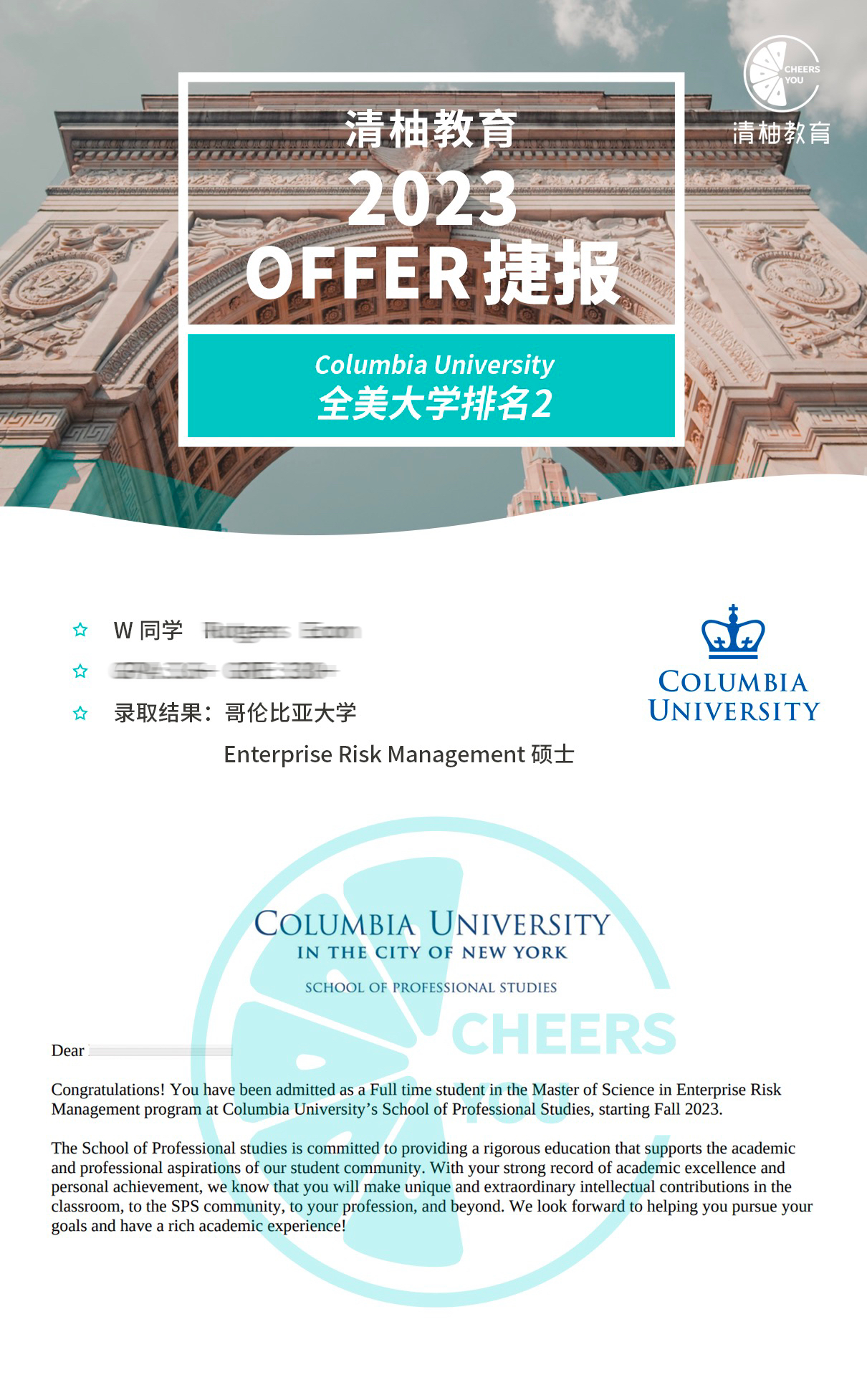
Finally, here are a few examples of successful admission offers we've secured for reference:

For more questions about studying abroad and graduate applications, feel free to add the CheersYou(清柚教育) advisor contact info below for detailed information.