
The National University of Singapore (NUS) Master of Economics program officially opened for Fall 2024 admissions on July 1, 2023!
.png?x-oss-process=style/opt-webp)
The NUS Master of Economics program aims to produce economic experts and consultants for businesses, government agencies, and NGOs, while also providing specialized training for students pursuing academic research in economics. Accordingly, the program offers two tracks: one is the career-oriented Applied Economics (Applied Economics); the other is the academically-focused Quantitative Economics (Quantitative Economics). Note: At the time of application, applicants must specify their preferred track and indicate whether they consent to being considered for the other track.
After completing the first semester and meeting the requirements of the other track, students may apply to switch to that track.
.JPEG)
Curriculum
Applied Economics Track
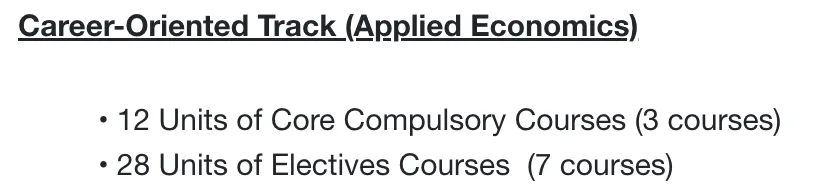
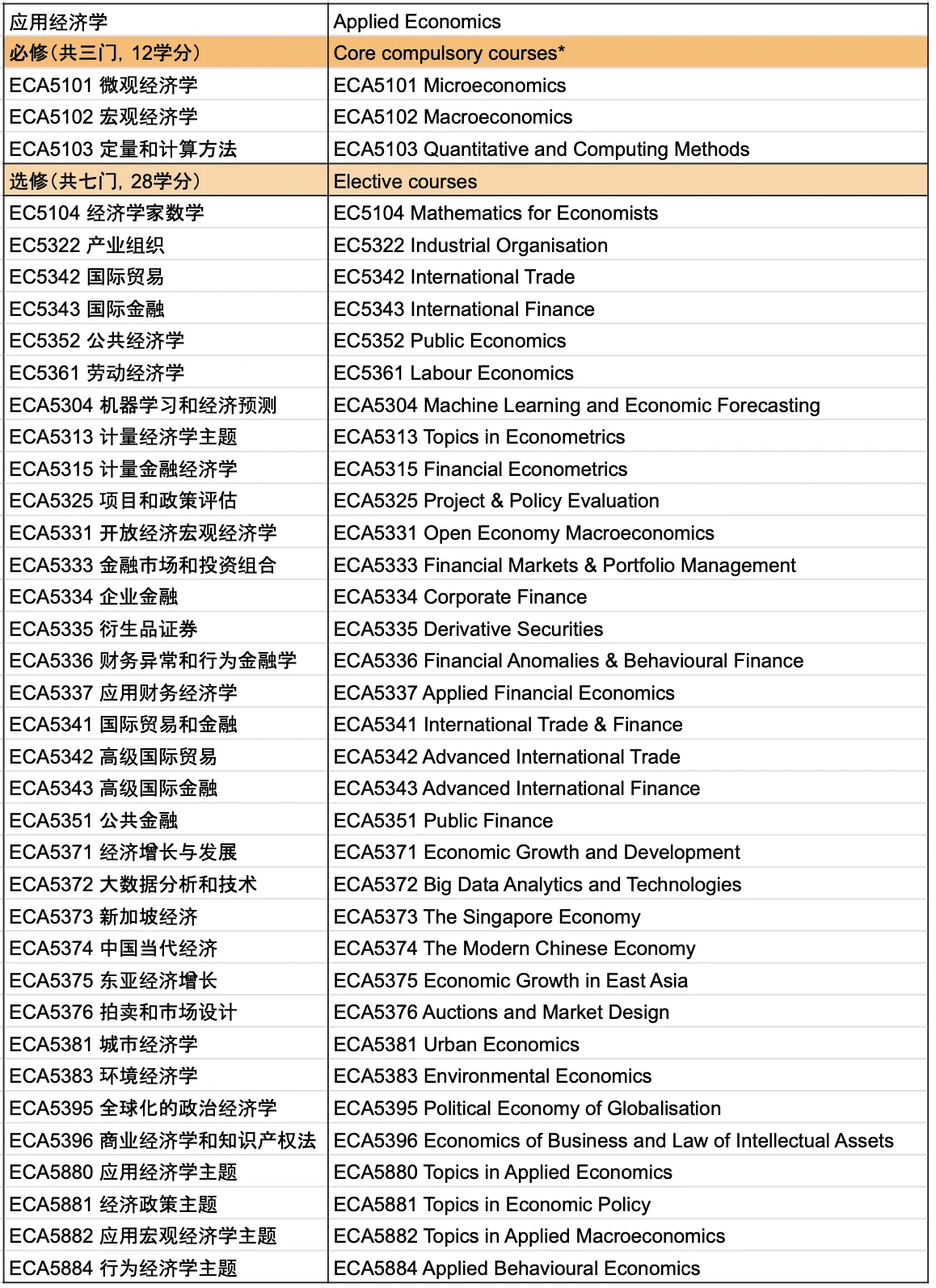
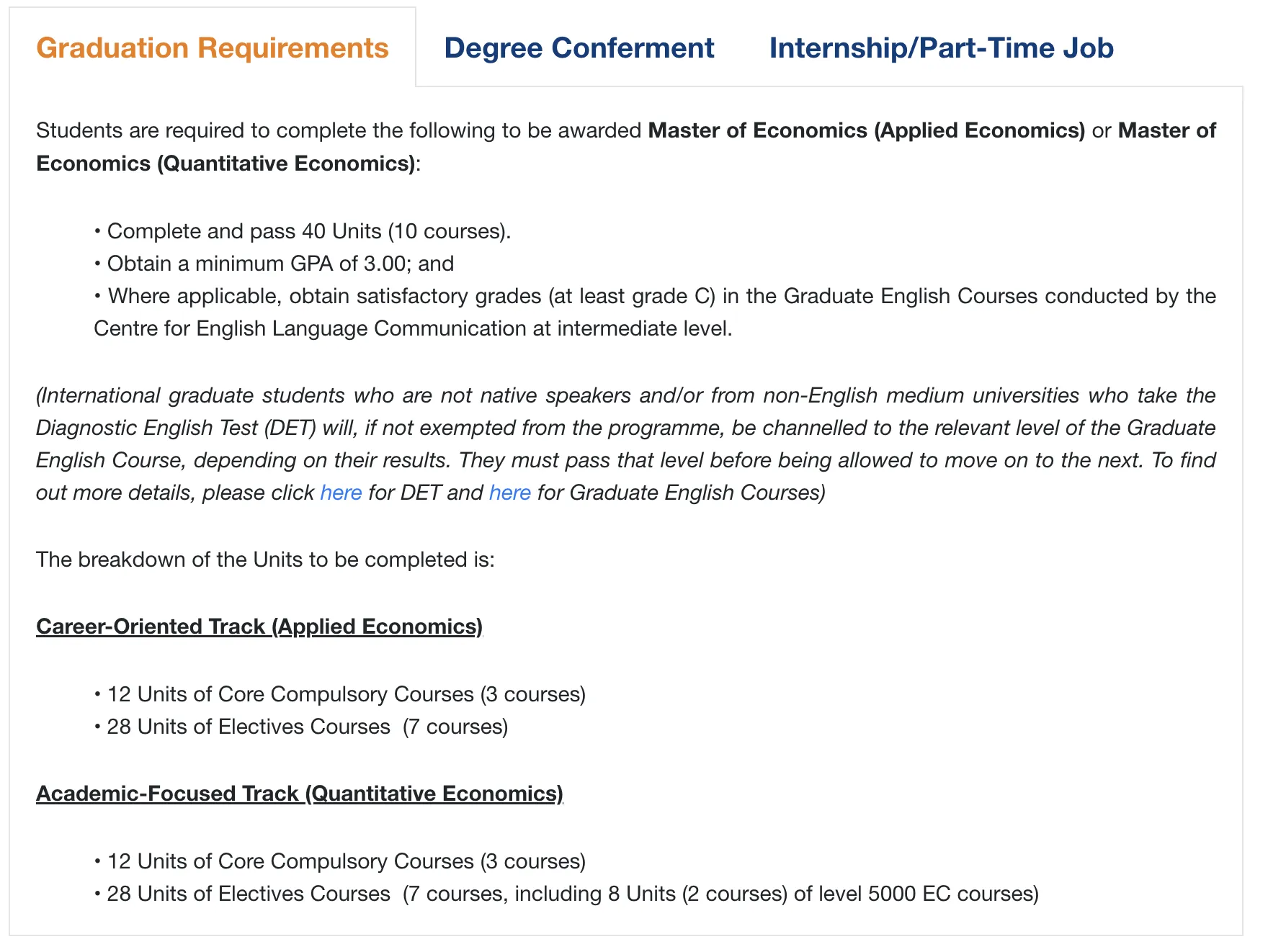
To successfully complete the program, students are required to take ten courses. Among these, three are compulsory core courses: Microeconomics (ECA5101 Microeconomics), Macroeconomics (ECA5102 Macroeconomics), and Quantitative and Computing Methods (ECA5103 Quantitative and Computing Methods).
The remaining seven courses are to be chosen from a list of electives.
Quantitative Economics Track
To successfully complete the program, students must take ten courses (totaling 40 credits). Among these, three are compulsory core courses: Microeconomics (ECA5101 Microeconomics), Macroeconomics (ECA5102 Macroeconomics), and Econometric Modelling and Applications I (EC5103 Econometric Modelling and Applications I).
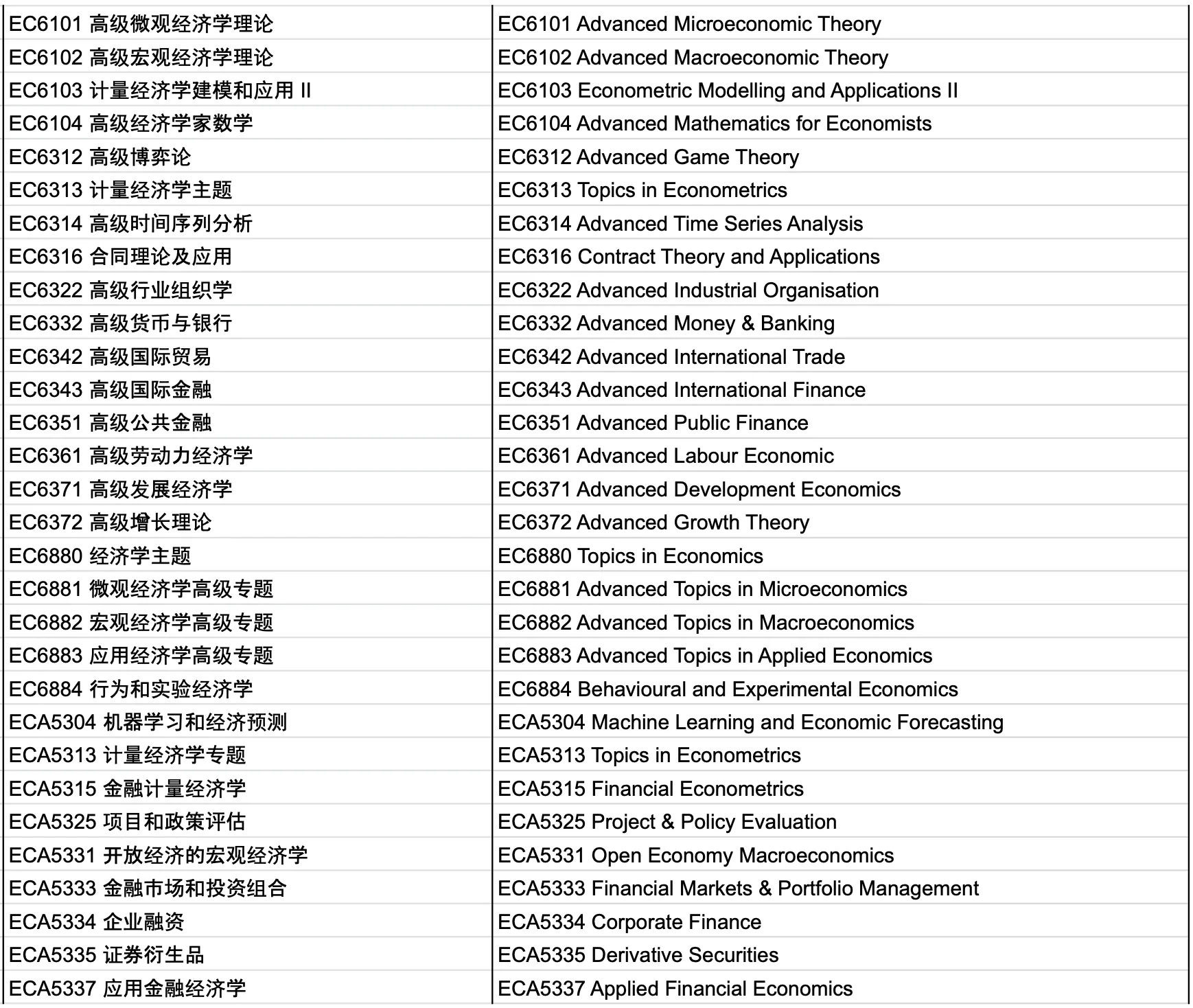
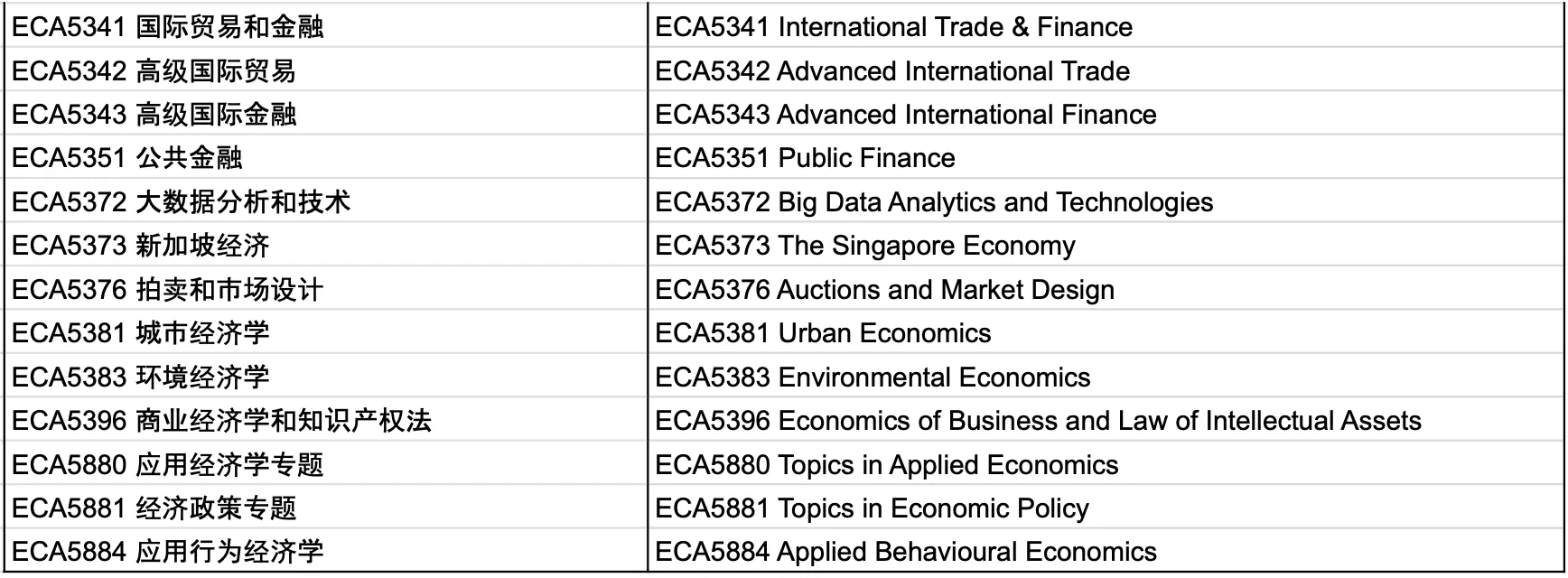
Unlike the Applied Economics track, students must select at least two level 5000 EC courses from the elective list for the remaining seven courses. The university also encourages students to take Mathematical Economics (EC5104) and at least one PhD-level EC course to fulfill their academic objectives.

.png?x-oss-process=style/opt-webp)
Program Duration
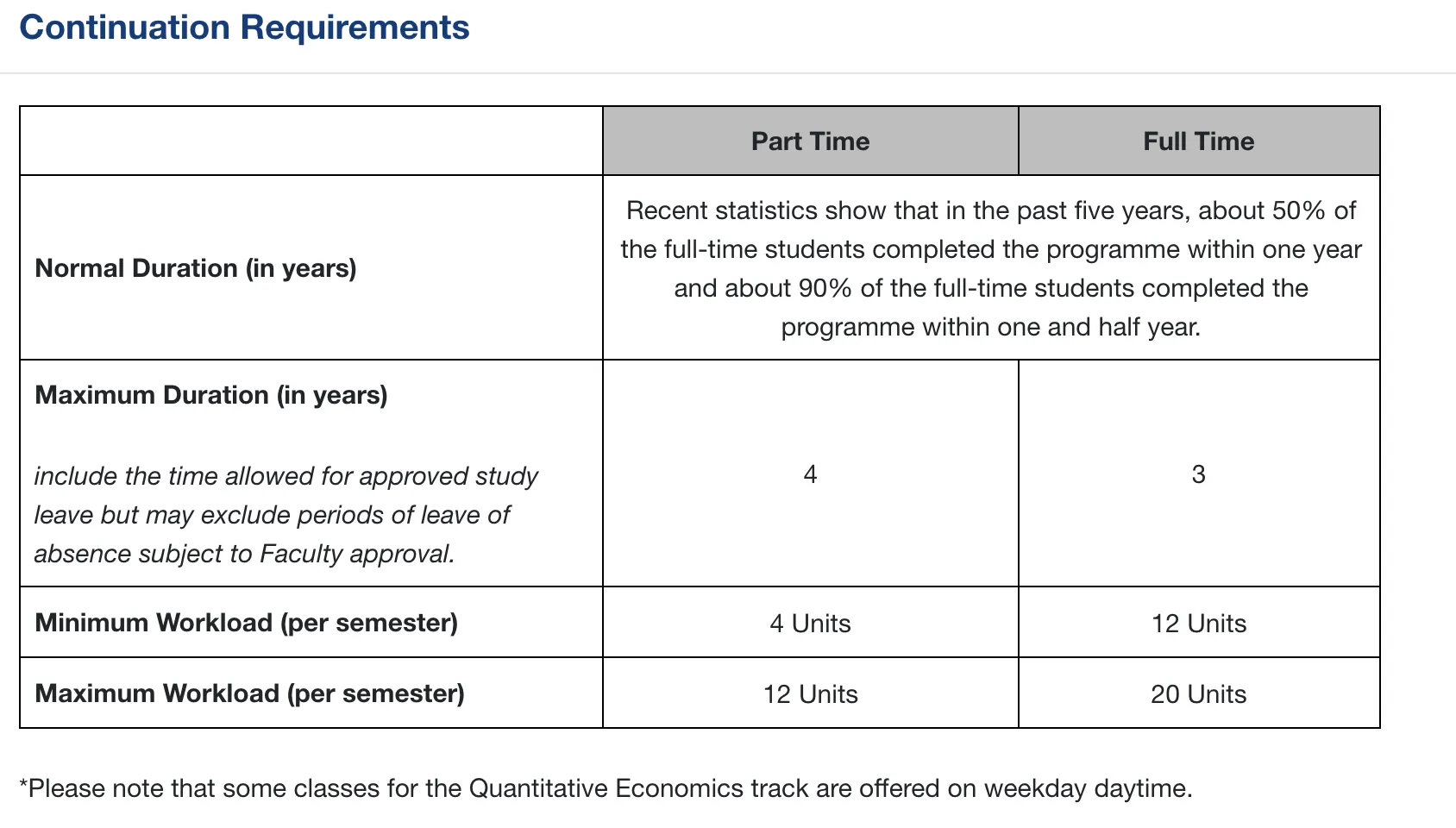
The recommended duration for both full-time and part-time study is one year (achieved by 50% of students in the past five years) to one and a half years (achieved by 90% of students).
The maximum candidature period is 4 years for part-time and 3 years for full-time students.
Students must complete between 12 and 20 credits per semester for full-time study, and between 4 and 12 credits for part-time study.
Academic Requirements
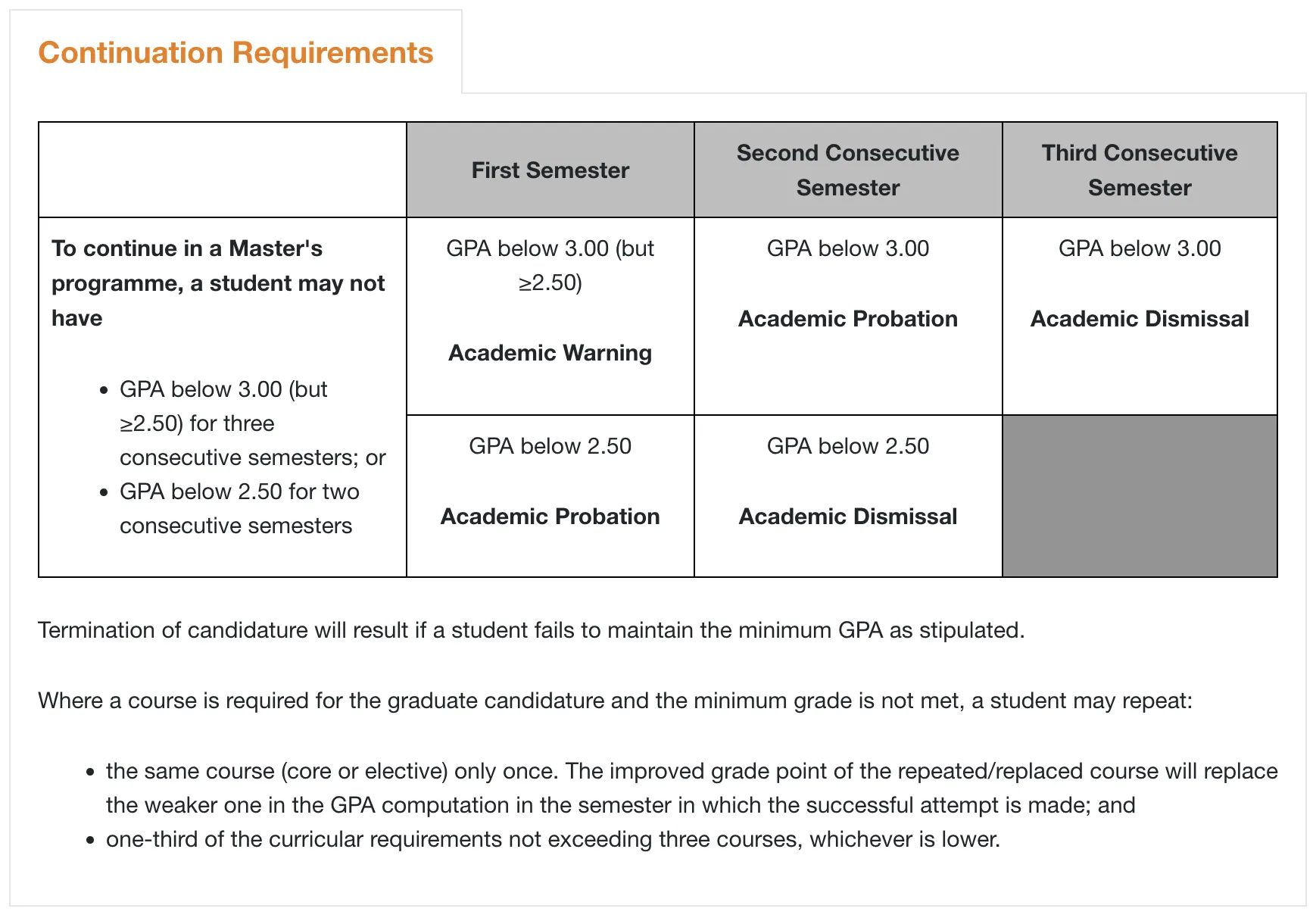
The NUS Master of Economics program has specific academic standing requirements for continuation. Students whose GPA falls below 3.0 in any semester are subject to the following measures:
For the first semester: students with a GPA below 3.0 but at least 2.5 receive an academic warning; those with a GPA below 2.5 are placed on academic probation.
If the GPA remains below 3.0 in the second semester, the student is placed on probation; if below 2.5, the student faces academic dismissal.
Alternatively, if the GPA is below 2.5 in the first two semesters and remains below 3.0 in the third semester, academic dismissal will be applied.
Graduation requirements for both tracks are the same:
-
Completion of 40 credits (10 courses)
-
A minimum cumulative GPA of 3.0 (and, if applicable, a satisfactory grade (at least a C) in the intermediate graduate English course at the English Language Communication Centre)
-
And completion of all required and elective courses as specified for each track.
Admission Requirements
Application Period
The Master of Economics admits students only once per year, for the August intake. The application period is from July 1 to January 15 of the following year. Application results for the August intake are announced in late May of the same year.
Application Method
Applications can be submitted online or by post, but online submission is strongly recommended.
Application Fee
A non-refundable application fee of S$100 (including tax).
Academic Qualifications
• A bachelor's degree in Economics or a related field (e.g., finance, accounting, mathematics, statistics, physics, engineering, operations research) from NUS; or
• A bachelor's degree in Economics or a related discipline with an average grade of at least B or equivalent, and successful completion of a placement test in the form of an oral interview conducted by at least three members of the Master of Economics committee;
• Other qualifications and experience subject to approval by the Graduate Committee.
English Language Requirements
Applicants whose native language and medium of university instruction is not English must submit TOEFL (Test of English as a Foreign Language) or IELTS (International English Language Testing System) scores as proof of English proficiency. Minimum score requirements are as follows:
-
Internet-based (iBT): minimum 85 (with at least 22 in the Writing section) / TOEFL ITP Plus for China*: 590 (with at least 60 in the Writing section)
-
Computer-based (CBT): minimum 237
-
IELTS and *IELTS Indicator: minimum overall band score 6.0
*In light of the COVID-19 situation, the Admissions Committee temporarily accepts TOEFL iBT® Special Home Edition, TOEFL ITP® Plus for China, and *IELTS Indicator until test centers reopen.
Applicants who completed their undergraduate studies in English but are not native speakers are encouraged to submit language test scores. If not, they must provide a letter explaining the request for IELTS/TOEFL waiver along with supporting documents. Some successful candidates may be required to take the university's English proficiency test and, if necessary, attend graduate English courses.
GMAT/GRE: Not explicitly required
Application Documents
Applicants should submit their application online; there is no need to mail any hard copy documents before the application deadline. If shortlisted, the university may contact the applicant to submit supporting documents by post.
Note: The university will process applications only after all required documents are received. The following documents are required for the online application:
• Latest academic transcripts
• Degree registration proof/certificate or student status letter (for current students)
• Two academic referee reports (submitted by the referees)
• TOEFL/IELTS score report (if applicable)
• Financial support documents (if applicable)
• Official identification document (passport / NRIC / SPR Re-entry Permit)
• Employment Pass and employer's approval letter (for international applicants working in Singapore)
Tuition and Scholarships
Tuition
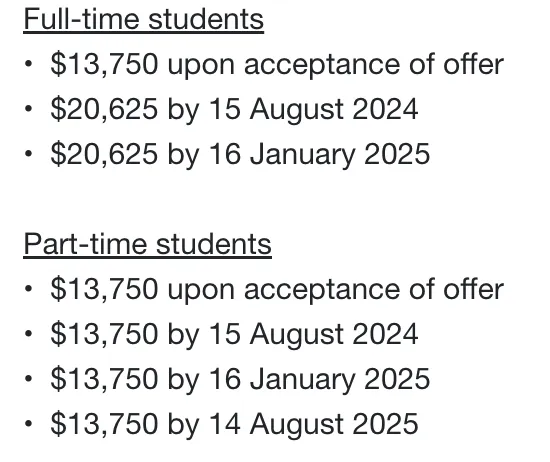
For the August 2024 intake, the tuition fee is S$55,000 (inclusive of tax) for all students, regardless of nationality. Both full-time and part-time students pay the fees in installments: the first payment upon acceptance of the offer, and subsequent payments with each semester.
Scholarships
No separate application is required; top-performing students in the program will receive an award of S$2,000 to S$5,000.
Career Prospects
Career prospects for NUS Master of Economics graduates depend on their chosen track. Graduates from the Applied Economics track are well-positioned for roles as economists or economic consultants in business, non-profit organizations, or government agencies. Graduates from the Quantitative Economics track typically pursue further studies, often moving on to PhD programs to become pioneers in economic research.