The London School of Economics and Political Science is a world-leading social science institution with a rich history and extensive academic resources. LSE offers a wide range of undergraduate and graduate programs across disciplines such as economics, political science, international relations, sociology, law, and management. Among them, the Department of Media and Communications has long focused on global communication and media studies, offering a diverse array of media programs. It enjoys worldwide renown for its high-quality research and excellent teaching.
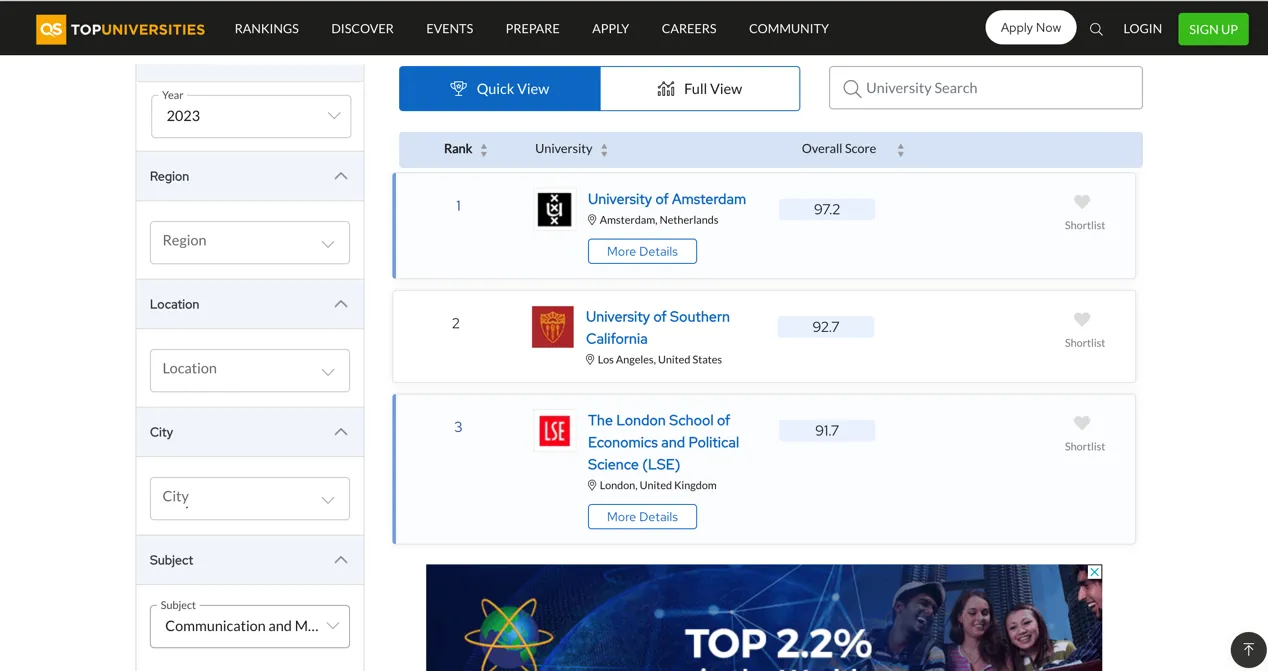
Today, let's explore LSE's Department of Media and Communications. For more inquiries, you can also scan the QR code below for a one-on-one consultation.

1. Overview of the LSE Department of Media and Communications
The Department of Media and Communications at the London School of Economics and Political Science (LSE) is a world-leading center for communication and media research and education, ranked first in the UK and third globally. The department's teaching is committed to critically examining the process of media-saturated globalization, researching the global phenomena related to the organization, production, and consumption of media and communications.
These media programs are suited for students with a social science background or professional experience in media and communications-related fields. Career prospects are very broad, spanning broadcasting, journalism, advertising, new media, political marketing, market research, regulation and policy, media management, and research in both public and private sectors.
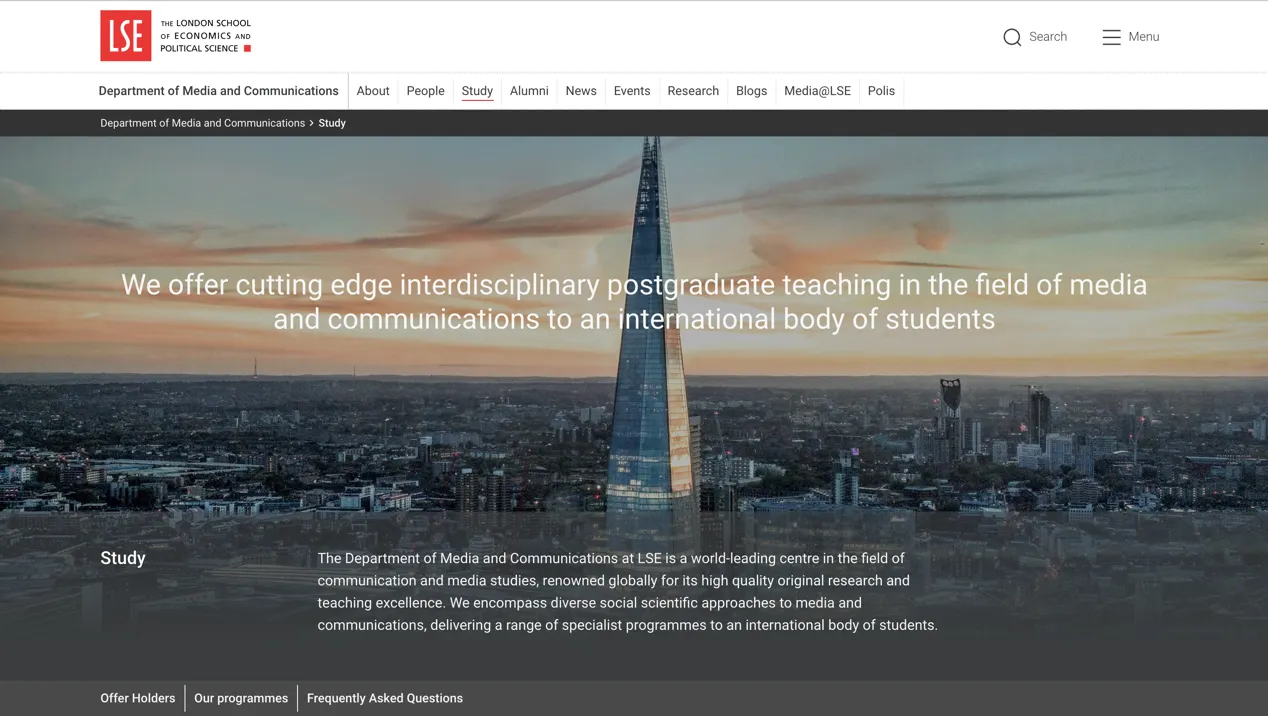
Link: https://www.lse.ac.uk/media-and-communications/study
2. Programs Offered
The Department of Media and Communications at LSE offers a range of graduate programs covering diverse study areas. There are 10 taught master's programs, 7 specialized research tracks, and 3 double degree programs.
- MSc Media and Communications
- MSc Media and Communications (Research)
- MSc Media and Communications (Data & Society)
- MSc Media and Communications (Governance)
- MSc Media, Communication and Development
- MSc Politics and Communication
- MSc Strategic Communications
- MSc/MA Global Media and Communications (LSE and USC)
- MSc/MA Global Media and Communications (LSE and Fudan)
- MSc/MA Global Media and Communications (LSE and UCT)
Beyond the Department of Media and Communications, other departments offer related programs such as MSc Gender, Media and Culture and MSc Social and Public Communication.
Additionally, there are the MSc/MA Global Media and Communications programs in partnership with the University of Southern California (USC), Fudan University, and the University of Cape Town (UCT).
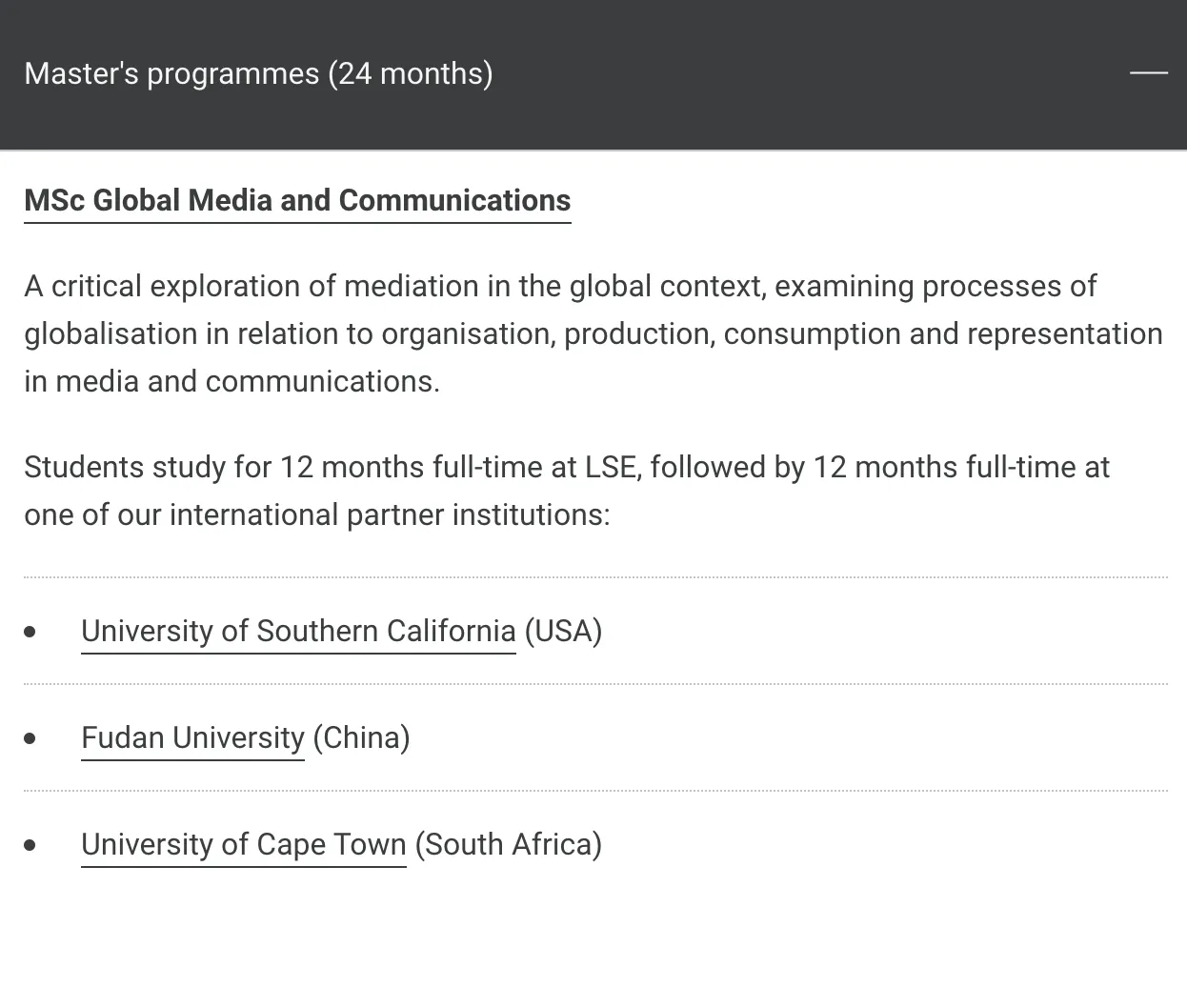
Most of these programs are one-year degrees, while the global media and communications programs with partner institutions span two years. Students spend their first year at LSE and the second year at the partner school. For these dual-degree programs, students typically complete two dissertations, and at USC, an internship is also required in the second year.
3. Introduction to the Global Media and Communications (LSE and USC) Program
Notably, the joint MSc/MA Global Media and Communications (LSE and USC) program is highly sought after. Students study at LSE in the UK for one year and then at the USC Annenberg School for Communication and Journalism in the US for the second year. The Annenberg School is highly regarded in the US, and USC has close ties with the Los Angeles media industry. Upon completion, students earn degrees from both institutions, making them highly competitive globally.
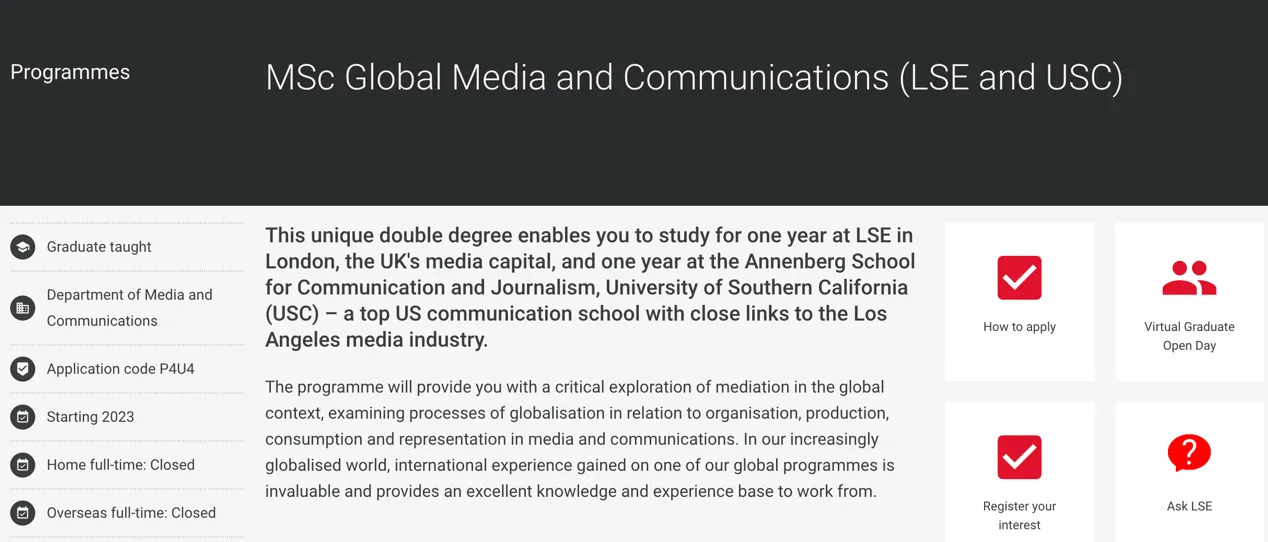
During the first year at LSE, students study theories and methods in media and communications. The curriculum features seven thematic areas:
- Global and Transnational Media
- Media, Culture and Community
- Politics and Publics
- Health Communication and Social Dynamics
- Groups, Organizations and Networks
- Information, Political Economy and Entertainment
- New Media and Technology
In the second year at USC Annenberg, students engage in research internships and related coursework.
Graduates of this program work in a variety of fields, including broadcasting, journalism, advertising, new media, political marketing, market research, regulation and policy, media management, and research in both public and private sectors.
4. Application Requirements
To apply for media and communications programs at LSE, applicants need a social science background or professional experience in media and communications if coming from other fields.
- 2:1 bachelor's degree (GPA 3.0+)
- GMAT/GRE: not required
- 2 letters of recommendation
- CV/resume
- Personal statement (500–1000 words)
- For the USC application, students generally only need to submit transcripts through USC's system.
- TOEFL or IELTS score
Finally, here are a few offer examples from LSE media programs for your reference.
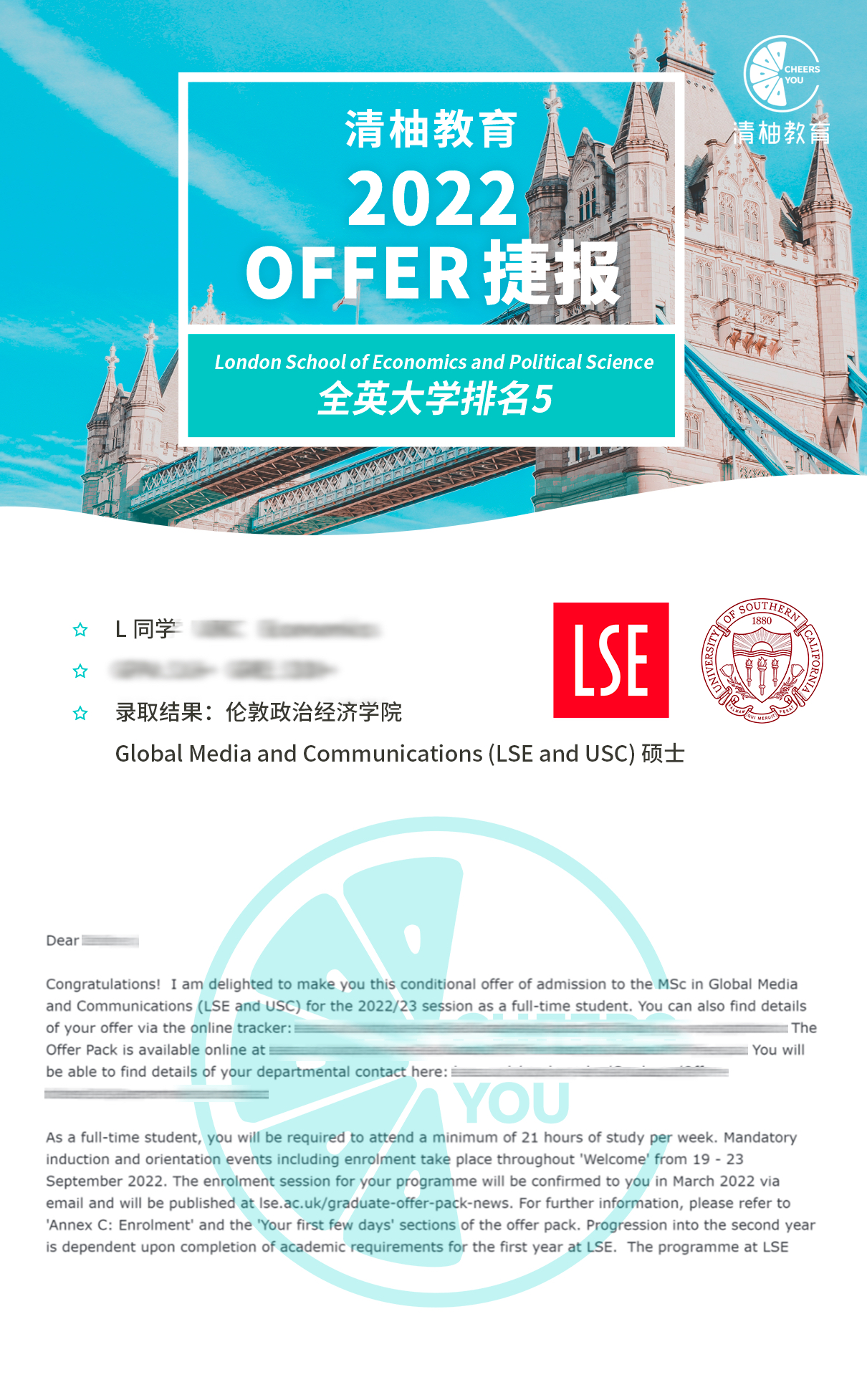
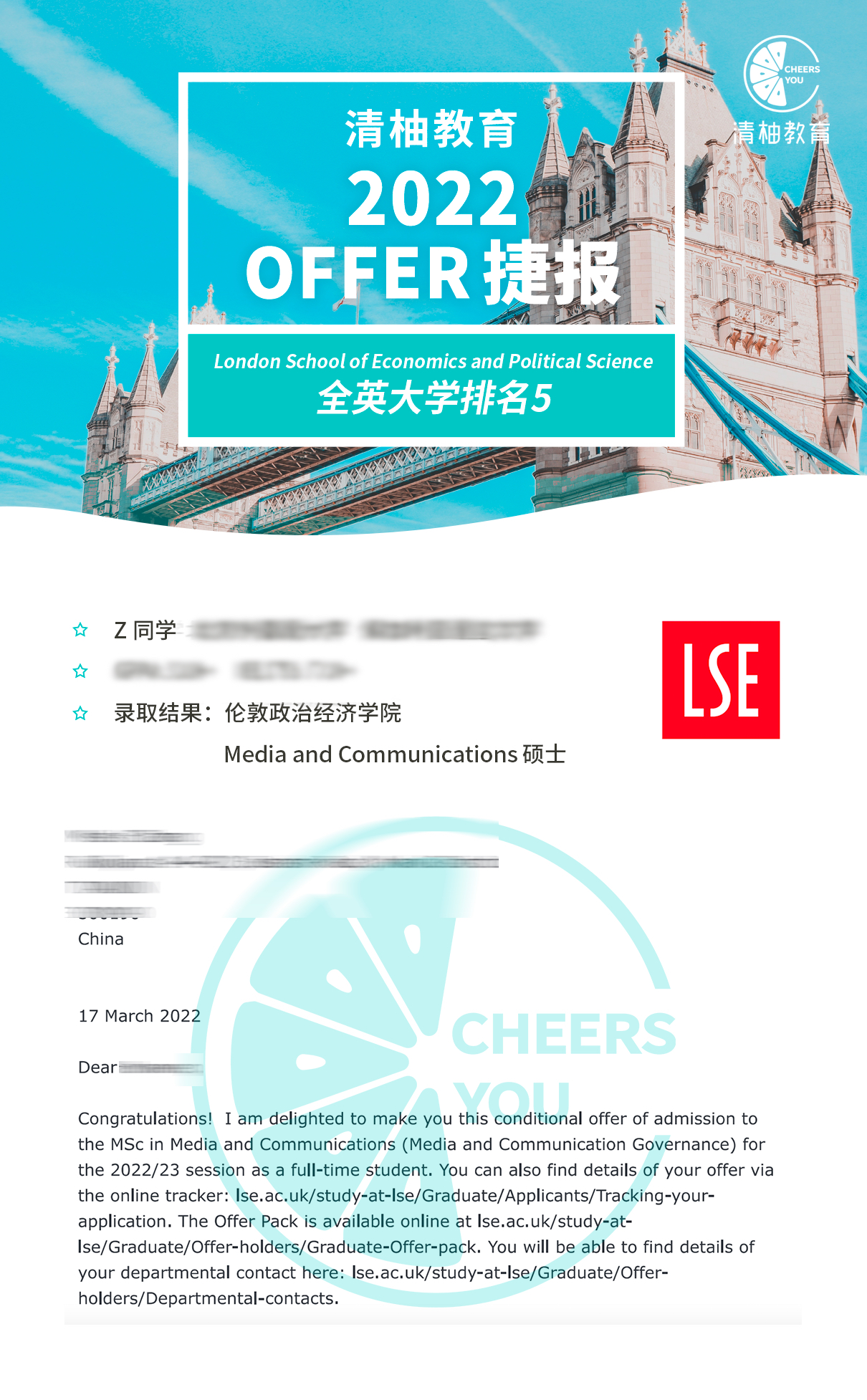
For more admission cases and questions about studying abroad or graduate applications, feel free to contact CheersYou(清柚教育) advisors for details using the information below.