
With the conclusion of the first post-reform GRE exam on September 22, all the questions you had about the reform have finally been answered!! Next, CheersYou(清柚教育)Key Questions will give you a quick summary!
Key Points!!!
- No long passage with 4 questions appeared!!!
- There are 7 Sentence Equivalence questions, accounting for 1/2 of total GRE fill-in-the-blank questions.
- Only one Logic question appeared in section 2.
- No one-question short passages.
- Data interpretation questions only appear in section 1.
- The test bank hasn't changed much; many students encountered familiar questions.
- The test experience is "smoother," but the tolerance for errors is lower.
- The test structure is largely consistent with the ETS official sample questions.
Summary of New GRE Exam Questions
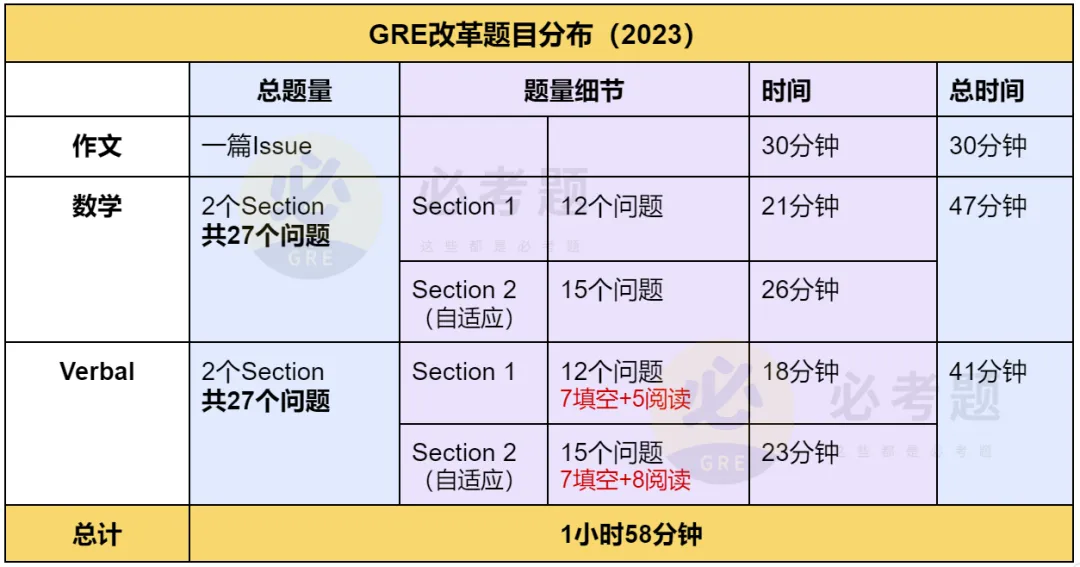
The order of Verbal and Quant is not fixed, and there are two scenarios:
① issue→Q→V→Q→V
② issue→V→Q→V→Q
Next, we present the detailed distribution of questions in the Verbal and Quant sections for the first post-reform GRE exam!
Detailed Distribution of Verbal Questions After GRE Reform
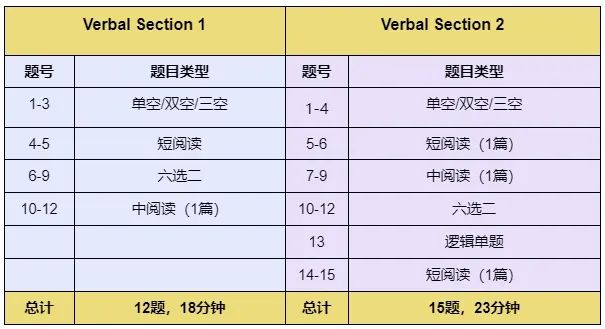
VerbalQuestion Type Summary
According to the first exam on 09/22 after the reform, the Verbal section had 14 fill-in-the-blank questions and 13 reading comprehension questions:
- section 1: 7 fill-in-the-blank questions (including 3 single/double/triple blank, 4 Sentence Equivalence), 5 reading comprehension questions (1 short passage, 1 medium passage)
- section 2: 7 fill-in-the-blank questions (4 single/double/triple blank, 3 Sentence Equivalence), 8 reading comprehension questions (1 critical reasoning, 2 short passages, 1 medium passage)
Summary
1. Long reading passages did not appear in either the sample test or the first real exam, confirming that the GRE indeed no longer includes them!!!
2. After the reform, the proportion of Sentence Equivalence has increased. With fewer total questions, Sentence Equivalence still has 7 questions (originally 8), accounting for 1/2 of fill-in-the-blank total, making it a key question type!
3. Unlike the sample test, in the first Verbal section of the post-reform exam, there were no critical reasoning or one-question short passages; instead, there was a two-question short passage.
Detailed Distribution of Quant Questions After GRE Reform
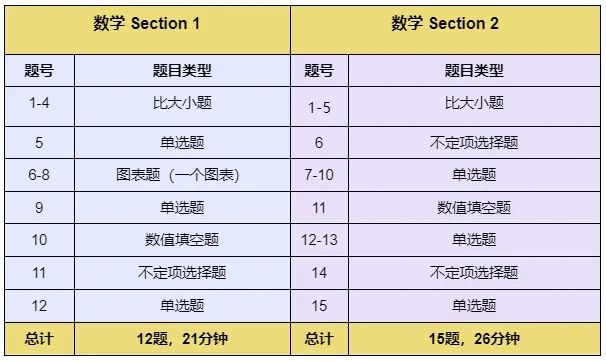
Quant Question Type Summary
In the first post-reform exam on 09/22, the distribution of Quant question types was consistent with the sample test: 9 Quantitative Comparison questions, 3 Data Interpretation questions, 2 Numeric Entry questions, and 13 multiple-choice questions (including single and multiple-answer):
- section 1: 4 Quantitative Comparison, 3 Data Interpretation, 1 Numeric Entry, and 4 multiple-choice (single and multiple-answer)
- section 2: 5 Quantitative Comparison, 1 Numeric Entry, and 9 multiple-choice (single and multiple-answer)
Summary
After the reform, Data Interpretation questions only appear in the first section, with one chart covering three questions, and no chart questions in the second section. This indicates that to enter Hard mode, it is crucial to solve the chart questions efficiently in the first section.
Overall, the post-reform GRE offers a better test experience and is more favorable for Chinese test-takers, though it may require a higher tolerance for error.
Moreover, the GRE test bank has not been replaced, so existing GRE materials remain perfectly applicable. Students can prepare with confidence, and we wish everyone an early good score!