
We all know that the personal statement is an essential component of transfer applications and a key resource for admissions offices to assess applicants' backgrounds.
The University of California, as the most comprehensive public university system in the U.S. with nearly 300,000 students, is hailed as the 'model of public higher education,' and its emphasis on essays goes without saying.
A great essay can not only be the icing on the cake but also provide timely help when needed. Today, CheersYou(清柚教育) has compiled key points about UC application essays based on official recommendations—essentials you cannot afford to miss.
.jpg?x-oss-process=style/opt-webp)
Transfer Essay Prompts: The '3+1' Structure
UC's personal insight questions serve as the application essays, comprising one required question and three chosen from seven optional prompts, with each response limited to 350 words.
One Required Question: How Have You Prepared for Your Intended Major?
Please describe how you have prepared for your intended major, including your readiness to succeed in your upper-division courses once you enroll at the university.
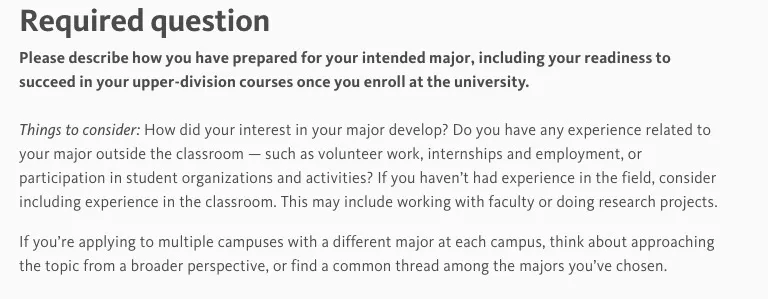
Before answering, consider the following:
- How did your interest in this major develop?
- How did your school experiences spark your interest in this major?
- What extracurricular experiences helped nurture this interest?
- Did your culture, family, or other factors influence your choice of major?
- How does your intended major relate to your long-term goals?
If you're applying to different majors across different campuses, think about this question from a broader perspective, or find common ground among your chosen majors. This will demonstrate your ability to synthesize and multitask, which can work in your favor.
Choose 3 out of 7 Prompts:
1. Leadership:
How have you positively influenced others? How have you helped a team solve problems and contribute? A leadership role goes beyond a title; it can be serving as a mentor, taking charge of a specific task, or organizing an event or project. Think about your achievements and what you learned from the experience. What were your responsibilities?
2. Creativity:
What does creativity mean to you? Do you have a creative skill that is important to you? What do you do with it? How has your creativity influenced your decisions inside and outside the classroom? Is your creativity related to your major or future career?
3. Talent:
What is your greatest talent or skill? If there is a talent or skill you are proud of, now is the time to share it. It doesn't have to be recognized or awarded. You can talk about why this talent or skill is meaningful to you. Is it innate or did you work hard to develop it? Has it provided opportunities in and out of the classroom?
4. Educational Opportunity/Barrier:
How did you take advantage of an educational opportunity to overcome a challenge in your studies? How have you applied the knowledge and skills gained from this experience? An educational opportunity can be any valuable aspect of your educational journey. If you choose to write about an educational barrier, how did you work to overcome it? How has overcoming this obstacle shaped who you are today?
5. Overcoming a Challenge:
What meaningful challenge did you encounter, and how did it affect your academic achievement? This challenge could be personal or one you faced in your community or school. This is a great opportunity to discuss any obstacles you've encountered and what you learned. Did you receive support or handle it on your own?
6. Community Service:
What have you done to make your school or community a better place? What was your role, motivation, and what did you gain? Think of community as a group, team, or place, such as your school, hometown, or family. What positive change did you bring? How did your actions benefit others or the community?
7. What Sets You Apart:
This is an open-ended prompt. From your perspective, what makes you stand out among UC applicants? What do you value in life? What are you passionate about? If admitted, what are you most looking forward to?
Since you have the freedom to choose, we strongly recommend playing to your strengths and avoiding weaknesses, and choosing what works best for you.
Before selecting prompts, reflect on yourself:
- Where do my strengths and advantages lie?
- Where are my weaknesses and disadvantages?
- Which keywords relate to events in my life experience?
Among these seven prompts, choose the three that best suit you, have the most to say, and are the 'juiciest.' If one or two stand out, start writing those first, then decide on the rest.
Essay Content: Tell Your Story, Focus on 'Me'
Writing application essays is a process of packaging yourself, or you could say it's about building a positive 'persona' in the eyes of admissions officers.
How can you make your personal statement stand out among thousands of applicants?
Preliminary Preparation
Dig deep into your life experiences and find examples that fit the prompts. Study the detailed descriptions and 'sub-questions' beneath each prompt, and outline your responses to stay on track.
For example, some applicants have been involved in small invention projects or even obtained officially certified patents, which can make great material for the 'creativity' prompt.
However, some domestic applicants tend to draw only from their school experiences, both inside and outside the classroom.
For the 'leadership' prompt, some write about taking on an important role in school or class activities; for 'overcoming a challenge,' they describe overcoming difficulties in a particular course and their progress.
These are not off-limits, but you need to phrase them with cultural differences in mind so that admissions officers can more easily understand the situations you describe.
At this point, you'll also realize the importance of background enhancement.
Brainstorming and Drafting
If you treat this experience like a movie, you are the protagonist. A movie character needs a dramatic character arc.
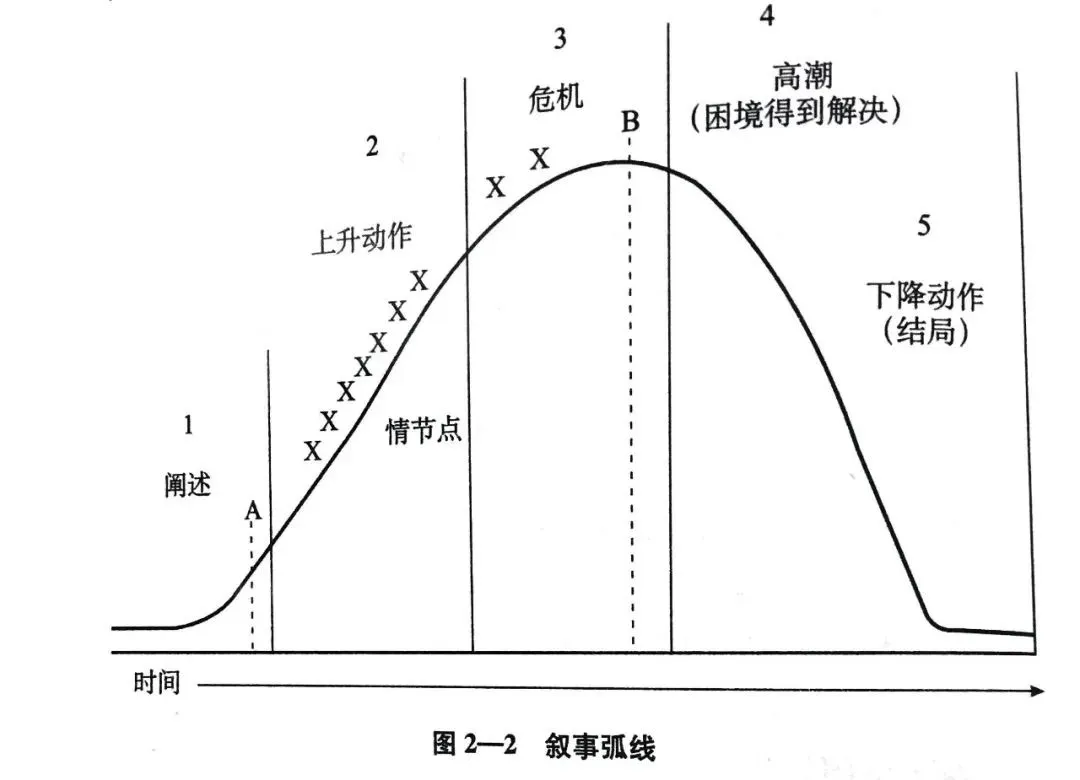
For instance, with the 'overcoming a challenge' prompt, you can contrast the before and after to highlight your character arc—from how weak you were to how strong you became. Similarly, for the 'leadership' prompt, you might go from facing indifference before your success to being admired after.
Through such methods, you prove yourself from both direct and indirect angles. Even if admissions officers only have time to read the opening and closing, they will notice the positive change you underwent through the experience you describe.
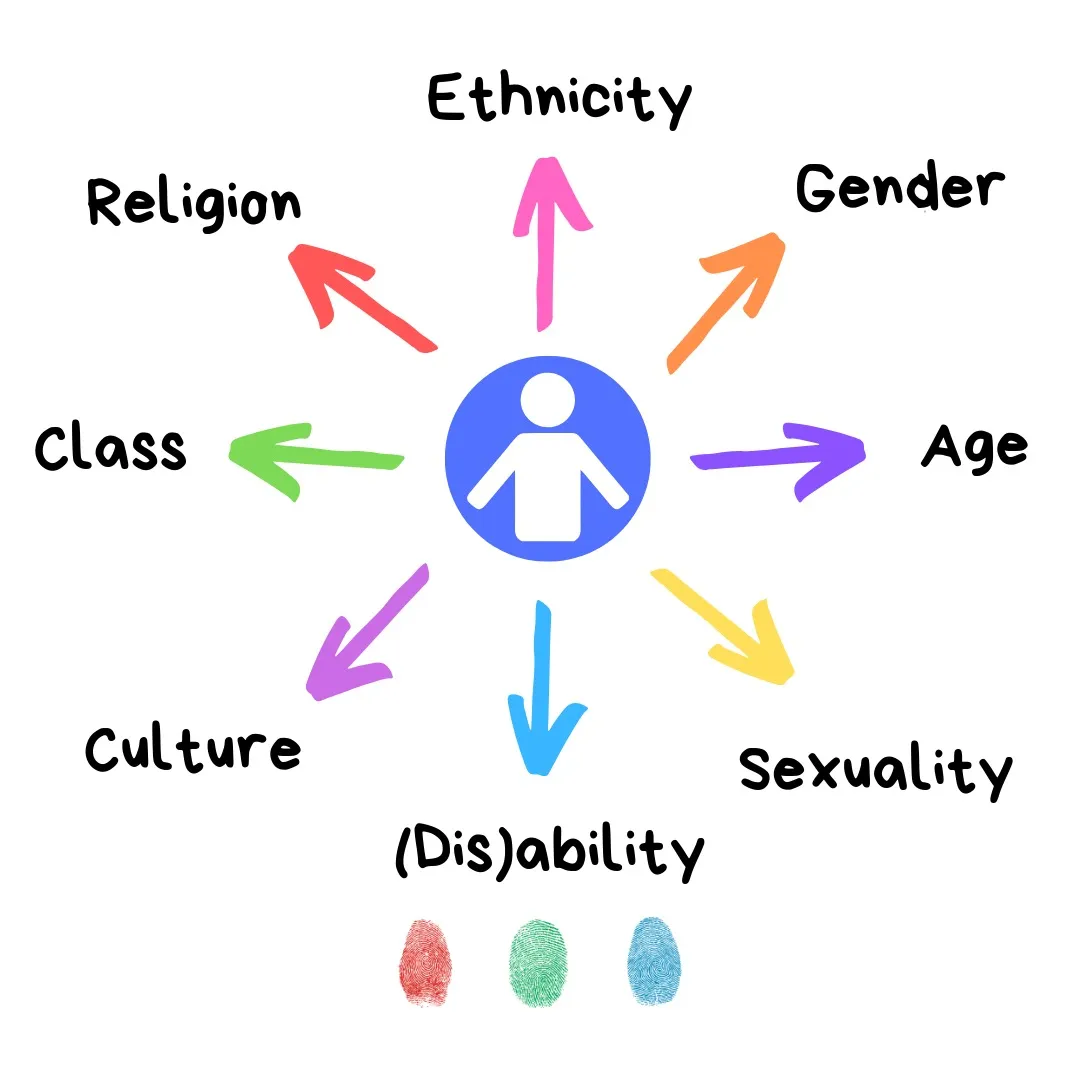
Additionally, if applicable, applicants can incorporate experiences of unfair treatment or limitations as a 'disadvantaged group' based on gender, race, social class, etc., into their prompts. This can connect to current social issues in the U.S., resonate with admissions officers, and also be a strategy for evoking sympathy.
Polishing and Refining
With the right support, essay writing is not a solo endeavor. Applicants should start early to give themselves ample time to seek help from others to improve their drafts, especially in terms of grammar and word choice.
Those studying in U.S. high schools or community colleges can turn to their school's writing center, tutors, English teachers, or even host families. Applicants in their home countries can also seek native speakers for polishing.
However, any polishing should not exceed the applicant's own English proficiency. Personal statements don't require complex grammar or lofty vocabulary; the most important thing is authenticity and originality to show your uniqueness.
Key Takeaways
Understand the prompt, understand the prompt, understand the prompt!
As mentioned earlier, carefully analyze the original prompt, including the summary and detailed instructions below it. It's best to outline first to avoid missing points or going off-topic and to help structure your essay.
Word Limit: 350 Words
There's a lot to say, but you can't be long-winded. Each UC personal insight question has a 350-word limit, so you must focus on what matters most, paying attention to the balance among the introduction, body, and conclusion.

That's why personal statements often go through multiple drafts—continuous cutting, revising, and refining to make every sentence concise and impactful. It's also why getting feedback from others is recommended; they can help you see what to keep and what to cut.
Not Just Right Values, but Positive Energy
Finally, sound values are the bedrock of a good essay. Moreover, your writing should radiate the positivity of an enthusiastic undergraduate applicant with an optimistic attitude toward society and bright hopes for the future.
Not only should you 'tell a story well,' but you should tell a 'good story.' Continuously refining your writing skills, grammar, and word choice helps you 'tell a story well,' while telling a 'good story' requires you to have a macro-level control over your essay from the start and continuously adjust and perfect your 'persona' during the writing process.
Focus on 'me,' and draw on your own experiences and insights. This is your 'personal statement,' so in the narrative, avoid expanding 'I' to a collective 'we.'
After understanding the UC essay prompts and writing tips, I believe every student who dreams of UC will feel more confident and prepared for the application process.
The application season for the new year has already begun, and students should start planning their applications as early as possible.
With UC admissions becoming increasingly competitive, CheersYou(清柚教育) advises students to plan as early as possible. Only by using resources wisely and effectively can you achieve satisfactory results.