The 2024 postgraduate entrance exam is over, and many students who took the exam are considering whether to capitalize on their momentum and take the GRE, since the GRE score is valid for 5 years and could be used if they plan to study abroad later.
So, as both are graduate entrance exams, what exactly are the differences between the GRE and the Chinese Postgraduate English Exam?
Today, we will compare the differences and similarities between the Chinese Postgraduate English Exam and the GRE from several aspects: vocabulary, reading, exam duration, and test format.
.jpeg)
1. Vocabulary
First, comparing vocabulary, the two exams have different vocabulary volume requirements, and the overlap is very low.
Vocabulary Volume
The Chinese Postgraduate English Exam syllabus requires a vocabulary of around 6,000, including many words from the CET-4 and CET-6.
In contrast, GRE vocabulary, in addition to including words from CET-4/6 and TOEFL, also has its own core vocabulary, totaling around 12,000 words.
Vocabulary Difficulty
In the Chinese Postgraduate English Exam vocabulary, GRE-level words account for less than 10%. Essentially, China's postgraduate English exam still tests students' mastery of the English language itself.
The GRE, however, fundamentally tests the test-taker's logical reasoning, analytical ability, and critical thinking, involving many highly academic and obscure terms. Moreover, the GRE assesses not just everyday meanings but more often the meanings of words in academic contexts, making it more challenging than the Chinese Postgraduate English Exam.
Let's compare the high-frequency vocabulary of the two exams.
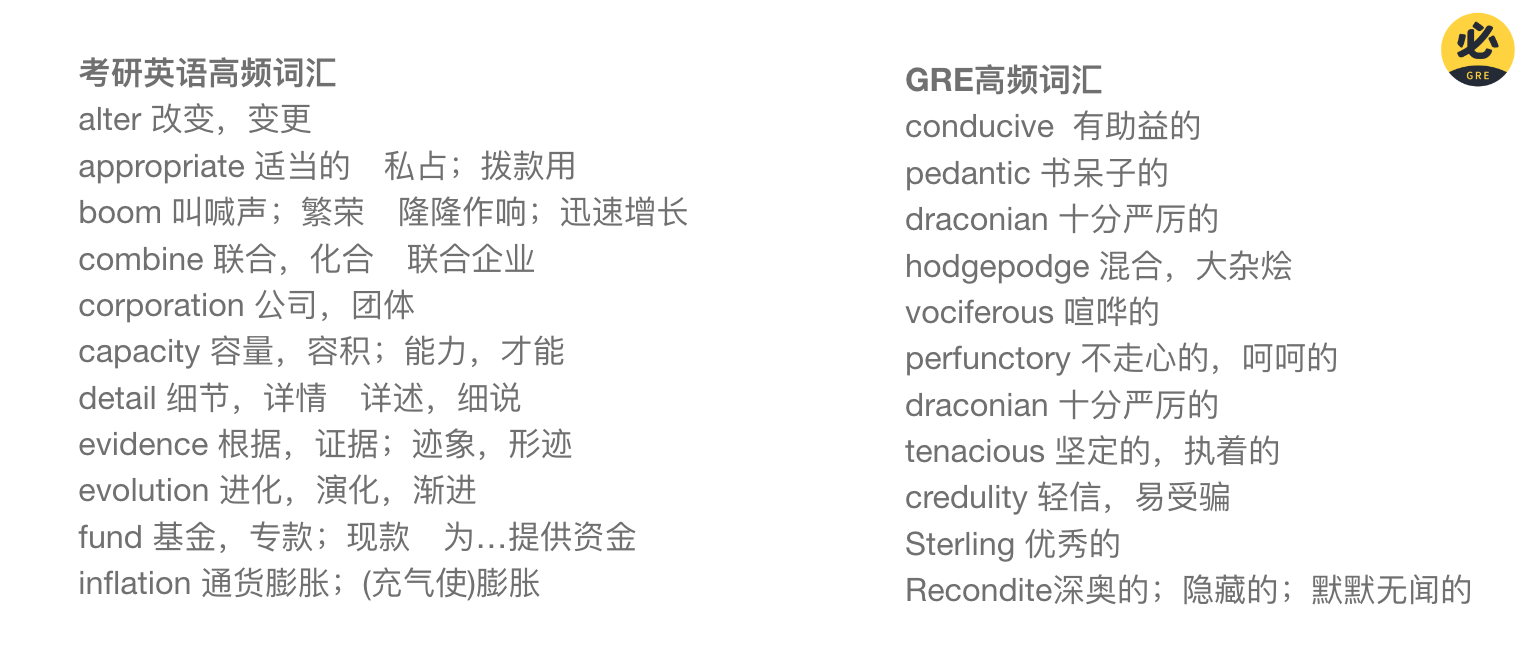
It's easy to see that the Chinese Postgraduate English Exam vocabulary is more everyday, with many overlapping with CET-4/6 words, while GRE vocabulary tends to be more obscure and specialized.
2. Fill-in-the-Blanks
Although both are tested in fill-in-the-blank format, the approach to synonym/antonym questions differs between the Chinese Postgraduate English Exam and GRE fill-in-the-blank questions.
Chinese Postgraduate English Exam

In this exam question, the logic is relatively direct. The meaning of the two sentences is opposite, so the answer is "however."
GRE

Looking at a GRE question: "Although" indicates a concessive relationship, implying a reversal; "did not" is a negation, also a reversal, so [blank 1] and [blank 2] are synonymous. Since "disparage" means to belittle, [blank 1] is a negative word.
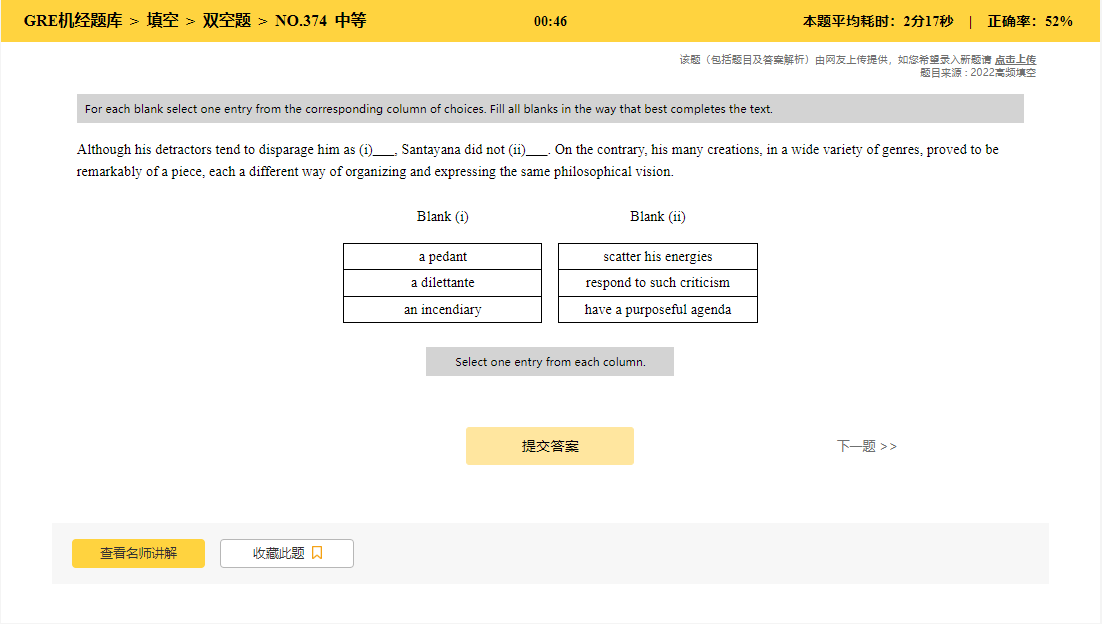
You can also verify with the second sentence: His many inventions in various fields have been proven remarkable. "On the contrary" indicates opposition, so the first sentence's "he did not scatter his energy" contrasts with the second's "many inventions were remarkable."
Therefore, the correct choices are B and D: "dilettante" means an amateur, and "scatter his energy" means to waste his efforts casually.
Translation: Although detractors accused him of being a dilettante, Santayana did not scatter his energy.
From these two questions, we can see that while there are similar testing points, the Chinese exam's points are more direct and only provide limited information for judgment. The GRE's logic is deeper, with multiple layers of reversal. It also provides more contextual information, allowing test-takers to infer answers using various methods.
3. Reading Comprehension
Chinese Postgraduate English Exam reading passages are mostly excerpted from foreign journals with minimal alteration, making the vocabulary and sentences relatively easy to understand.
GRE reading passages cover a wide range of topics, drawing from authoritative magazines across disciplines, including journals, books, and academic papers.
However, they are not directly copied; instead, source articles are first selected, and then the sentence structures, vocabulary, and even the article's logic are rewritten. Many words and sentences are rephrased to increase the difficulty and differentiate test-takers.

Source: The New Yorker
This is an original passage from The New Yorker. The circled part in red shows the correct answer choice in the actual GRE fill-in-the-blank question. But the version modified by ETS is:
In the 1980s, many historians sounded urgent calls for (i) synthesis in American historical writing, as longer and longer monographs on smaller and smaller subjects were being written--dazzling studies, but pieces of a puzzle no one was putting together. This scholarship was not illuminating the central themes of history but (ii) obscure them.
After comparison, you can see that the question removes minor details from the original, preserving the most logically significant words.
4. Test Format
The test formats of the two exams are completely different.
The Chinese Postgraduate English Exam is a paper-based test, allowing test-takers to answer questions they are confident about first and then revisit difficult ones, giving them more freedom in pacing.
The GRE is a computer-based test with very tight time constraints. After the reform, the entire exam lasts about 2 hours, covering all GRE sections (Analytical Writing, Verbal Reasoning—fill-in-the-blanks and reading comprehension, and Quantitative Reasoning). Each section has a countdown timer, and once you move to the next section, you cannot go back to review or change previous answers. Many test-takers report running out of time. To address this, it is essential to take mock exams beforehand and consciously practice pacing.
5. Question Delivery
The Chinese Postgraduate English Exam uses uniform questions, meaning every test-taker receives the exact same set of questions. Each year features new questions, which are later fully publicly released. Therefore, candidates can use official past questions as reference for preparation.
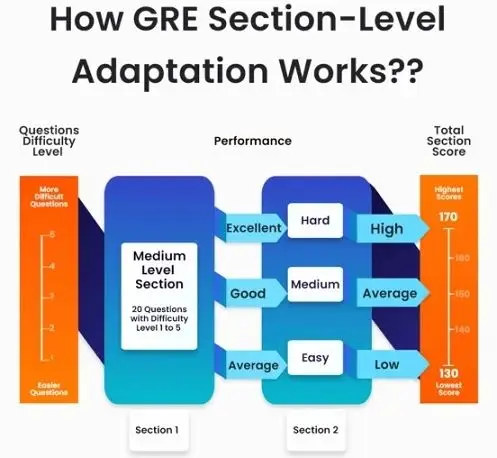
The GRE, on the other hand, is a computer-adaptive test. Initially, everyone receives questions of similar difficulty, but later question difficulty adjusts based on your performance in the previous section: if you score well earlier, you'll face harder questions later.
Overall, the GRE is more difficult than the Chinese Postgraduate English Exam. For students whose postgraduate exam results are not ideal and who plan to switch to the study-abroad path, they must not take the GRE lightly. They should do their homework and prepare diligently!
All-New GRE Spring Subject-Specific Courses
【Before the course】
Pre-study the latest vocabulary, long & difficult sentences, and math materials to build a solid foundation for the GRE live classes!
【During the course】
Reading / Fill-in-the-Blanks / Math Methods Classes: Combine methods with practice to systematically build a correct logical framework for all three sections!
【After the course】
90-day course replay + synchronized updates of new GRE questions & past exam questions + unlimited full-length mock exams!
Covers the entire GRE prep process, with comprehensive materials & mock exams
Two weeks of targeted learning to conquer your weak subjects
Registration is now open!
.png)
Add a teacher now to customize your exclusive GRE study plan!
.jpeg)