The 24Fall application season is drawing to a close, and many are nearly losing their minds waiting for offers, terrified they’ll end up with nowhere to go…
.png)
As spots at top universities dwindle, the chances for students are looking slimmer and slimmer.
Plenty of students haven’t received a single offer yet, but rejection letters are piling up...
UK Universities Send Out a Wave of Rejection Letters
Rejections from UK schools are coming fast and furious. All you can do is accept it and tell yourself that rejections build character—there’s really nothing else to be done.
.png)
Some rejection letters will kindly tell you the specific reason, like your undergraduate institution’s ranking is too low, the major doesn’t match, or you lack internship experience. That gives you a direction to argue your case—at least you’ll know why you were denied.
But some schools don’t even bother giving a reason. Their answer is essentially: I can reject you just because I feel like it—do I really need an excuse?
.png)
Then there are universities that have started playing a waiting game, either putting applicants on the waitlist or endlessly dragging out decisions. Honestly, wouldn’t it be better to just end the suspense, one way or another?
.png)
And the rejection from UCL is even more absurd: “Your academic performance is excellent, your understanding of the program is very good, and you have a strong motivation to develop. However! Sorry, I just don’t want you…” You really don’t know whether to laugh or cry.
.png)
Of course, the most classic reason has to be “Due to the highly competitive nature of this program, we are unable to offer you admission.”
Take the University of Leeds, for example. This year, so many hopeful applicants with outstanding backgrounds were shut out for this very reason—programs that were supposed to be safeties ended up rejecting them outright.
.png)
There are even cases where Leeds rejection letters first stated that all requirements were met but competition was too intense, yet after appealing, the applicant was told they didn’t meet the minimum requirements…
.png)
Because of this, many are joking that Leeds has now become a “little G6”! It’s gotten incredibly cocky, application difficulty has skyrocketed, and rejections are being sent out left and right.
Admission Standards for Popular US Programs Have Skyrocketed
It’s not just the UK and Hong Kong—the rejection letters recently sent out by American universities are just as terrifying!
Take the recently released decisions from JHU’s Carey Business School. Across the board, those admitted have GPAs of 3.7+ or 3.8+… A huge number of applicants with strong testing and academic backgrounds received ruthless rejections…
.png)
You might think it’s overqualification, but what you don’t realize is that the admission bar has already seen a qualitative leap.
.png)
Let’s just say, Carey is no longer the old Carey. The JHU that used to love sending out offers and scholarships is long gone.
.png)
Besides that, programs like the well-known School of Professional Studies (SPS), after continuing to sharply raise application requirements for 24Fall, are now sending out rejection letters without mercy.
When you see that rejection in your inbox, you can’t help but wonder: I thought these were supposed to be “easy,” so why am I not even getting a splash of that “easy water”?
Has 25Fall Already Quietly Begun?!
Looking at the flood of brutal rejection letters online and the continuously rising application requirements at major universities, it’s no wonder even students applying for 26Fall and 27Fall have started posting anxious pleas on social media...
.png)
.png)
Faced with this increasingly competitive study-abroad environment, it’s true that we need a high degree of alertness and foresight, but excessive anxiety is pointless and unnecessary! Especially for 25Fall students, the right thing to do now is to put anxiety aside and start taking action step by step!
Select Schools and Majors Wisely
First, based on your undergraduate GPA and academic background, and by referencing the overall and subject-specific rankings of target universities, determine a rough range.
As competition has intensified over the past two application cycles, applying to multiple countries has become a new trend for graduate admissions. Overall, the advantages of a multi-country application strategy are significant:
-
Use a combined strategy to boost your acceptance rate
-
Avoid “sudden” policy risks and always keep a backup plan
-
Prevent delays caused by slim odds and turn a backup into a real option
In short, applying to multiple countries expands your choices and creates more possibilities. The most important thing is to understand the characteristics of each region’s application process, plan rationally, and don’t just pick schools blindly.
You can refer to the comparative chart of study-abroad applications in the UK, US, Canada, Hong Kong, Singapore, and Australia compiled by CheersYou(清柚教育) to understand the similarities and differences among popular destinations.
.jpg?x-oss-process=style/opt-webp)
Beyond that, school selection and program targeting have their own tricks. CheersYou(清柚教育) has also summarized four key factors that cannot be ignored when choosing schools and programs.
.jpg?x-oss-process=style/opt-webp)
By matching and filtering schools and programs according to these four dimensions, you can efficiently finalize your selection—and do so in a way that is targeted and fits your personal situation and needs.
This approach also avoids the drawbacks of “casting a wide net” while greatly increasing your chances of getting into your dream school.
Make a Good Time Management Plan
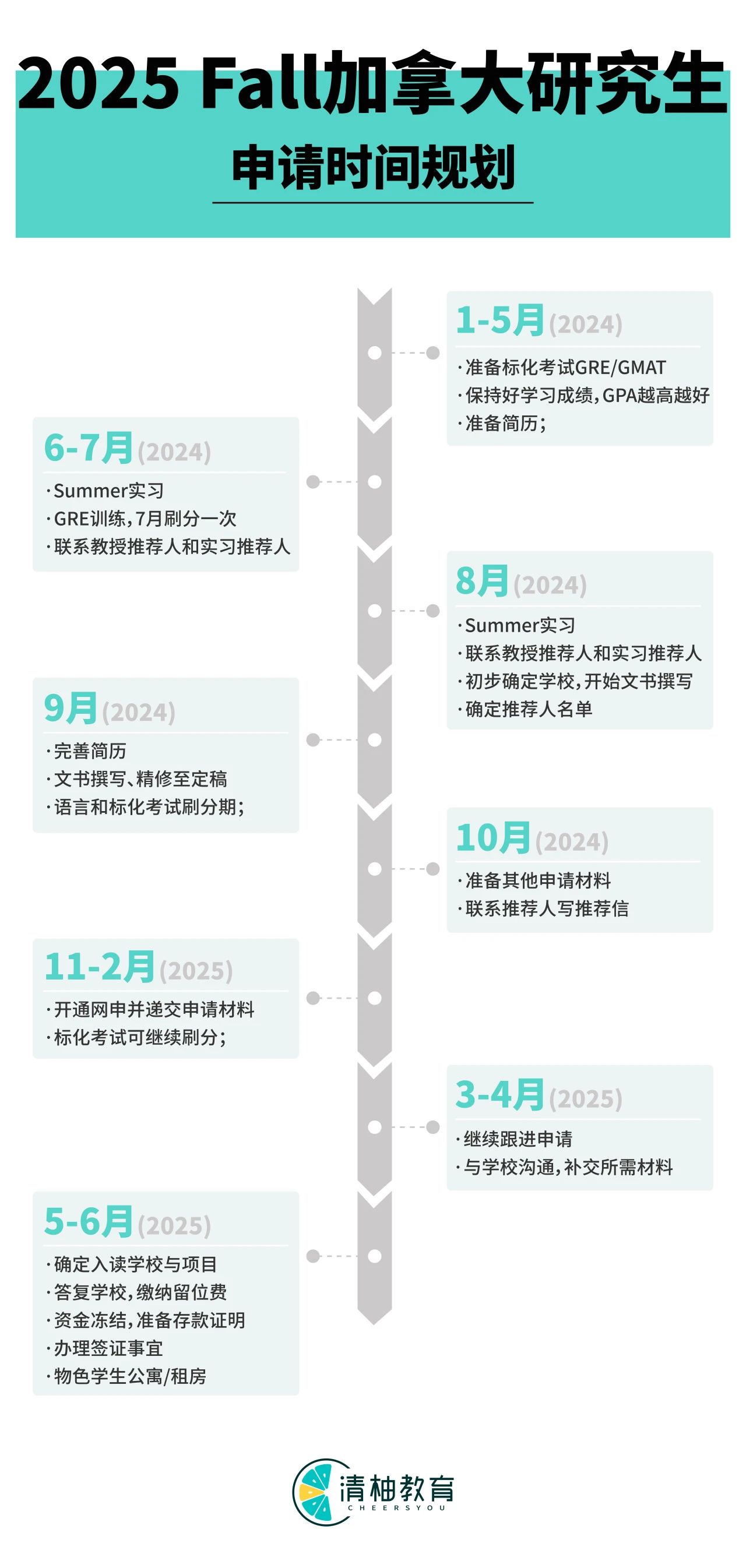
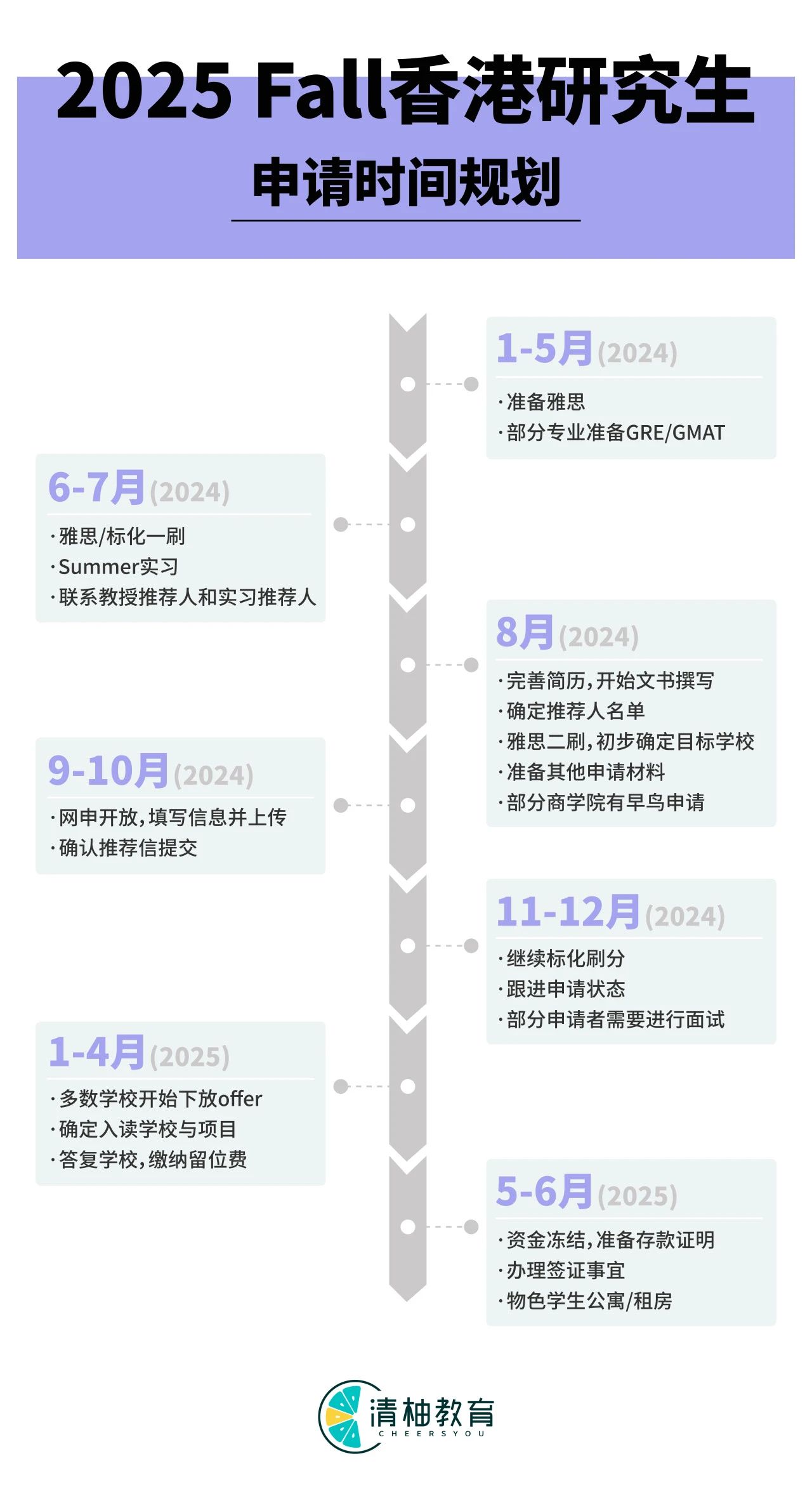
Whether you’re an early bird or a late starter, if you plan to study abroad for graduate school, you should have a clear application roadmap. Effective planning will make your application journey much smoother.
Keep in mind that the timeline differs depending on which country or region you’re applying to, so be sure to plan your schedule wisely.
.jpg?x-oss-process=style/opt-webp)


Submit Standardized Test Scores
As the “hard currency” of graduate applications, GPA is always the first key to unlocking the door of your dream school. Many universities have minimum GPA requirements, and without an excellent GPA, your application will barely get off the ground. So, doing everything you can to boost your GPA is extremely important.
For those applying to business, STEM, or similar programs, a strong GRE or GMAT score is also essential. It goes a long way in demonstrating to admissions officers your comprehension and academic ability.
That’s why you must prepare early, aim to achieve your target score quickly, and lighten the load for later application steps!
Enrich Your Background and Experiences
Next comes the enhancement of your soft skills and background, such as activities, internships, research, etc. that are related to your intended field of study.
No matter what direction you’re applying to, internship or research experience is something admissions officers view as indispensable. A strong soft background can add the finishing touch and significantly boost your competitiveness.
Prepare Application Documents
Additionally, there’s the preparation of application essays and documents, including letters of recommendation and personal statements. These are a critical part of the entire application.
Essays can be thought of as the second key to opening the door to your dream school. They give admissions officers a window into your ability to express yourself, your logical thinking skills, and your genuine interest in the program. Writing a standout essay is truly vital for a successful application.
Of course, the subsequent steps of submitting online applications and completing interviews must not be taken lightly either. So be sure to prepare thoroughly in advance and avoid any mistakes!
While excessive anxiety is unnecessary, we still need to get an early start. Only by allowing plenty of time to prepare can you stand out in an increasingly competitive application season!
Finally, I wish everyone the best in getting their offers and starting their own learning journey at their dream school soon!
.png)