The Master of Public Policy Master of Public Policy (MPP) program at the University of Chicago is a two-year, full-time program designed to cultivate public policy leaders with critical thinking, analytical skills, and leadership abilities. Renowned for its rigorous academic research and practice-oriented curriculum, the program attracts students from around the world. For more information or questions, students can scan the QR code below to connect with an advisor for a one-on-one consultation.
.png)
1. Program Overview
The Master of Public Policy (MPP) program at the University of Chicago has been converted to a STEM-designated program, meaning that graduates are eligible for three years of Optional Practical Training (OPT) after graduation. Because the MPP program imposes few restrictions on applicants' undergraduate backgrounds and helps strengthen quantitative analysis skills, it has become a popular choice for entering the consulting industry. Thus, the MPP is not limited to liberal arts students; in fact, students with science or engineering backgrounds are also very suitable and often have a competitive advantage. The program typically welcomes students from diverse academic backgrounds, including economics, political science, history, literature, international relations, engineering, and environmental science.
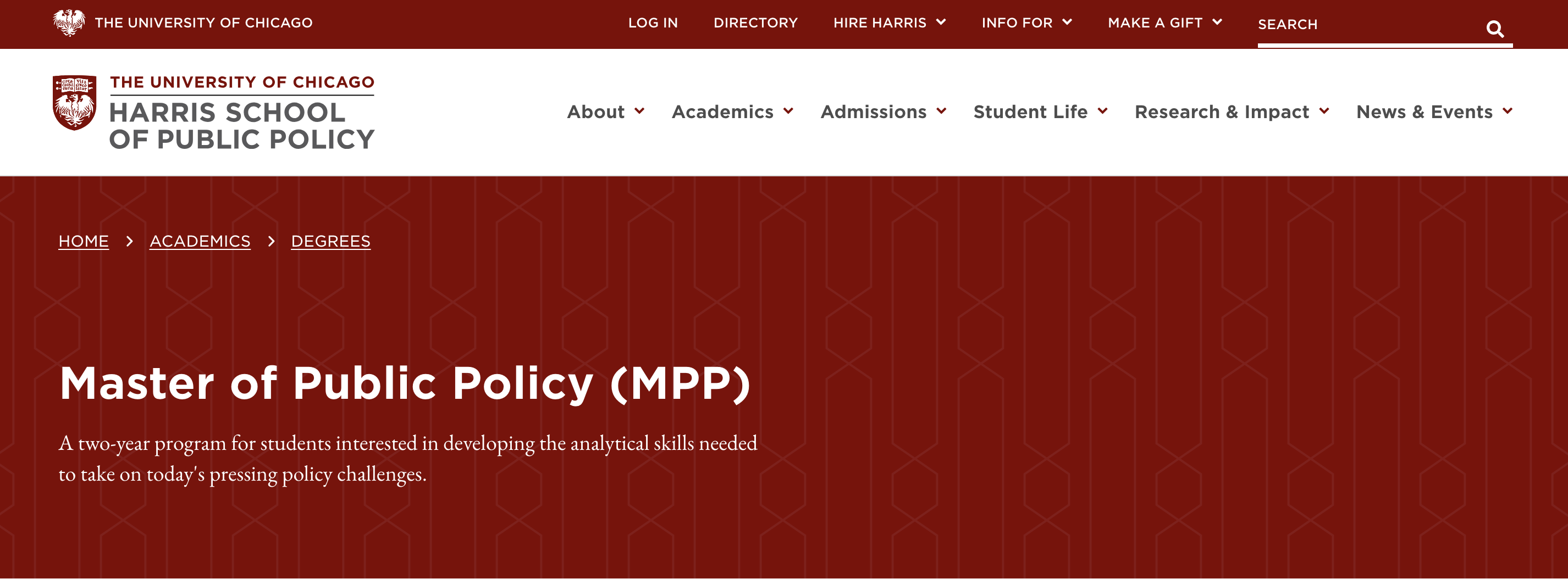 Official website link: https://harris.uchicago.edu/academics/degrees/master-public-policy-mpp
2. Curriculum
Students must complete 18 courses throughout the program, 12 of which must be taken within the relevant professional fields at the school. Among these 12 courses are 6 required courses covering foundational subjects such as microeconomics, statistics, policy analysis, and political science, while the other 6 are flexible electives. Students also have the opportunity to choose an additional 6 courses from other divisions of the university to meet their academic interests and career goals.
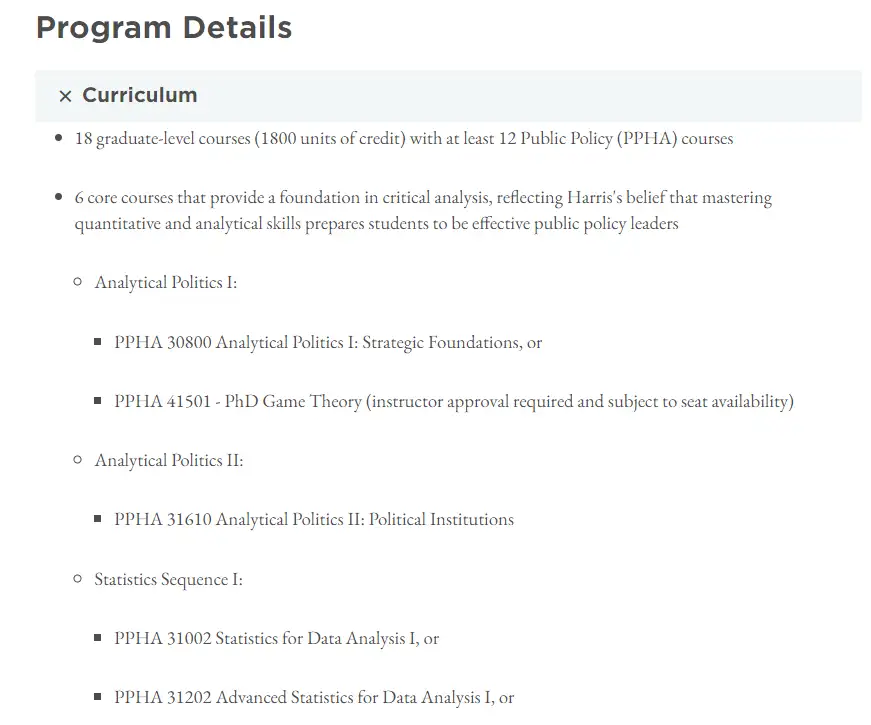
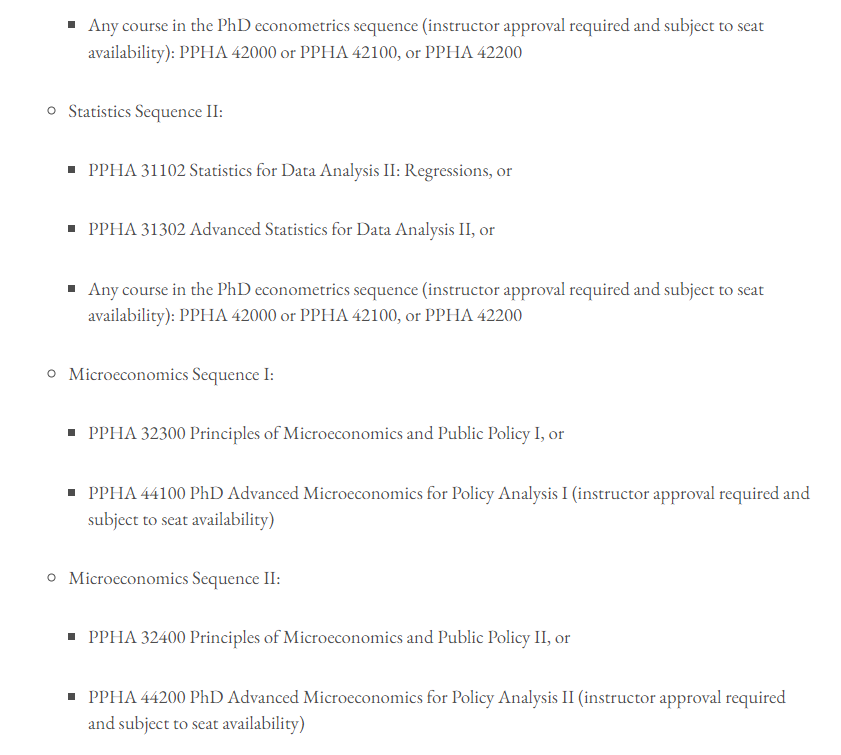
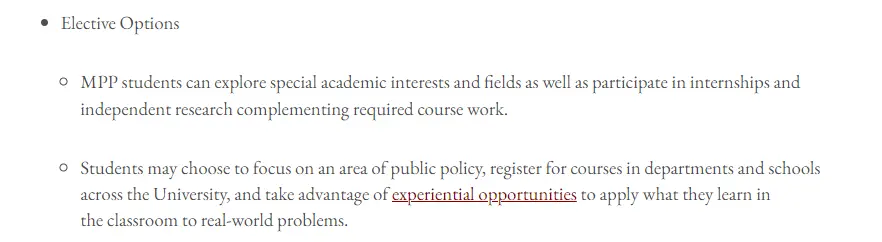
Although rooted in tradition, the Master of Public Policy (MPP) program at the Harris School features a curriculum in which statistics and data analysis courses account for a substantial proportion, reflecting society's growing demand for professionals with interdisciplinary capabilities, especially in handling big data.
The course schedule is intensive, with team projects almost every week, along with papers and exams. There are typically two exams per quarter, while the number of papers varies by course requirements—ranging from two to three per semester, generally two to three pages long and in the form of policy memos, to as many as four per semester. Additionally, the reading load is relatively demanding.
3. Admissions Requirements
Transcripts
Resume/CV
Three letters of recommendation
Personal statement
GRE scores
Language proficiency: IELTS 7+ (no subscore below 7); TOEFL officially requires 95+, but 100+ is recommended
Essay (within 300 words)
Application Tips: A GPA of at least 3.5 is recommended. For language scores, applicants with IELTS 7 or TOEFL below 100 generally have little chance of admission. Moreover, the essays are crucial because the school does not conduct interviews; decisions are made solely based on the candidate's written materials. (In addition to detailing one's experiences, interests, career plans, and research, applicants are required to write two short essays related to public policy.) Therefore, it is advisable to focus heavily on the essays when applying.
4. Career Prospects
- Government sector: Graduates can work in relevant departments at the federal, state, or local government level, participating in policy formulation, project management, and data analysis.
- Research institutions: At universities, research institutes, or think tanks, graduates can engage in STEM-related policy research, providing scientific evidence for policymakers.
- Private sector: At technology companies, pharmaceutical firms, or energy corporations, graduates can leverage their public policy background to support strategic decision-making.
- Entrepreneurial opportunities: Graduates with an entrepreneurial spirit can apply their knowledge to solve real-world problems.
Below are the offers from the University of Chicago's MPP program received by CheersYou(清柚教育) students this year, for your reference.
.png)
.png)
.png)
For more information about studying abroad and graduate applications, you can also add the contact info of a CheersYou(清柚教育) advisor below.