UC San Diego (UCSD), one of the top public research universities in the United States, has long attracted students worldwide to its Master of Finance program at the Rady School of Management. The program recently underwent a major update, officially renamed Master of Quantitative Finance (MQF), signaling deeper development in financial engineering. For more details and any questions about graduate applications, scan the QR code below for a one-on-one consultation.

1. Program Introduction
The Rady School explained that the new name, Master of Quantitative Finance, better reflects the quantitative content of the curriculum and the skills students develop. While the name has changed, the core courses and program objectives remain the same. The MQF remains a STEM-designated degree, and students can complete it in 12 or 15 months. Graduates will be equipped to apply state-of-the-art quantitative analysis to drive financial decision-making and risk management.
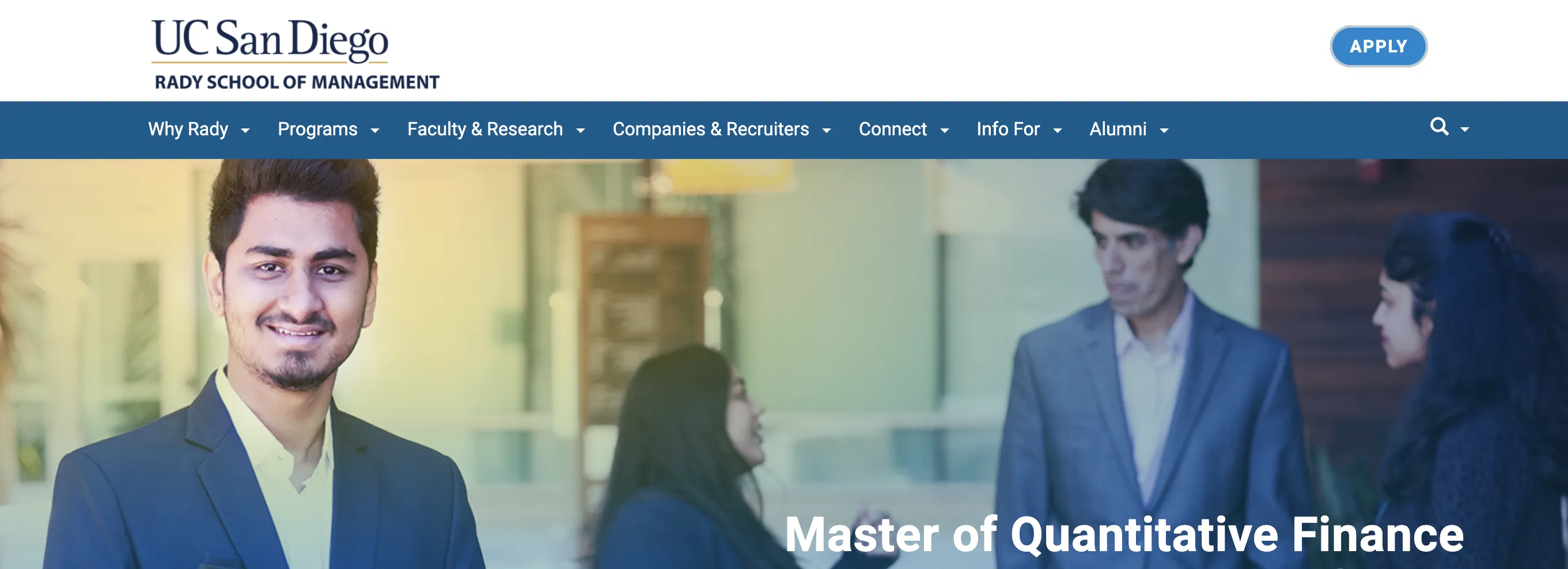
Official website: https://rady.ucsd.edu/programs/master-quantitative-finance/index.html
2. Curriculum
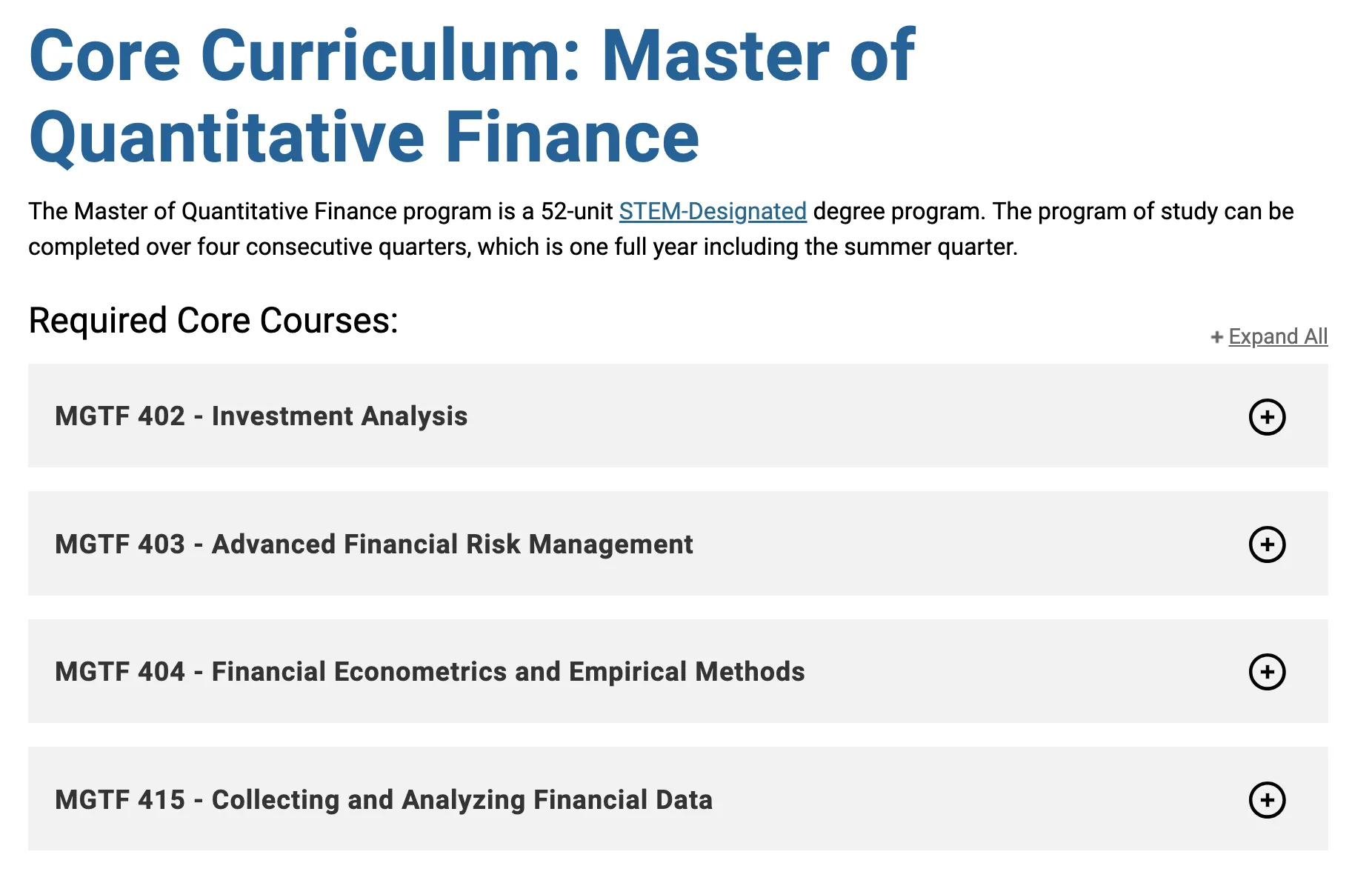
The MQF program prepares students to analyze large, often multiple, real-time datasets for financial decision-making and risk management. Students will be exposed to empirical methods drawn from UCSD's world-renowned econometrics research. The curriculum closely integrates theory and practice, providing a solid foundation in finance while developing hands-on skills in quantitative analysis, data processing, and financial model building.
3. Admission Requirements
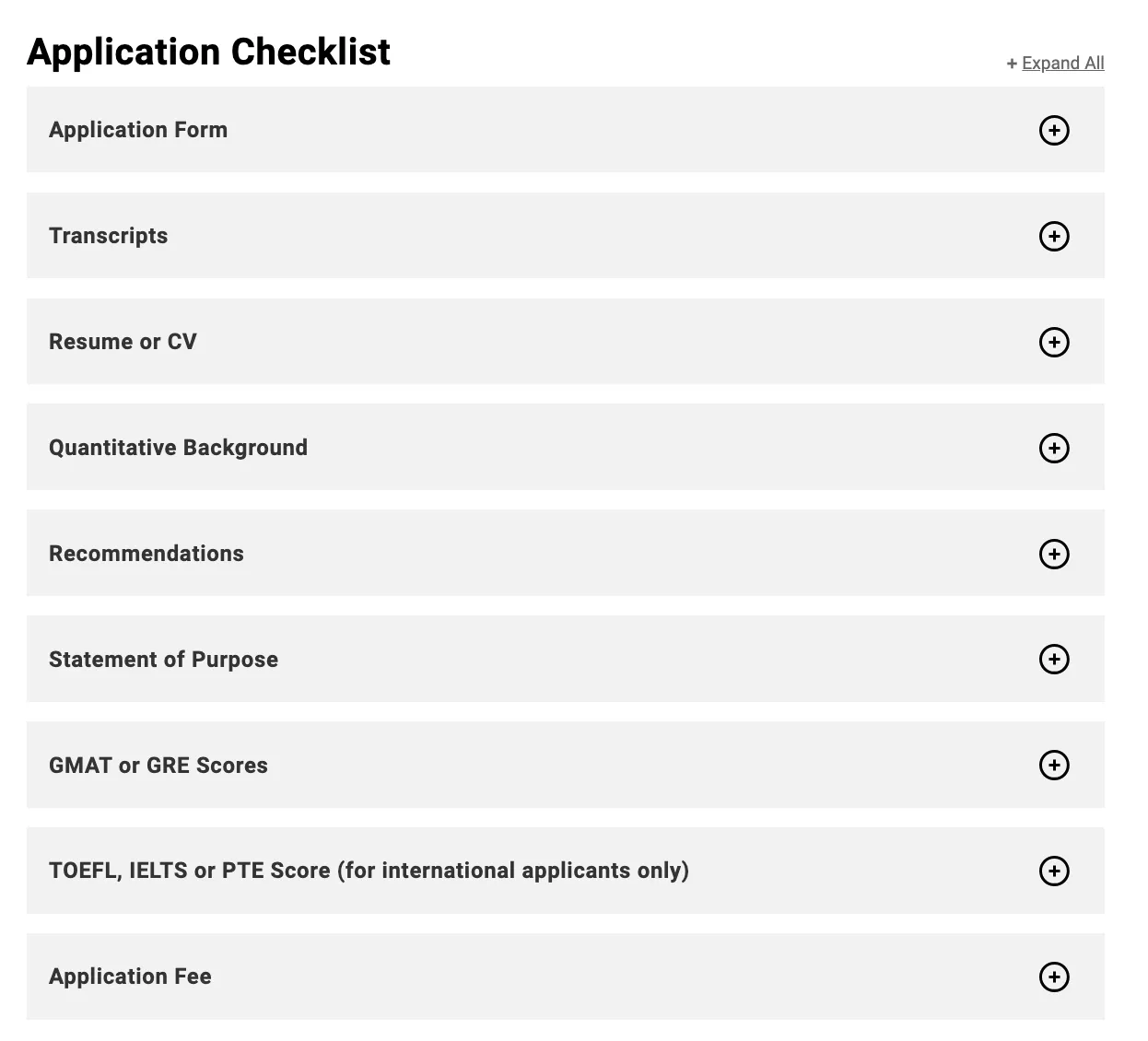
Applicants typically hold an undergraduate degree in finance, economics, engineering, computer science, mathematics, physics, or statistics, though other majors will also be considered. Experience in statistical applications and programming is preferred, especially familiarity with tools such as Python, SAS, STATA, MatLab, R, and S-Plus. Language requirements: IELTS no lower than 7.0, TOEFL no lower than 90. In addition, GMAT or GRE scores are required for admission.
Based on the 2023 entering class profile released by UCSD: the MQF cohort had 146 students, with a nearly balanced gender ratio and an average age of 23. The average GPA was 3.46, average TOEFL 105, and average IELTS 7.2. Average GMAT and GRE scores also reflected strong academic preparation. In terms of academic background, accounting/finance majors made up the largest share at 46%, followed by economics, business/management science, and mathematics/statistics.
4. Career Prospects
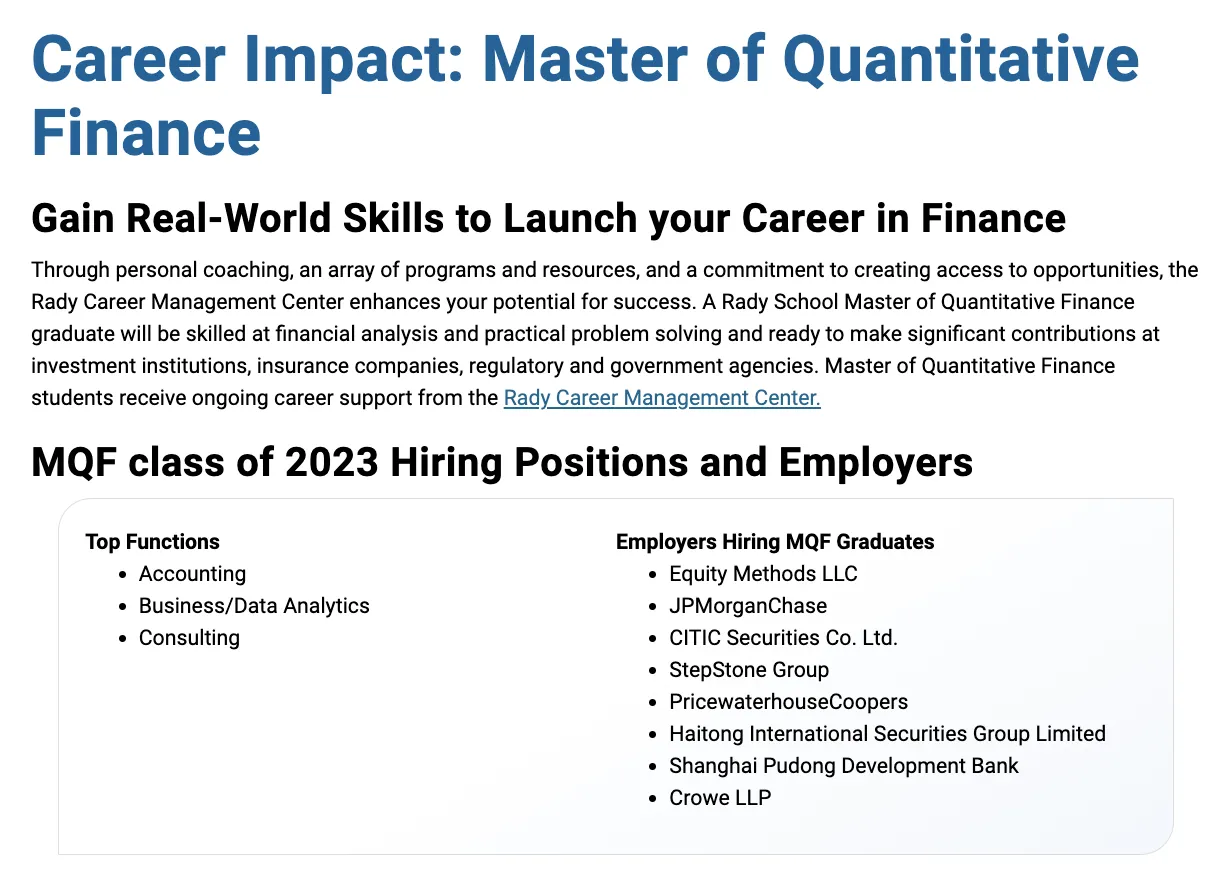
With the upgrade to Master of Quantitative Finance, UCSD's program not only enjoys strong academic prestige but also provides graduates with broad career opportunities. Here are the main directions for MQF graduates:
1. Investment Banking and Asset Management
Graduates possess deep financial theory knowledge and strong data analysis capabilities, making them highly sought after in investment banks and asset management firms. They can work on trading strategy development, risk management, portfolio management, and more, using advanced quantitative models and algorithms to create value.
2. Hedge Funds and Private Equity
In hedge funds and private equity, MQF graduates can apply their quantitative skills to market analysis, risk assessment, and strategy formulation. Their work may include building and testing quantitative trading strategies and leveraging big data and machine learning to identify investment opportunities.
3. Financial Technology (FinTech) Companies
With the rise of fintech, graduates have excellent prospects in this field. They can join fintech companies to work on product development, algorithmic trading, data analysis, and risk management, using technology to address pain points in the financial industry and drive innovation.
4. Consulting and Data Analytics
In consulting firms or data analytics agencies, MQF graduates can use their expertise to provide clients with strategic planning, market analysis, and risk management advice. They help clients understand complex financial products, optimize financial decisions, and forecast market trends.
5. Regulatory Agencies and Policy Making
Graduates can also join financial regulatory agencies or participate in policy making, leveraging their deep understanding of financial markets to provide technical support and analysis for fair and effective financial policies and regulations.
6. Academic Research and Education
For those passionate about academic research, they can pursue a PhD or work in universities and research institutions, contributing to theoretical development and talent cultivation in finance.
For more admission cases and questions about studying abroad, add the CheersYou(清柚教育) advisor contact below for details.