
It's almost the start of school, and many prospective Australian international students are still anxiously waiting for their student visas.
But instead of visas, what they got was the bad news of the Australian visa application fee hike.
.png?x-oss-process=style/opt-webp)
Source: Australian Government
The federal government confirmed in a recent press release that the student visa application fee will increase from AUD 710 to AUD 1,600. This has frustrated many prospective Australian students, who wonder: Are you deliberately delaying visa processing?
.png?x-oss-process=style/opt-webp)
Source: Xiaohongshu
However, in order to reduce immigration, Australia has recently issued various policies tightening student visas, and now it's hiking fees across the board? It's all about making it harder for international students...
According to data from the Australian Department of Home Affairs, the proportion of overseas student visa applications rejected this year has reached a record high, with up to 1 in 5 student visas being denied...
But it's not just Australia—visa policies in many countries seem to be tightening. First, Canada announced the new BC PNP policy, then the UK raised the minimum wage requirement for work visas... Studying abroad, visas, and immigration seem to have switched to hard mode!
.png?x-oss-process=style/opt-webp)
Australia Officially Announces: Visa Restrictions Tighten Again!
Starting from May, Australia announced another increase in the financial requirement for international students and student guardians to obtain a visa!
When applying for an Australian student visa, international students must provide proof of funds of at least AUD 29,710.
.png?x-oss-process=style/opt-webp)
Source: Australian Government
This is already the second time Australia has raised the financial requirement for international students in just seven months. Last October, the requirement was increased from AUD 21,041 to AUD 24,505.
Not only that, on June 12, the Australian government announced that from July 1 this year, the pathway to convert an onshore tourist visa to a student visa will no longer exist! No one will be able to benefit from this policy, and international students holding 485 visas will also be unable to change to student visas onshore.
.png?x-oss-process=style/opt-webp)
.png?x-oss-process=style/opt-webp)
Source: Australian Government
In fact, back in March this year, the Australian government had already raised the English language requirements for international students, increasing the IELTS score required for a student visa (500) from 5.5 to 6.0.
.png?x-oss-process=style/opt-webp)
Source: Australian Government
For the 485 work visa that graduates can apply for, the minimum IELTS score requirement has been raised from 6.0 to 6.5, with a minimum of 5.5 in each band. Even the validity period of English test scores has been shortened from within 3 years before the date of visa application to within 1 year.
.png?x-oss-process=style/opt-webp)
Source: Australian Government
It seems the Australian government is really going all out to achieve its goal of halving Australia's immigration numbers within the next two years!
Canada's Study and Immigration Policies Keep Tightening
Not long ago, the Canadian government announced the new BC Provincial Nominee Program (BC PNP) policy, drastically changing the old policy where studying guaranteed a pathway to permanent residence.
The days of getting permanent residency right after a master's degree are gone. The former BC PNP International Post-Graduate stream has been officially canceled.
On April 5, Canada's federal immigration minister officially announced a two-year plan to reduce the number of temporary residents.
Canada's study permit allocation will be cut by about 30%. Among them, Ontario, a popular destination, will see a cut of nearly 50%, and BC a reduction of 20%.
.png?x-oss-process=style/opt-webp)
Source: Government of Canada
In fact, as early as January this year, Canada announced it would set a cap on the number of study permits.
Canada is expected to issue 360,000 study permits in 2024, a decrease of 35% compared to 2023. The cap mainly targets international students pursuing undergraduate degrees in Canada.
.png?x-oss-process=style/opt-webp)
Source: Canada.ca
Yet, despite the increasingly difficult study and immigration landscape in Canada, a large number of applicants continue to flood in, leading Canadian institutions, where demand far outstrips supply, to constantly raise admission thresholds.
Therefore, students planning to apply to Canadian universities must be mentally prepared and start planning as early as possible.
UK Immigration Policy Facing Overhaul?
In the UK, a newly released research report by the think tank Onward suggests that UK immigration rules should undergo a complete overhaul.
.png?x-oss-process=style/opt-webp)
Source: dailymail
The think tank recommends that low-skilled, low-income immigrants should be phased out, and only a select group of high-level universities should be allowed to sponsor visas for overseas students. It also suggests that the Graduate Route visa (PSW visa) should be abolished...
This news has caused an uproar among international students in the UK, as the PSW visa is crucial for those who want to stay and work in the UK after graduation.
.png?x-oss-process=style/opt-webp)
Source: GOV.UK
The PSW allows graduates to stay in the UK to work or look for work without a sponsor. Undergraduate and master's graduates can get a 2-year work visa, while PhD graduates can get 3 years.
And these suggestions from the think tank Onward have surprisingly received support from cabinet ministers...
In fact, over the past two years, the UK government has been continuously tightening study and immigration policies to control excessive immigration.
Since last July, the UK government has raised work permit and visa fees by 20%; for work visas, the minimum salary threshold has increased by nearly 50%...
However, prospective students planning to apply to the UK shouldn't be too pessimistic. The current tightening of visa policies for international students has already caused a significant drop in deposits and tuition fees received by many UK universities.
Over 50 schools have been forced to lay off staff or cut spending. It is expected that 40% of UK universities will run a budget deficit this year.
.png?x-oss-process=style/opt-webp)
Source: tekedia
Universities have begun to protest to the government. The Russell Group has also warned that the UK government's visa restrictions have already caused serious economic losses to UK universities, and any further visa restrictions would destabilize the sector!
Perhaps we can expect some positive policy shifts in the future.
Note These New Rules for U.S. F-1 Visas
The U.S. F-1 student visa application process has also undergone many detailed adjustments in recent years, worth noting!
The issuance date for student visas (F and M) has been changed from 120 days before the course start date to within 365 days! This means students heading to the U.S. will have more time to prepare their visa applications.
.png?x-oss-process=style/opt-webp)
Source: Weibo
It's important to note that after obtaining the student visa, the earliest entry date remains 30 days before the start of school.
.png?x-oss-process=style/opt-webp)
Source: USCIS
During the pandemic, the U.S. Citizenship and Immigration Services (USCIS) allowed F-1 and M-1 students to apply for visas using printed I-20 forms. This rule is still in effect, and currently, F-1 and M-1 students can still apply for visas using copies or printouts of the I-20.
Source: USCIS
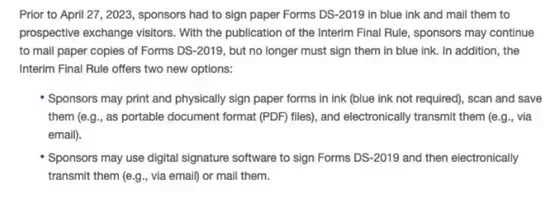
For J visa applicants, they can now also use copies or printouts of the electronic DS-2019 form to apply for visas.
In the process of applying for a study visa, some fees have increased or may increase. These include the SEVIS fee, MRV visa fee, courier fee for passport pickup, and the fee for submitting 221G documents.
As for U.S. immigration policy, according to the recently released first round of H-1B visa lottery results for fiscal year 2024 by USCIS, the H-1B selection rate in 2024 is similar to last year, at around 25%.
However, in recent years, many large U.S. tech companies have canceled their sponsorship of PERM (Program Electronic Review Management) applications, which is undoubtedly bad news for international students, as PERM is usually the first step for foreign employees to obtain a U.S. green card.
How International Students Can Handle Unpredictable Policies
The continuously tightening study visa and immigration policies in various countries serve as a wake-up call for students preparing to study abroad.
In the face of unpredictable policies everywhere, it is best to plan ahead and allow ample time for your applications. That way, even if faced with temporary policy changes, we still have enough time to adjust our application plans.
Moreover, when preparing applications, consider diversifying risks, such as applying to multiple countries and locations. The external situation is constantly changing, so in addition to continuously improving your own capabilities and staying steady, everyone should also adjust their mindset. After all, he who laughs last laughs best.
The 25Fall application season is about to begin. I hope everyone can plan early, apply early, get offers early, and ultimately successfully secure admission to your dream school!