
QuantNet has just released the latest 2025 ranking of U.S. financial engineering programs.
Baruch's Financial Engineering program hands over the top spot this year; Princeton takes first place, and CMU continues to hold a Top 3 position. MIT surges four spots back into the Top 5, beating out Columbia's Financial Engineering and UChicago's Financial Mathematics.
This year, QuantNet surveyed programs in financial engineering, financial mathematics, and quantitative finance, evaluating them on admissions, employment, and career services to determine the rankings. The employment rates of many programs fluctuated significantly, leading to a major reshuffle in the final rankings.
2025 Full Rankings
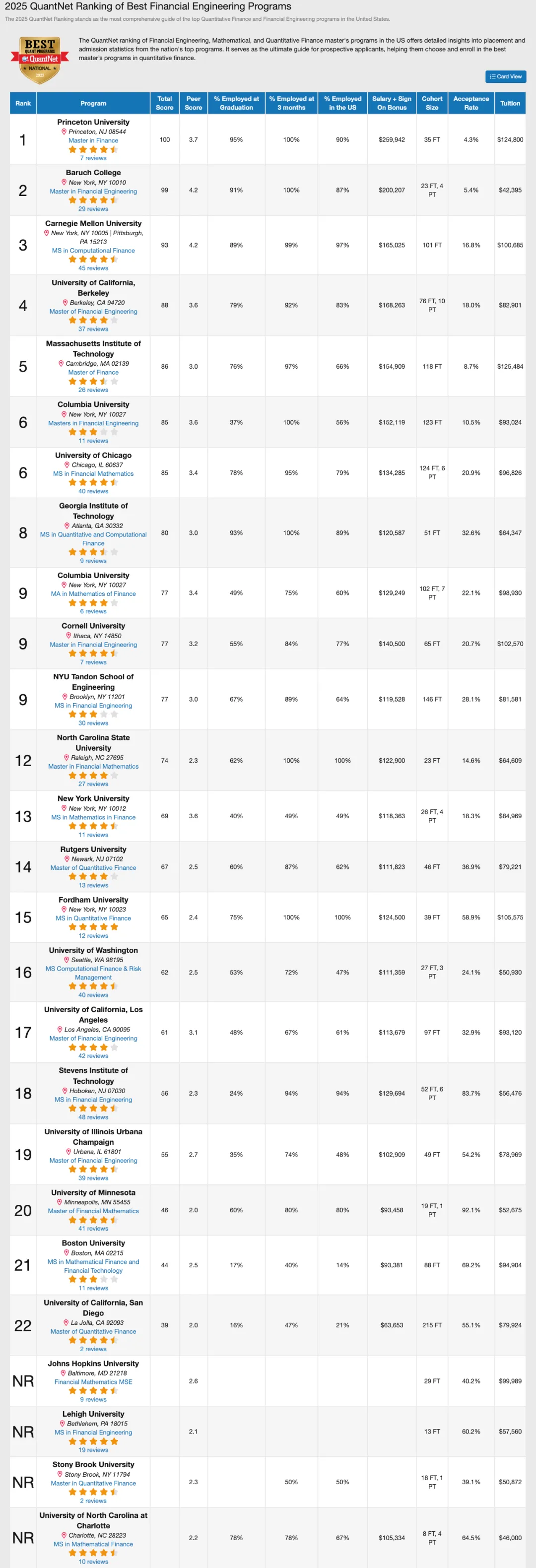
Princeton's Master in Finance edges out Baruch to top the list, while Baruch's Financial Engineering and CMU's Computational Finance rank second and third. MIT returns to the Top 5, and Georgia Tech breaks into the Top 10.
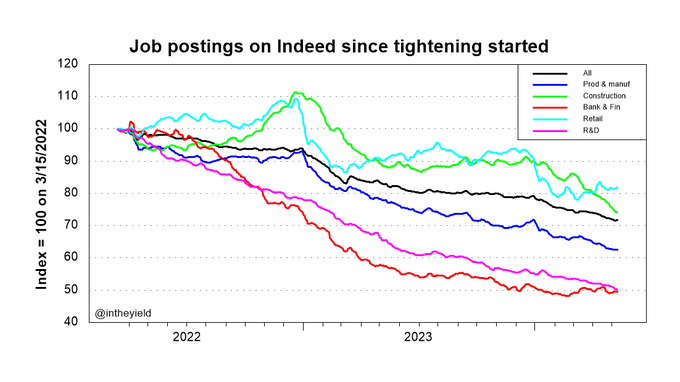
This year's job market is bleak, with most programs seeing a drop in employment rates. Baruch, which had long dominated the rankings, falls from grace due to a lower employment rate, while NYU's Mathematics in Finance and UCLA's Financial Engineering saw employment rates plummet by 50%, causing both to fall out of the Top 12.
Columbia's Financial Engineering, ranked 6th, saw its employment rate at graduation drop to a shocking 37%, with the U.S. employment rate also below 60%, highlighting just how tough the job search has been this year.
Overall, due to changes in the employment environment and adjustments to some programs' employment data, the rankings have shifted dramatically compared to last year.
2025 Ranking Methodology
Peer Assessment (20%)
Employment Outcomes (55%)
- Graduation Employment Rate (10%)
- Employment Rate Three Months After Graduation (15%)
- Average Starting Salary and Sign-on Bonus (20%)
- Employer Satisfaction (10%)
Student Quality (25%)
- Undergraduate GPA (17.5%)
- Acceptance Rate (7.5%)
In this year's ranking, the student quality metric continues to exclude GRE scores.
Significance of QuantNet Rankings
The QuantNet rankings have always played a crucial guiding role for financial engineering students, especially those planning to work in the U.S. for some time. In the post-pandemic economic recovery, this ranking is arguably even more valuable for applicants.
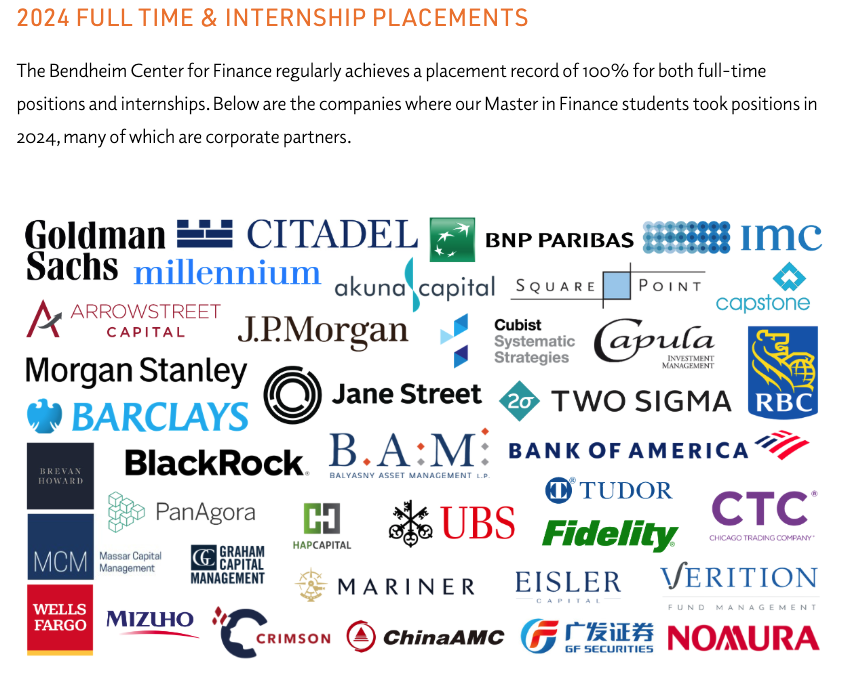
Take Princeton's MFin as an example: according to the latest data on graduate placement, the official employment rate at graduation is as high as 100%. This stellar employment performance helped Princeton claim the top spot this year.

We can also see that among the companies hiring graduates, top employers include Goldman Sachs, J.P. Morgan, Morgan Stanley, UBS, Barclays, Blackstone, and other prestigious firms.
Top programs can offer good job prospects and return on investment. Since QuantNet places the greatest weight on employment outcomes, MFE applicants who prioritize employment can use the rankings to select programs that best suit their needs.
Of course, from this year's QuantNet employment data, we can see that even programs with historically very stable employment can encounter unexpected problems as the market environment changes. There is no absolutely safe or popular major; there is only the right choice that fits you.
Having a discerning eye when choosing schools and programs is crucial. You need to see the strengths and prospects of each program and fully consider them in the context of your own situation in order to succeed in the future.
.png)