
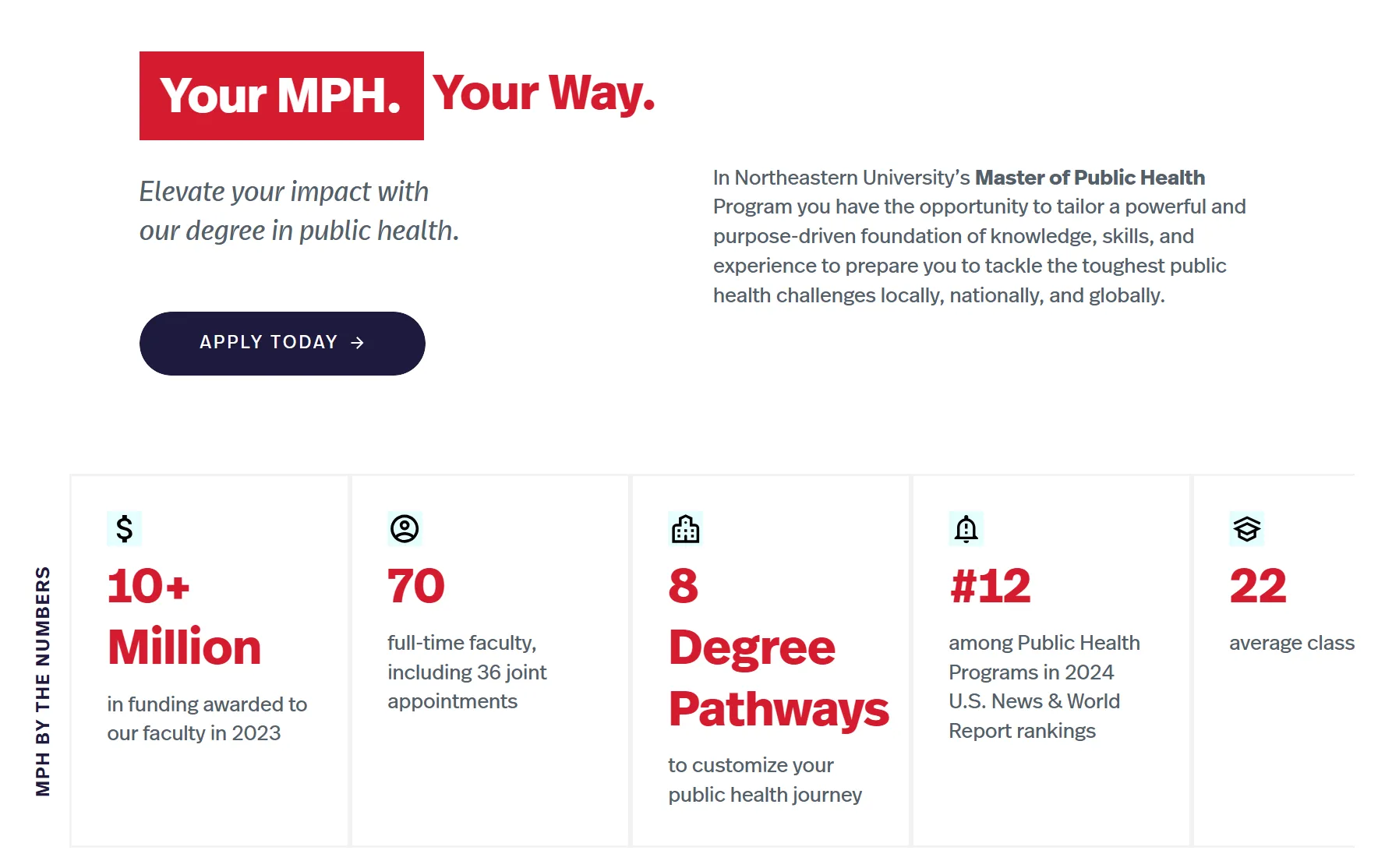
Northeastern University, located in Boston, Massachusetts, is a renowned research university. Its MPH program, supported by the university's strong academic resources and advanced research facilities, is dedicated to cultivating professionals with solid public health knowledge, practical skills, and leadership abilities. As public health gains increasing attention, Northeastern's Master of Public Health program provides an excellent learning and growth platform for students aspiring to enter this field. The following will analyze the program in detail from four aspects: program introduction, curriculum, application requirements, and career development prospects. For more details and any questions about graduate school applications, you can also scan the QR code below for a one-on-one consultation.

Program Introduction
The program emphasizes a deep integration of theory and practice. Through close collaboration with local communities, healthcare institutions, and public health agencies, students have ample opportunities to participate in field projects and practical activities. This not only allows students to apply classroom knowledge to real-world scenarios but also enables them to deeply understand the practical challenges facing the public health field and accumulate valuable hands-on experience.
The program boasts a strong faculty, with professors who not only possess profound academic expertise but also have extensive experience in public health practice. They employ diverse teaching methods, such as case analysis, group discussions, and simulation exercises, to stimulate students' critical thinking and problem-solving skills, helping them comprehensively enhance their professional competence.
Official website link: https://bouve.northeastern.edu/programs/master-of-public-health-mph/
Curriculum
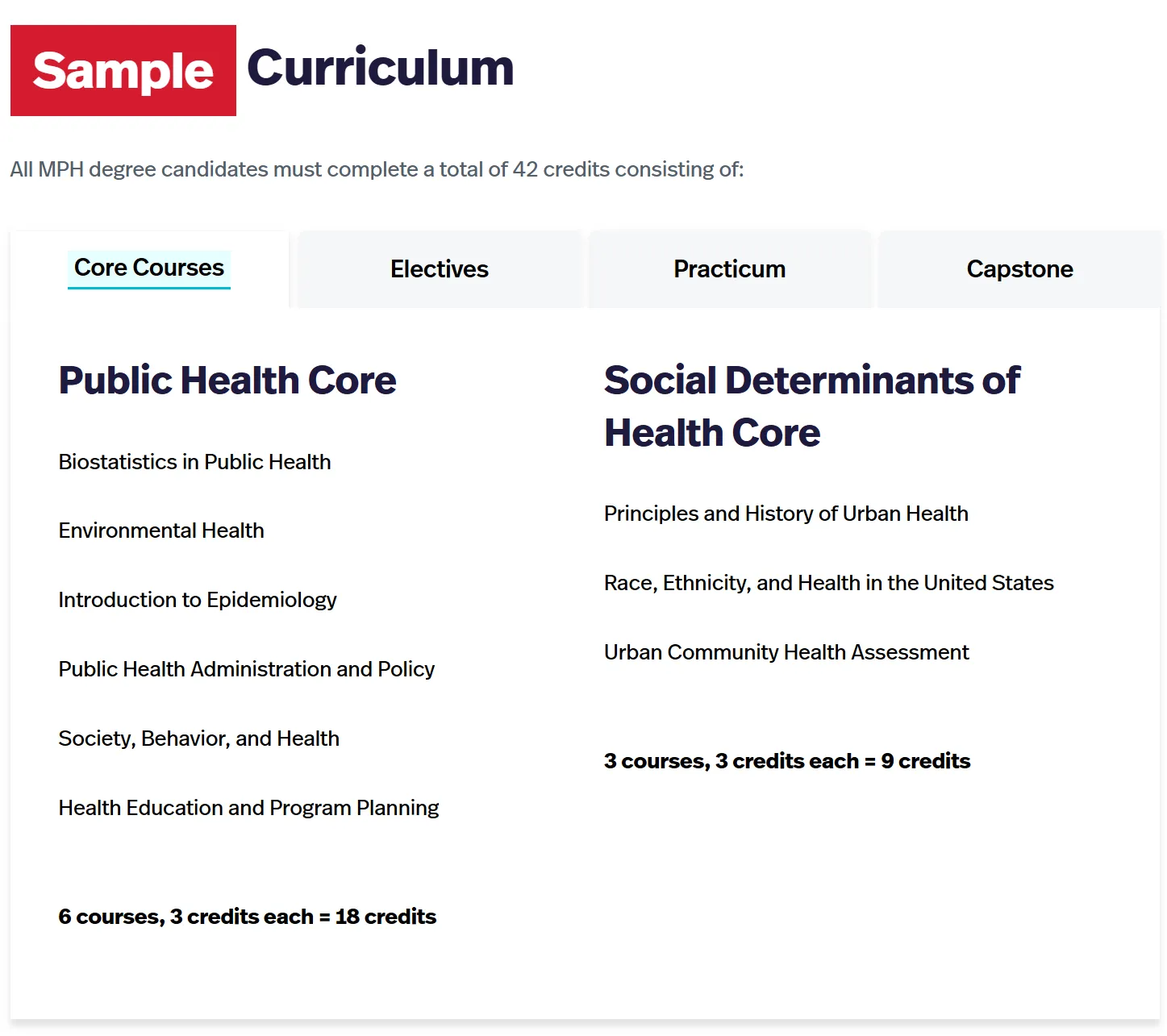
Core Courses
- Biostatistics: This course is an essential tool for public health research and practice. Students will learn basic methods for data collection, organization, and analysis, master core concepts such as probability distributions, parameter estimation, and hypothesis testing, and learn to use statistical software for data analysis, providing quantitative support for subsequent research and program evaluation.
- Epidemiology: As a cornerstone discipline of public health, epidemiology primarily studies the distribution of diseases in populations and their influencing factors. Students will delve into disease surveillance, etiology exploration, disease prevention and control strategies, and through actual case analysis, master how to apply epidemiological methods to solve public health problems.
- Environmental Health Sciences: Focuses on the impact of environmental factors on human health. The course covers environmental issues such as air, water, and soil pollution, as well as fields like food safety and occupational health. Students will learn to assess environmental hazards and develop environmental protection measures to safeguard public health.
- Social and Behavioral Sciences: Explores the influence of social, cultural, psychological, and other factors on health behaviors and health status. Students will learn theories and methods in health communication, health education, and community mobilization, enabling them to better understand and intervene in population health behaviors in public health practice.
- Health Policy and Management: Primarily studies the organization, operation, and policy-making of health systems. Students will learn about health resource allocation, medical quality management, and health policy analysis, cultivating the ability to effectively manage and advocate for policies in the public health field.
Elective Courses
Students can choose elective courses based on their personal interests and career plans, such as Global Health, Infectious Disease Prevention and Control, Chronic Disease Prevention, and Health Informatics. These electives further broaden students' knowledge and allow them to delve deeply into specific areas. For example, the Global Health course will explore public health challenges faced by different countries and regions, as well as the role of international cooperation in addressing global health issues; the Health Informatics course focuses on cultivating students' ability to use information technology to improve public health services and management.
Additionally, the program includes a practical internship component. Students are required to complete a certain duration of internship in relevant institutions or organizations, applying their knowledge to real-world work, while also building professional networks to prepare for future employment.
Application Requirements
Academic Background
Typically, applicants are required to hold a bachelor's degree. There is no strict restriction on the undergraduate major, but students with backgrounds in biology, chemistry, statistics, sociology, or related disciplines have an advantage. Applicants need to demonstrate a certain level of quantitative analysis skills, such as having taken courses in statistics or calculus.
Language Requirements
For international students, the TOEFL iBT total score must be at least 90, with each subsection no lower than 22; the IELTS total score must be at least 7.0, with each subsection no lower than 6.5. Some students may need to take the university's English placement test to determine if additional English language support is required.
Other Materials
- Personal Statement: It is necessary to explain the motivation for applying to the program, personal background, career goals, and understanding and passion for the public health field. Through the personal statement, the admissions committee can understand the applicant's uniqueness and fit with the program.
- Letters of Recommendation: Generally, two letters of recommendation are required, preferably from professors, mentors, or employers who can attest to the applicant's academic ability, work performance, or research potential. The letters should highlight the applicant's strengths, abilities, and potential for development in the public health field.
- Resume: List in detail the applicant's educational background, work experience, internship experience, research projects, volunteer activities, and honors and awards received, showcasing comprehensive quality and professional experiences.
Career Development Prospects
Graduates of Northeastern University's MPH program have broad employment opportunities in the public health field. As public health concerns continue to grow, the demand for public health professionals is also steadily increasing.
Government Public Health Agencies
Graduates can work in public health institutions at the local, state, or federal level, such as the Centers for Disease Control and Prevention (CDC) or health commissions. Positions include public health specialist, disease surveillance analyst, and health policy maker. Responsibilities primarily involve formulating and implementing public health policies, monitoring disease trends, and carrying out health education and promotion activities.
Healthcare Institutions
In settings such as hospitals and clinics, MPH graduates can serve as infection control specialists or health managers. They are responsible for developing and implementing infection prevention and control measures to ensure the safety of patients and medical staff, while also conducting patient health education and health management to improve health literacy and self-care capabilities.
Non-Profit Organizations
Many non-profit organizations are dedicated to improving public health, such as charitable foundations and community health centers. Graduates can work in project management, health promotion, community development, and more within these organizations. By organizing and implementing various public health programs, they provide health services to vulnerable groups and promote community health improvement.
Corporate Health Management Departments
An increasing number of companies are paying attention to employee health and establishing dedicated health management departments. MPH graduates can work as occupational health and safety specialists or health benefits managers within corporations. They are responsible for developing and implementing corporate health management plans, preventing occupational diseases, and enhancing employee health and productivity.
Overall, Northeastern University's Master of Public Health program provides students with a comprehensive public health education. Through a rich curriculum, rigorous application requirements, and broad employment prospects, it helps students achieve their career goals in the public health field and contribute to improving public health.
For more admission cases and questions related to graduate school applications, you can also contact a CheersYou(清柚教育) advisor through the information below for details.