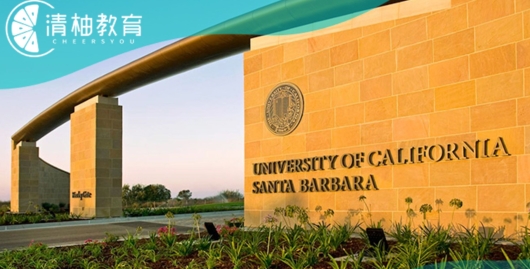
In an era of rapid technological advancement, the integration of technology and management has become a key driving force for change and development across many industries. The Master of Technology Management (MTM) program offered by the University of California, Santa Barbara (UCSB) is precisely designed to meet this trend, providing an excellent learning platform for students aspiring to excel in the field of technology management. In the following sections, we will provide a comprehensive overview of this program from four dimensions: program introduction, curriculum, admission requirements, and career prospects. For more details and other graduate application questions, you can also scan the QR code below for a one-on-one consultation.
Program Introduction
As a top public research university in the United States, UCSB's MTM program leverages the university's profound foundation in engineering, science, and business to cultivate compound talents who understand both technology and management. The program breaks traditional disciplinary boundaries, organically integrating engineering technology knowledge with business management concepts to create an interdisciplinary learning experience for students.
A key feature of the MTM program is its close connection between academia and industry. The university maintains extensive and deep collaborations with numerous high-tech companies, startups, and research institutions. This allows students not only to access cutting-edge technological developments and management theories in class but also to go deep into companies through internships and project collaborations, participate in real project operations, accumulate valuable industry experience, and adapt to the workplace environment in advance.
Moreover, the program boasts an outstanding faculty. Instructors include both senior professors from various top departments on campus, who have excellent research achievements and rich teaching experience in their respective fields, and industry executives and experts who bring real business cases and practical skills. This diverse faculty ensures that students receive a high-quality education that balances theory and practice.
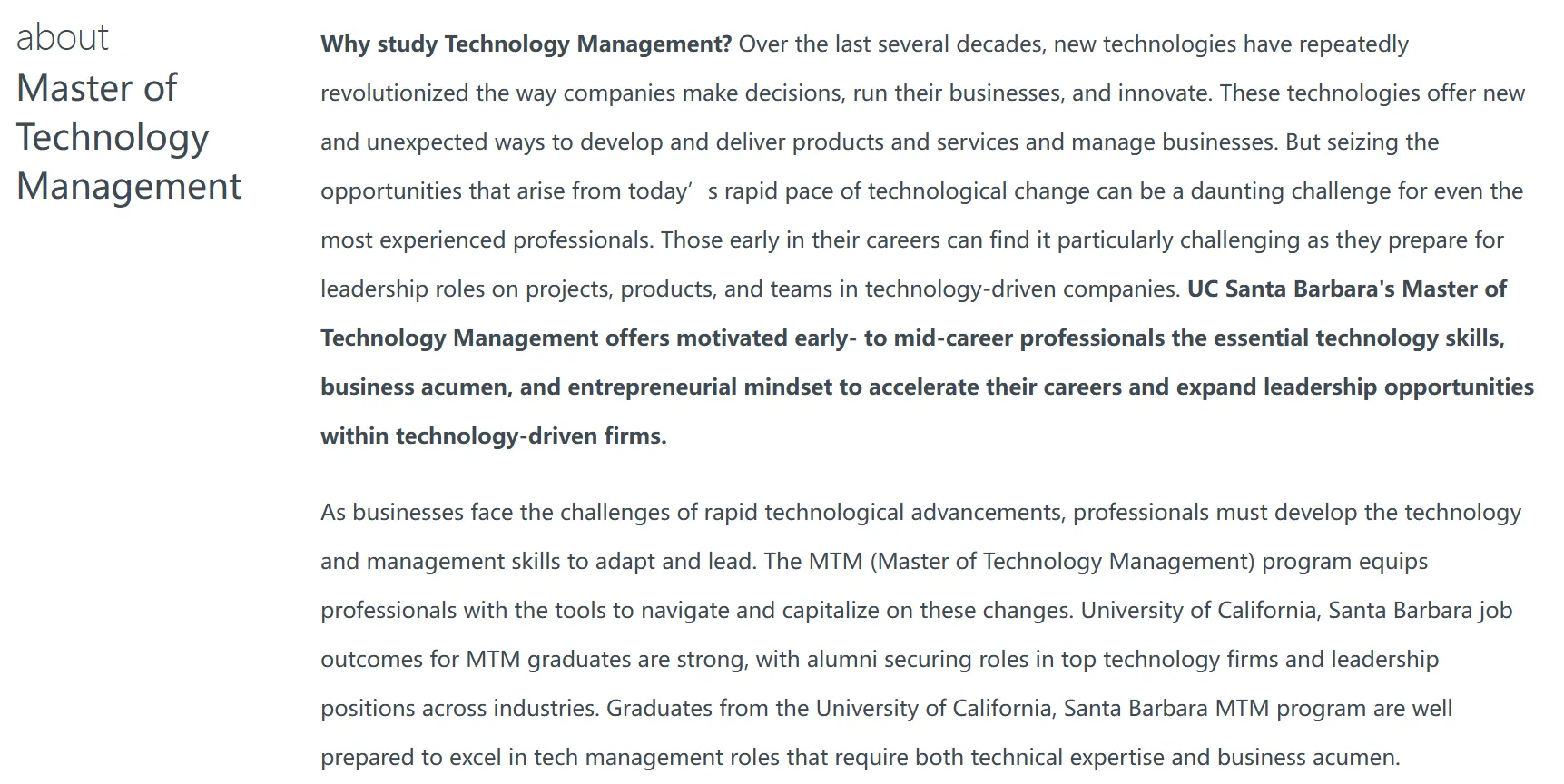
Official website: https://tmp.ucsb.edu/academics/master-technology-management
Curriculum
Core Courses
- Technology Strategy and Innovation: This course focuses on the core role of technology in corporate strategy formulation, exploring how to drive enterprise development through technological innovation. Students will learn to analyze technology trends, evaluate the commercial potential of new technologies, and formulate effective technology innovation strategies to maintain competitive advantage in the market.
- Engineering Economics: Teaches students to apply economic principles and methods to solve decision-making problems in engineering. It covers cost-benefit analysis, investment decisions, risk assessment, etc., helping students learn to allocate resources and analyze economic feasibility in technology projects.
- Technology Marketing and Sales: In-depth study of marketing strategies for technology products and services. Students will learn how to identify target customer groups, position product value, develop pricing strategies, and conduct effective sales activities to successfully bring technological achievements to market.
- Technology Operations Management: Focuses on the operational processes of technology enterprises, including supply chain management, production planning and control, quality management, etc. Students will learn how to optimize operational efficiency and ensure high-quality delivery of products and services.
- Leadership and Team Management: Emphasizes the development of students' leadership and teamwork skills in a technology management environment. Through case studies, simulations, etc., students will learn to motivate team members, handle conflicts, build efficient teams, and drive the smooth implementation of technology projects.
Elective Courses
The MTM program offers a wide variety of elective courses, and students can choose based on their personal interests and career plans. For example, "Intellectual Property Management" teaches how to protect and manage intellectual property in technological innovation; "Entrepreneurship and New Venture Management" is aimed at students with entrepreneurial intentions, covering key aspects of the entrepreneurial process from business plan development to fundraising. There are also courses like "Big Data and Business Analytics" and "Global Technology Management" to meet the learning needs of different students in various sub-fields of technology management.
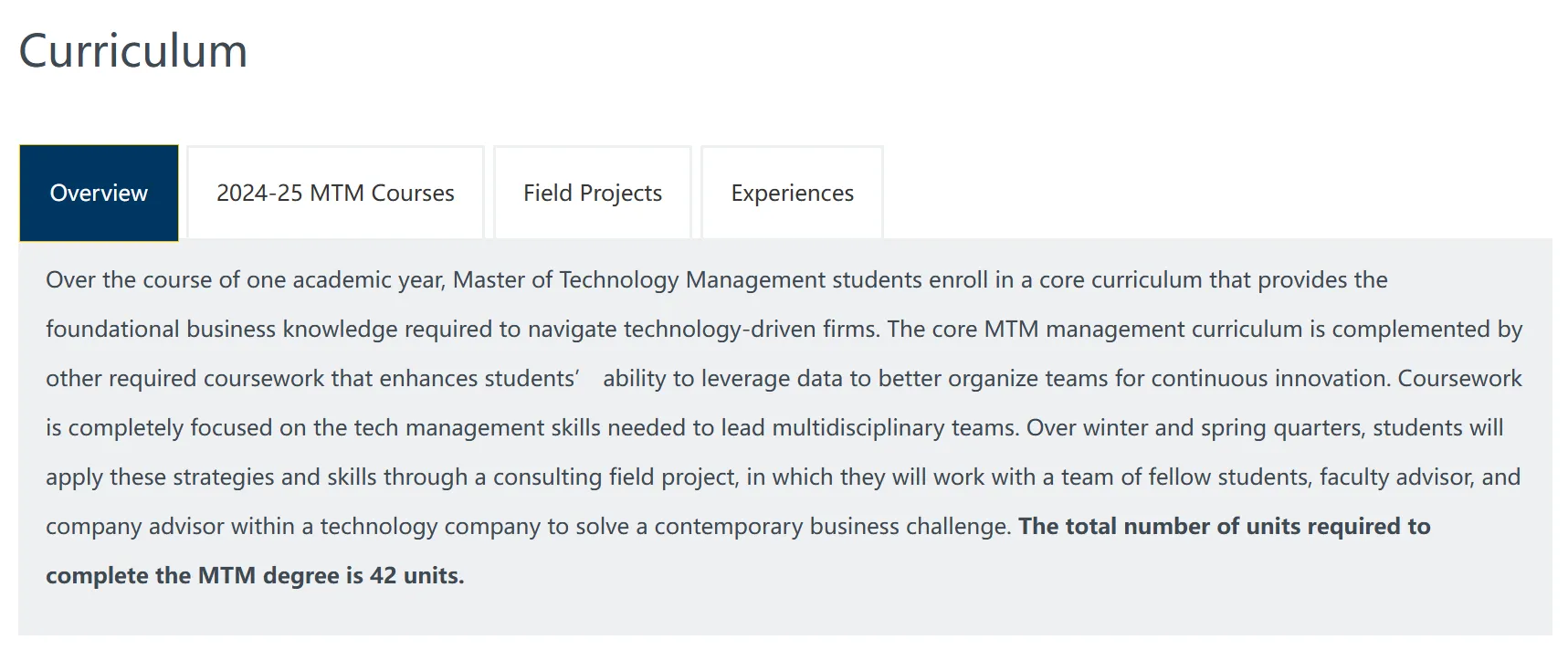
Additionally, the program includes practical courses and a capstone project. The practical courses require students to complete an internship of a certain duration at partner companies, applying their knowledge to real work scenarios; the capstone project requires students to complete a comprehensive technology management project in teams, honing their ability to integrate knowledge and solve complex problems.
Admission Requirements
Academic Background
Applicants are generally required to hold a bachelor's degree. There is no strict restriction on undergraduate major, but a foundation in science, engineering, or business is recommended. Applicants should have strong mathematical and analytical skills, as the program involves significant quantitative analysis. Coursework in calculus, statistics, linear algebra, etc., will be advantageous.
Language Requirements
For international students, a TOEFL iBT total score of at least 80 or an IELTS overall band score of at least 7.0 is required. Some students may need to take an English proficiency test organized by the university to determine if additional English language support courses are needed.
Standardized Test Scores
GRE scores are required; while no minimum score is set, a competitive score can enhance admission chances. GMAT scores are also accepted, and for applicants with work experience or a stronger orientation toward business management, GMAT scores can be submitted as supplementary material.
Other Materials
- Personal Statement: Applicants are required to elaborate in detail on their motivation for applying to the MTM program, personal background, career goals, and understanding and insights into the field of technology management. Through the personal statement, the admissions committee hopes to understand the applicant's unique perspective and fit with the program.
- Letters of Recommendation: Generally, two letters are required. Recommenders should preferably be professors, mentors, or employers who can attest to the applicant's academic ability, work performance, or research potential. The letters should highlight the applicant's strengths, abilities, and potential for development in technology management.
- Resume: A detailed listing of the applicant's educational background, work experience (if any), internship experience, research projects, awards, etc., to comprehensively demonstrate personal qualities and professional experience.
Career Prospects
Graduates of UCSB's MTM program are highly competitive in the job market and enjoy broad career paths, thanks to their unique interdisciplinary knowledge and extensive practical experience.
Technology Companies
In various technology companies, MTM graduates can take on multiple key roles. For example, a Technology Project Manager oversees the planning, execution, and monitoring of technology projects to ensure on-time, high-quality completion; a Product Manager focuses on the full lifecycle management of a product, from concept design to market launch, coordinating resources to meet market demands; a Technology Strategy Consultant provides advice on technology development directions to senior management and assists in formulating long-term technology strategies.
Finance and Investment Institutions
With the booming tech industry, there is a growing demand for technology-savvy professionals in finance and investment institutions. MTM graduates can work as technology industry analysts, evaluating and analyzing emerging technologies to inform investment decisions; or as venture capital managers, identifying promising tech startups, investing in them, and participating in their strategic planning and operational management.
Consulting Firms
In management consulting and technology consulting firms, MTM graduates can leverage their dual background in technology and management to provide professional solutions to clients. For instance, they may offer digital transformation consulting services to traditional enterprises, helping them develop technology upgrade strategies and optimize business processes; or provide professional advice on management issues faced by technology companies, such as organizational restructuring and marketing strategy formulation.
Entrepreneurship
For MTM graduates with entrepreneurial dreams, the comprehensive abilities cultivated by the program provide a solid foundation for entrepreneurship. They understand both technological innovation and business operations and management, enabling them to better seize market opportunities, build teams, raise funds, and drive the development of their ventures.
In summary, the MTM program at UCSB, with its unique design, comprehensive curriculum, clear admission requirements, and broad career prospects, opens doors to a successful career in technology management. Whether seeking a breakthrough in an existing career path or aiming to embark on a new technology entrepreneurship journey, the MTM program offers strong support and assurance. For more admission cases and questions about studying abroad or applying to graduate school, you can also add the contact information of a CheersYou(清柚教育) teacher below for detailed information.