As the financial industry evolves and demand for quantitative analysis talent surges, the Master of Science in Quantitative Finance (MSQF) program at Washington University in St. Louis (WashU) stands out as a popular choice for students pursuing finance careers. Below, we will provide a comprehensive overview of this highly-regarded program from four aspects: program introduction, curriculum, application requirements, and career prospects.For more details and any questions related to graduate applications, you can also scan the QR code below for a one-on-one consultation.

Program Introduction
Washington University in St. Louis is a top-tier private research university in the United States, renowned for its academic excellence and educational quality. The MSQF program leverages the university's strong academic resources and deep expertise in finance, aiming to cultivate advanced quantitative finance professionals with solid mathematics, statistics, and computer science skills, as well as a profound understanding of financial theory and practice.
A distinctive feature of the program is its highly interdisciplinary nature. It integrates the strengths of the Olin Business School, the College of Arts & Sciences, and the McKelvey School of Engineering, breaking down traditional disciplinary barriers and allowing students to study in a cross-disciplinary environment. This unique teaching approach enables students to understand financial issues from multiple perspectives, developing comprehensive and in-depth analytical skills to tackle complex and dynamic financial market challenges.
Furthermore, the MSQF program emphasizes a close combination of practice and theory. The school has established extensive partnerships with numerous well-known financial institutions, providing students with ample internship and practical opportunities. Students can participate in real-world financial projects, interact with industry experts, and apply classroom knowledge to actual work scenarios, gaining valuable practical experience that lays a solid foundation for their future careers.
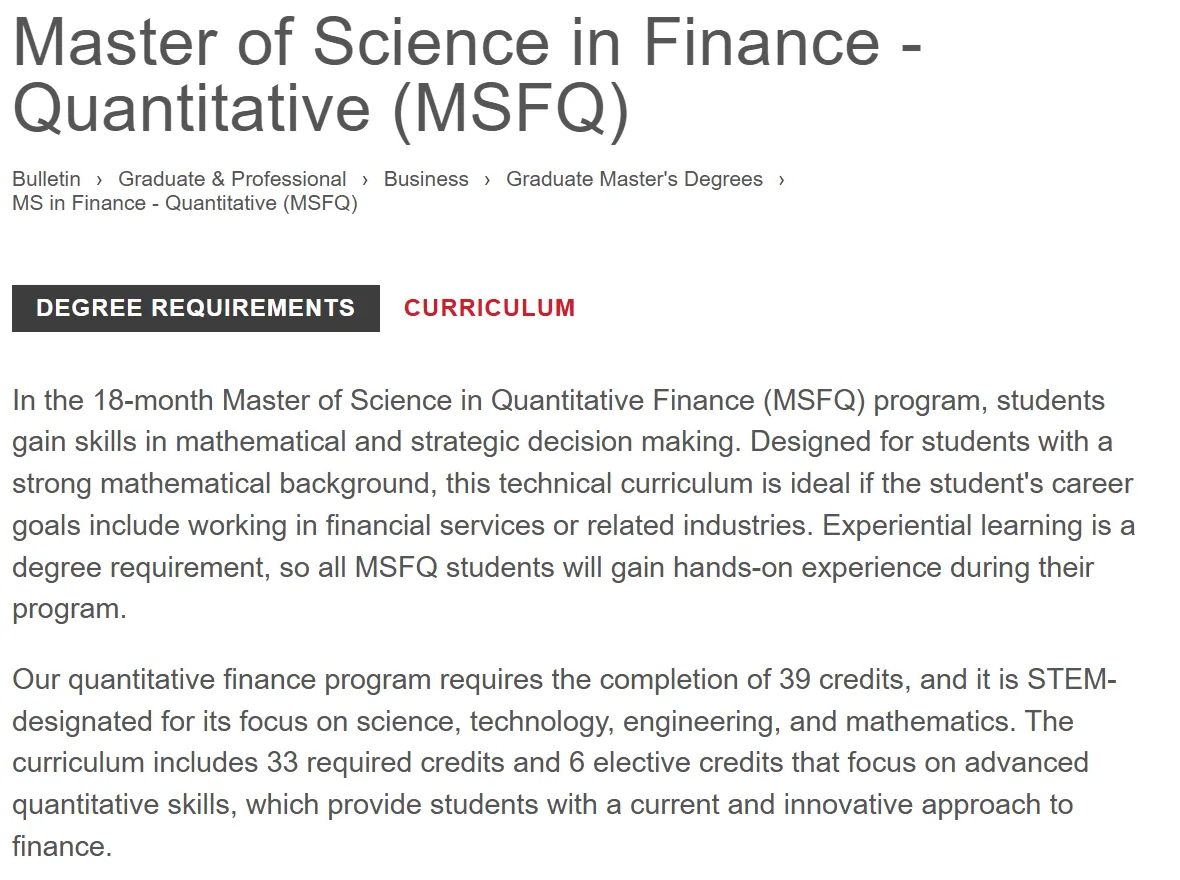
Official website: https://bulletin.wustl.edu/grad/business/graduate-masters/finance-quanti...
Curriculum
Core Courses
- Foundations of Financial Mathematics: This course builds the mathematical framework needed for finance, covering core topics such as calculus, linear algebra, probability theory, and mathematical statistics. Through in-depth study of these mathematical tools, students can better understand and solve financial models and problems encountered in subsequent courses.
- Financial Economics: Focuses on the fundamental principles of financial markets and economic theory, exploring important topics such as asset pricing, the term structure of interest rates, and risk management. Students learn to analyze financial phenomena using economic theory, providing theoretical support for investment decisions and risk management.
- Econometrics: Teaches students to analyze and forecast financial data using statistical methods and mathematical models. Course content includes regression analysis, time series analysis, and panel data models, enabling students to extract valuable information from massive financial data and provide data-driven support for financial decisions.
- Computational Finance: Emphasizes the development of students' ability to solve financial problems using computer programming. Students learn programming languages such as Python and C++ for applications in financial modeling, algorithmic trading, and risk management, acquiring skills to develop financial computing tools and models.
- Financial Risk Management: Delves into the identification, measurement, and control of financial risks. Students study models and management strategies for various risks such as credit risk, market risk, and liquidity risk, and learn how to use financial derivatives for hedging, ensuring the stable operation of financial institutions and corporations.
Elective Courses
The MSQF program offers a diverse range of elective courses to meet different students' interests and career plans. For example, the "Advanced Investments" course explores modern investment theories and strategies, including asset allocation, security analysis, and portfolio management; "Financial Derivatives Pricing" focuses on pricing models and trading strategies for various derivatives (such as futures, options, swaps); and "Quantitative Trading Strategies" emphasizes developing students' ability to develop and implement quantitative trading strategies, covering cutting-edge areas like algorithmic and high-frequency trading.
Additionally, the program includes practical courses and a Capstone Project. The practical course arranges internships at partner financial institutions, allowing students to hone their professional skills in real-world settings. The Capstone Project requires students to complete a comprehensive financial research or application project as a team, showcasing the knowledge and skills accumulated throughout the program, and cultivating their problem-solving abilities and team collaboration spirit.
Application Requirements
Academic Background
Applicants are typically required to hold a bachelor's degree, preferably with a strong background in mathematics, statistics, computer science, or related fields. Applicants should have completed courses in calculus, linear algebra, probability, statistics, and at least one programming language course (such as Python, Java, etc.). Previous coursework in finance or economics is advantageous but not mandatory.
Language Requirements
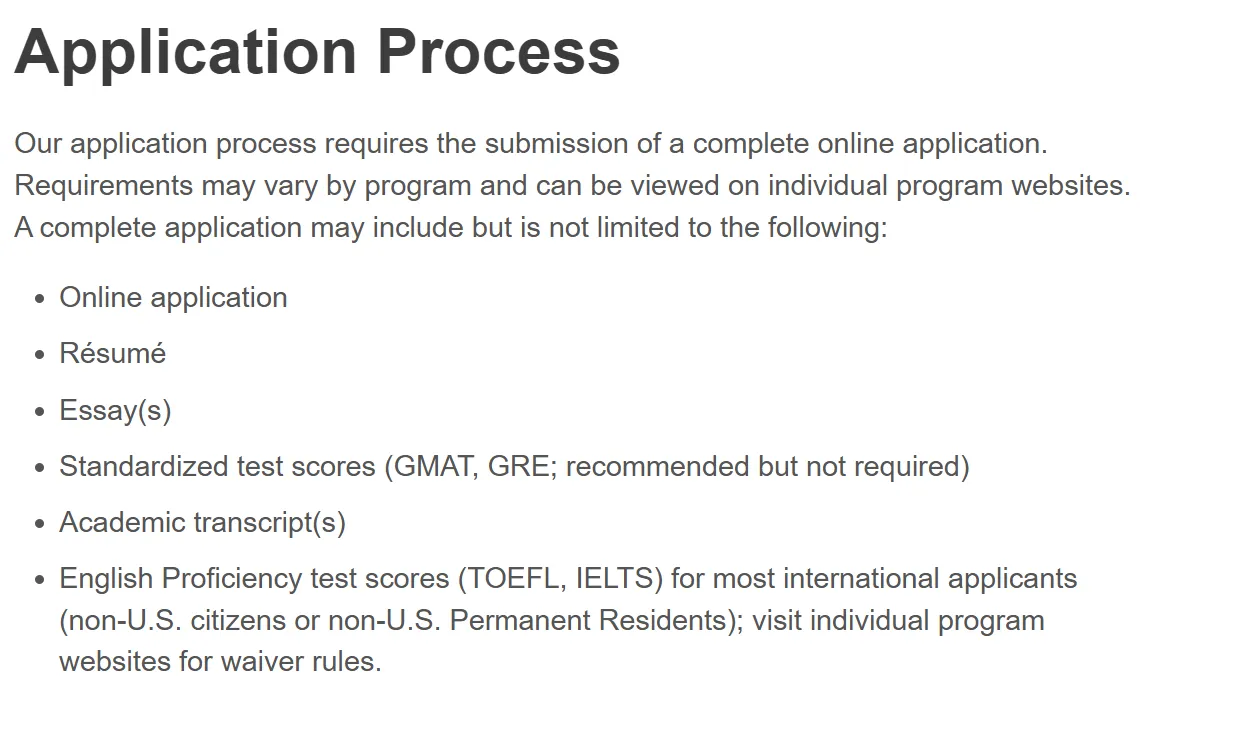
For international students, a TOEFL iBT score of at least 90 is required; an IELTS overall band score of at least 7.0 is required. Some students may need to take an English proficiency test administered by the university to determine whether additional English language support courses are necessary.
Standardized Test Scores
GRE scores are required. While no strict minimum is set by the school, competitive scores (especially a high quantitative section score) can enhance admission chances. GMAT scores are also accepted and may be submitted as supplementary material, particularly for applicants with work experience or those leaning towards a business finance orientation.
Other Materials
- Personal Statement: Applicants must detail their motivation for the MSQF program, personal background, career goals, and understanding of and passion for quantitative finance. Through the personal statement, the admissions committee seeks to understand the applicant's unique personality, academic drive, and fit with the program.
- Letters of Recommendation: Generally, two letters of recommendation are required. Recommenders should be professors, advisors, or employers who can speak to the applicant's academic ability, research potential, or work performance. Letters should highlight the applicant's strengths and potential in the field of quantitative finance.
- Resume/CV: A comprehensive overview of the applicant's educational background, work experience (if any), internship experience, research projects, competition awards, relevant certifications, and other information, demonstrating overall qualifications and professional competence.
Career Prospects
Graduates of the WashU MSQF program, armed with professional knowledge and practical experience, are highly sought after in the job market and enjoy promising career prospects. They can pursue quantitative analysis and risk management roles in investment banks; serve as portfolio manager assistants or conduct quantitative research at asset management firms; find opportunities in financial risk management and credit analysis at commercial banks; or work on algorithmic trading development, blockchain applications, and big data analysis at fintech companies.
For more admission cases and questions about graduate applications, you can also add the contact information of a CheersYou(清柚教育) advisor below to learn more.