
In the era of data-driven decision-making, the field of business analytics has become a key driving force across numerous industries. Boston University's MS in Applied Business Analytics program offers an attractive learning path for students eager to make their mark in this popular field. The following provides a comprehensive analysis of the program, covering program introduction, curriculum, admission requirements, and career development prospects. For more details and other graduate application questions, you can scan the QR code below for a one-on-one consultation.

Program Introduction
Boston University, as a prestigious private research university with a long history and strong reputation in the United States, has deep academic foundations. Its MS in Applied Business Analytics program aims to cultivate professionals who can proficiently use data analysis tools and techniques to solve complex business problems.
The program's biggest highlight lies in its tight integration of business practice and data analysis technology. The school fully understands the urgent corporate demand for application-oriented talent, so the teaching process focuses on engaging students in real business case analyses and project practice. Through partnerships with enterprises in Boston and around the world, students have the opportunity to work with real business data and actual business scenarios, applying theoretical knowledge directly to solving practical problems, thereby accumulating valuable hands-on experience.
In addition, the program boasts strong faculty resources. The teaching team comprises experts from multiple fields, including the business school and the computer science department. They not only possess solid academic backgrounds but also have rich industry experience, providing students with comprehensive and in-depth teaching guidance to help them master cutting-edge business analytics knowledge and skills.
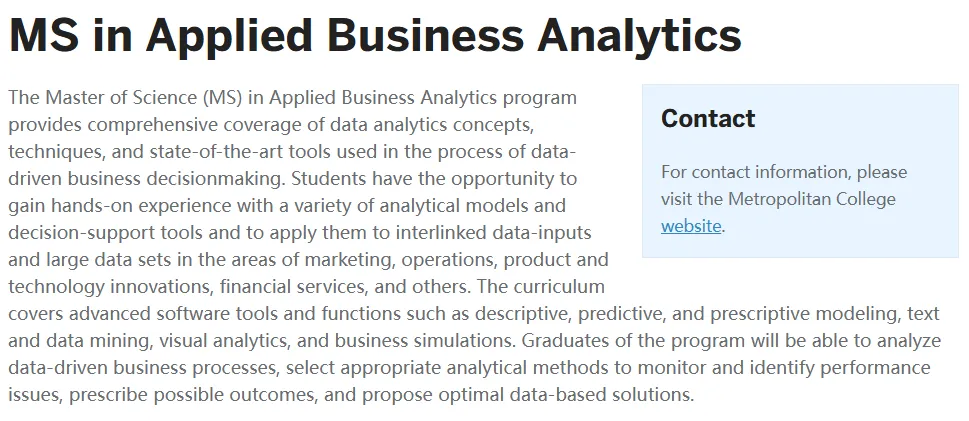
Official website: https://www.bu.edu/academics/met/programs/administrative-sciences/ms-in-...
Curriculum
Core Courses
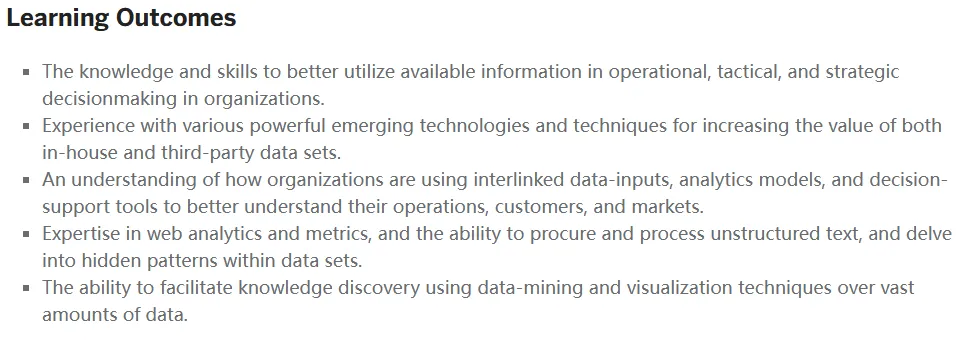
- Business Analytics Fundamentals: This course establishes the theoretical framework for business analytics, covering fundamental concepts of data analysis, data collection, and preprocessing methods. Students will learn how to extract valuable information from massive data sets and how to use statistical methods for preliminary exploratory data analysis, laying a solid foundation for further study.
- Data Mining and Machine Learning: Focuses on core algorithms and techniques in data mining and machine learning. Students will learn classification algorithms (such as decision trees and support vector machines), clustering algorithms (such as K-Means clustering), and regression analysis, mastering how to apply these techniques to build predictive models, uncover hidden patterns and regularities in data, and support business decision-making.
- Business Intelligence and Visualization: Teaches students how to use business intelligence tools (such as Tableau and Power BI) to transform complex data into intuitive and easily understandable visualized reports and dashboards. Through effective data visualization, students can clearly present data analysis results, helping business managers quickly grasp the implications behind the data and make informed decisions.
- Optimization Models and Decision Making: Concentrates on the application of optimization theory and methods in business decision-making. Students will learn to construct and solve optimization models such as linear programming and integer programming, and how to find the optimal business decisions under resource constraints to maximize enterprise benefits.
Elective Courses
- Advanced Data Analytics Topics: Offers in-depth exploration of advanced data analytics themes, such as deep learning applications in business analytics, text mining, and sentiment analysis. Based on their interests and career plans, students can further expand their data analytics skills and master cutting-edge techniques.
- Industry Application Analytics: Provides specialized course modules tailored to different industries (e.g., finance, healthcare, retail). Students will learn how to apply business analytics methods in specific sectors, understand the data characteristics and business needs of each industry, and develop the ability to perform data analysis and decision support in particular domains.
Practical Experience
Practice is an integral part of the program. Students are required to participate in a semester-long practical project, usually in collaboration with local enterprises. In this project, students form teams, delve into the company's business problems, collect and analyze relevant data, propose actionable solutions, and present their findings to corporate management. This practical experience not only enhances students' hands-on skills but also strengthens their teamwork and communication abilities.
Admission Requirements
Academic Background
Applicants must hold a bachelor's degree. While there is no strict restriction on undergraduate major, students with a foundation in mathematics, statistics, or computer science have an advantage. The school expects applicants to have completed college-level courses in calculus, linear algebra, probability and statistics, as well as programming languages (like Python or R). For Chinese students, a recommended undergraduate GPA is 3.0 or above (on a 4.0 scale); graduates from well-known domestic institutions may face relatively higher grade expectations.
Standardized Test Scores
- GRE/GMAT: The school accepts GRE or GMAT scores. Although there is no minimum score cutoff, strong scores increase admission chances. Generally, GRE verbal scores above 150 and quantitative scores above 155, or a GMAT total score above 650 are considered competitive.
- TOEFL/IELTS: International students must submit language test scores. The minimum TOEFL total score is 90, with no subsection below 20; the minimum IELTS total score is 6.5, with no subsection below 6.0. Some students may be required to participate in an English-speaking interview arranged by the school to further assess language proficiency.
Personal Statement
The personal statement should clearly articulate the applicant's interest in the applied business analytics field, past relevant experiences (such as internships or projects), and reasons for choosing Boston University's program. It should also explicitly state career goals and what the applicant hopes to achieve through the program. The recommended length is around 500-1000 words. The personal statement must highlight the applicant's motivation, problem-solving skills, and passion for business analytics.
Letters of Recommendation
Typically, two letters of recommendation are required, preferably from university professors, advisors, or employers who can assess the applicant's academic ability and work ethic. The recommendations should detail the applicant's strengths, professional skills, teamwork, and potential for development in business analytics, providing a comprehensive reference for the admissions committee.
Resume
The resume should concisely list the applicant's educational background, work experience (if any), academic achievements (such as published papers or research projects), internship experiences, awards, and honors. Emphasize experiences and skills related to business analytics, such as data analysis project experience, programming proficiency, and statistical analysis capabilities, to demonstrate alignment with the program.

Career Prospects
Career Paths
- Financial Industry: Graduates can work as financial analysts, risk analysts, etc., in banks, investment firms, insurance companies, and other financial institutions. Responsibilities include analyzing market trends, assessing investment risks, and formulating credit strategies, providing data-driven support for financial decisions.
- Technology Industry: Roles as data analysts, product managers, etc., in internet technology companies and software enterprises. Use data to analyze user behavior and market demands, optimize product design and marketing strategies, and drive product innovation and business growth.
- Retail and Consumer Goods Industry: Work in retail enterprises and fast-moving consumer goods companies in market analysis, sales forecasting, etc. By analyzing sales data and consumer preferences, formulate precise marketing strategies, and optimize inventory management and supply chain planning.
- Consulting Firms: Join management consulting firms or data analytics consulting companies, providing business analytics solutions to clients across various industries. Assist clients in solving complex business problems, formulating strategic plans, and enhancing competitiveness.
Employment Advantages
Boston University's brand influence and the program's professional nature provide strong support for graduates' employment. The program's emphasis on practical experience means students accumulate hands-on project experience, giving them a distinct advantage in the job market and enabling rapid adaptation to corporate work environments and business needs. Moreover, Boston, as a major commercial and technology hub in the United States, offers abundant employment resources; numerous renowned companies provide a wealth of internship and job opportunities for students. The school's career development center also offers comprehensive employment guidance and support, including resume revision, interview coaching, and job fair organization, helping students successfully launch their careers.
Overall, Boston University's MS in Applied Business Analytics program is a highly valuable choice, laying a solid foundation for students' career development in business analytics. It holds great appeal for both recent undergraduates and working professionals with some experience. In the 25fall application season, CheersYou(清柚教育) students also received offers from this program. If you want to learn about application timelines and backgrounds, as well as more admission cases and study abroad application-related questions, you can add the contact information of CheersYou(清柚教育) advisors below for more details.