Among the many popular study-abroad disciplines, transportation-related fields are gradually gaining prominence. Imperial College London (IC), as a world-leading institution, has garnered considerable attention for its MSc in Transport program. So, what exactly does this program entail? In the following sections, we will provide a detailed analysis covering the program overview, curriculum, admission requirements, and career development prospects. For more information and any questions regarding graduate applications, feel free to scan the QR code below for a one-on-one consultation.

1. Program Overview
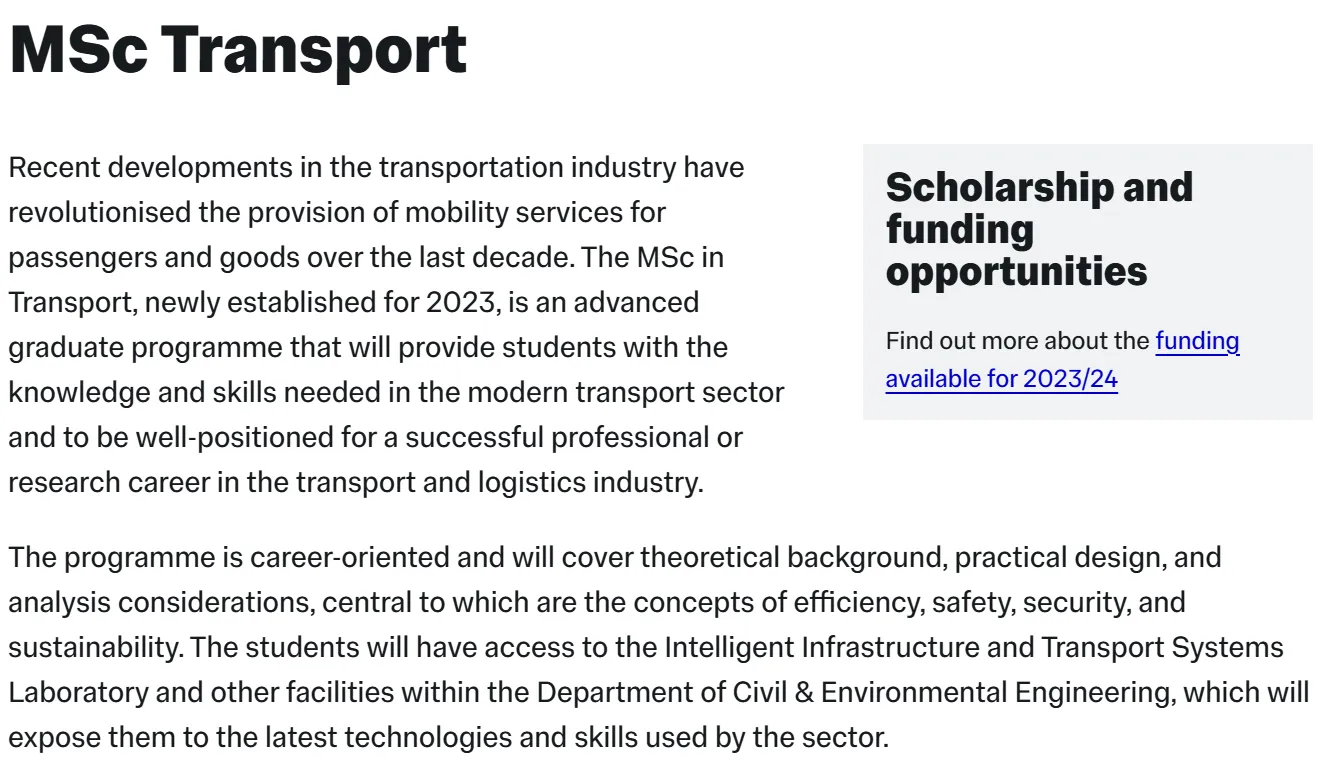
The MSc in Transport at Imperial College London aims to develop professionals capable of tackling complex global transportation issues. Leveraging the university's strong foundation in engineering, science, and business, the program offers an interdisciplinary learning experience.
The program attracts outstanding students and renowned scholars from around the world, fostering a vibrant academic atmosphere. Here, students not only engage with cutting-edge transportation research but also participate in real-world research projects, enhancing their practical skills. Moreover, IC maintains close collaborations with many internationally recognized companies and research institutions, providing students with abundant industry resources and networking opportunities to better integrate into their future professional environments.
Official Website: https://www.imperial.ac.uk/civil-engineering/prospective-students/postgr...
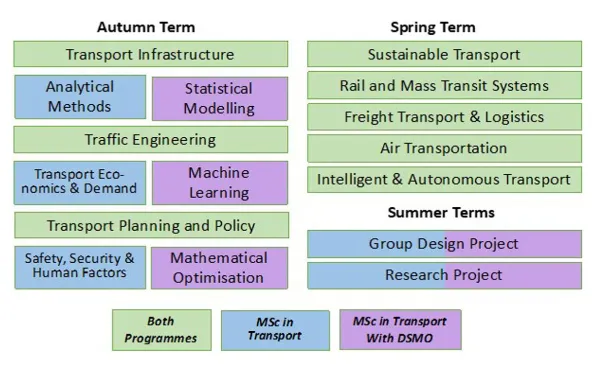
2. Curriculum
- Core Courses
- Transport Systems Analysis: This course focuses on in-depth analysis of various transport systems such as highways, railways, and aviation. Using mathematical models and data analysis methods, it helps students understand the operational principles of transport systems and learn how to evaluate system performance and propose optimization solutions.
- Transport Economics: This course explores the economic dynamics of the transport sector. Students will study transport demand and supply theories, cost-benefit analysis, and the impact of policy-making on transport markets, building a solid foundation in economic theory for future work in transport planning and management.
- Transport Planning and Design: This course develops students' abilities in transport infrastructure planning and design. It covers areas such as urban transport planning and logistics park design, equipping students to apply advanced techniques and concepts to create rational and sustainable transport plans.
- Elective Courses
- Intelligent Transport Systems: With rapid technological advancement, intelligent transport has become a hot topic in the industry. This course introduces the application of smart traffic technologies in transport, such as autonomous driving and vehicle-to-infrastructure coordination, enabling students to stay current and understand the practical uses and future trends of emerging technologies in transport.
- Sustainable Transport: In light of escalating environmental concerns, sustainable transport has become a global focus. This course encourages students to explore how to meet transport demands while achieving environmental protection and sustainable resource use, covering topics like green transport policies and new energy transport.
The diverse curriculum ensures that students gain a solid grounding in the fundamentals of transport studies while allowing them to pursue in-depth learning in specialized areas aligned with their personal interests and career aspirations.
3. Admission Requirements
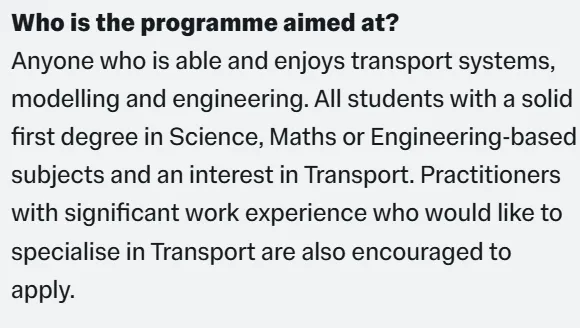
- Academic Background: Applicants are typically expected to hold an undergraduate degree in a relevant discipline such as transport engineering, civil engineering, mathematics, physics, computer science, or other engineering fields. Strong academic performance is required, generally equivalent to a UK upper second-class honours degree (2:1) or above, or a minimum score of 80-85% from a leading Chinese university.
- Language Requirements: An overall IELTS score of 6.5 with no component below 6.0, or a TOEFL score of 92 overall with no sub-score below 20. English proficiency is crucial to ensure students can fully engage with the English-medium instruction.
- Letters of Recommendation: Two letters of recommendation are required, preferably from professors or advisors familiar with the applicant’s academic performance and research potential. The letters should detail the applicant’s strengths, abilities, and potential for growth in the relevant field.
- Personal Statement: The personal statement is a key document to showcase the applicant's unique qualities and motivations. In it, students should clearly articulate their interest in transport studies, career goals, and why they believe Imperial’s MSc in Transport is the right fit for them, highlighting their strengths and distinctive characteristics.
4. Career Development Prospects
- Diverse Career Paths
- Transportation Planning Departments: Graduates can join government transportation planning departments to design and plan urban transport networks. For example, creating subway expansion plans for major cities or optimizing bus route layouts to enhance urban transport efficiency.
- Logistics and Supply Chain Companies: In the logistics sector, transportation is a critical link. Graduates can work in logistics transport scheduling, warehouse planning, etc., helping companies reduce logistics costs, improve goods transport efficiency, and strengthen competitiveness.
- Consulting Firms: Many leading international consulting firms have transport advisory arms. With the expertise gained at IC, graduates can provide professional transport strategy consulting services, such as assisting companies in assessing the investment feasibility of new transport projects.
- Research Institutions: For those with research interests, graduates can pursue further studies or join research institutions to conduct cutting-edge research in the transport field, driving technological innovation and advancement.
- Competitive Salaries
Due to the program's specialized and practical nature, graduates are highly competitive in the job market and command attractive salaries. In developed Western countries, entry-level MSc in Transport graduates can earn around $50,000–$80,000 annually, with significant increases as experience and skills grow. In China, starting salaries for related positions in top-tier cities can reach approximately RMB 100,000–150,000, with ample room for advancement.
In summary, Imperial College London's MSc in Transport excels in academic training, curriculum design, and career prospects. For students dedicated to making an impact in the transport sector, it is undoubtedly a highly attractive option. However, competition for admission is intense, so prospective applicants should prepare thoroughly in advance to boost their chances of success. In the Fall 2025 application cycle, CheersYou(清柚教育) students have already received offers from this program.

For details on application timelines and backgrounds, more admission case studies, and any questions related to graduate applications, feel free to contact a CheersYou(清柚教育) advisor using the information below.