Amid the global digital wave, data science has gained widespread attention as an emerging and highly influential discipline. The University of Bristol's MSc Data Science program offers an excellent platform for students eager to enter the field. Below, we provide a comprehensive analysis of the program, including its overview, curriculum, admissions requirements, and career prospects. For more details and any application questions, scan the QR code below for one-on-one consultation.

Program Overview
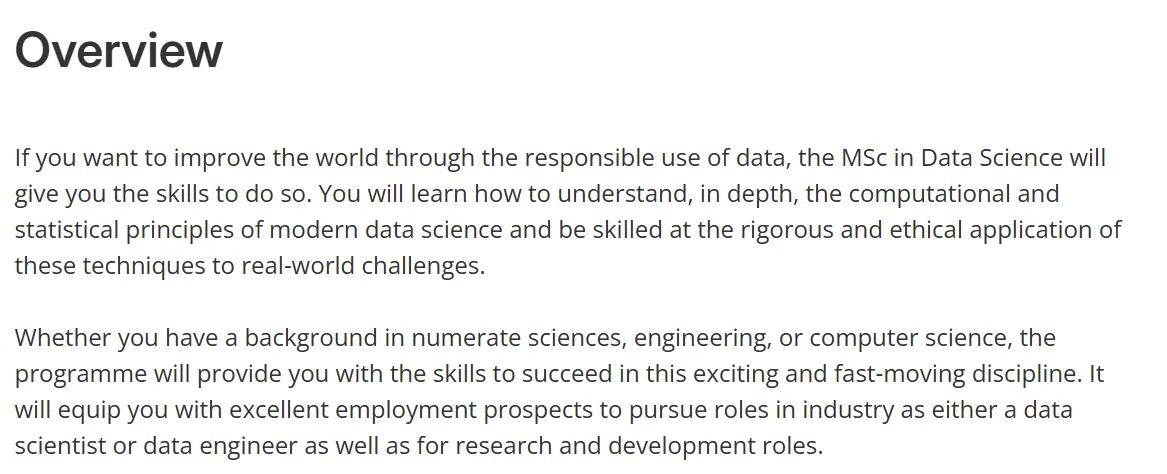
The University of Bristol is a top UK institution, renowned for its academic research and teaching quality. The MSc Data Science program aims to cultivate professionals with solid theoretical knowledge and practical skills in data science.
The program brings together experts from computer science, statistics, mathematics, and other fields, forming an interdisciplinary teaching and research team. This interdisciplinary environment allows students to engage with knowledge and methods from different domains, broadening their perspectives and developing their ability to solve complex data problems using a multidisciplinary approach.
Moreover, the University of Bristol maintains close partnerships with numerous renowned companies and research institutions. This provides students with abundant internship and practical opportunities, enabling them to apply their learning to real-world projects, gain valuable industry experience, and create favorable conditions for employment after graduation.
Official Website: https://www.bristol.ac.uk/study/postgraduate/taught/msc-data-science/
Curriculum
- Core Courses
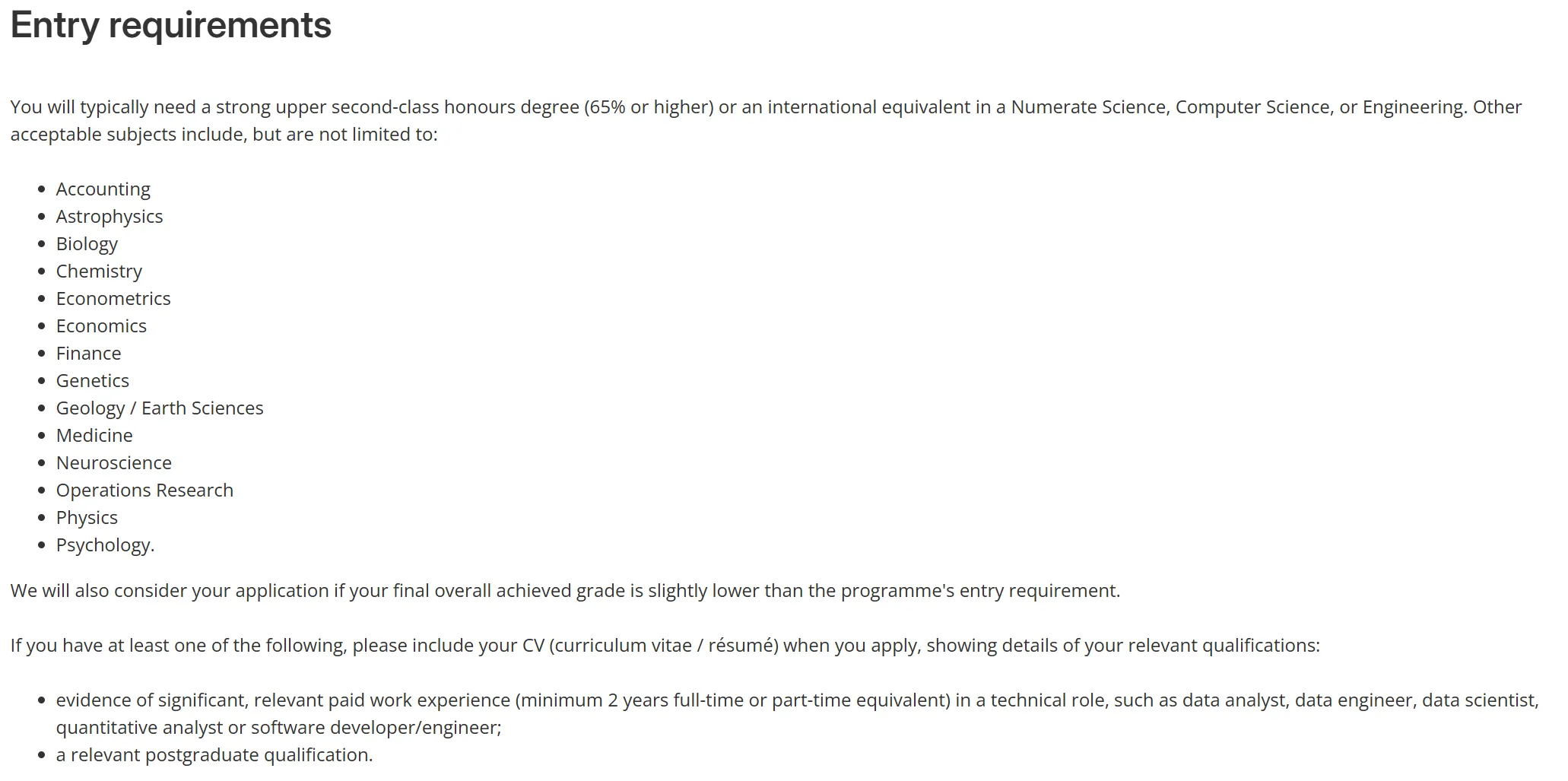
- Data Mining and Machine Learning: This course is a core component of data science. Students will learn various data mining algorithms and machine learning models, such as decision trees, neural networks, support vector machines, etc., mastering how to extract valuable information from massive data sets and perform prediction and classification tasks. Through real-world cases and programming practice, students will become proficient in implementing these algorithms and models using Python and other programming languages.
- Data Visualization: Effective data visualization helps people better understand the stories behind the data. The course teaches students how to select appropriate visualization tools and techniques, such as Matplotlib and Seaborn, to present complex data as intuitive and understandable charts and graphics. Students will also learn to design visualization schemes that highlight key features and trends in the data.
- Database and Big Data Management: As data volumes continue to grow, database management and big data processing become crucial. Students will delve into the principles and operations of relational and non-relational databases, and master SQL for data querying and management. They will also be introduced to big data processing frameworks like Hadoop and Spark, learning how to handle and store large-scale datasets.
- Elective Courses
- Deep Learning: As an important branch of machine learning, deep learning has achieved great success in fields such as image recognition and natural language processing. This course will explore the theory and practice of deep learning, including the principles, training methods, and applications of models like Convolutional Neural Networks (CNNs), Recurrent Neural Networks (RNNs) and their variants (e.g., LSTM, GRU). Students will work on practical projects using deep learning frameworks (such as TensorFlow or PyTorch) to solve real problems.
- Data Ethics and Law: While data science advances rapidly, data ethics and legal issues are becoming increasingly prominent. This course will guide students to consider the ethical and legal issues in data collection, use, and sharing, such as privacy protection, data security, and algorithmic bias. Students will study relevant laws and regulations and develop the awareness to follow ethical guidelines in data science practice.
The diverse curriculum ensures students not only gain a comprehensive grasp of data science fundamentals but also allows them to delve into specific areas based on personal interests and career plans.
Admissions Requirements
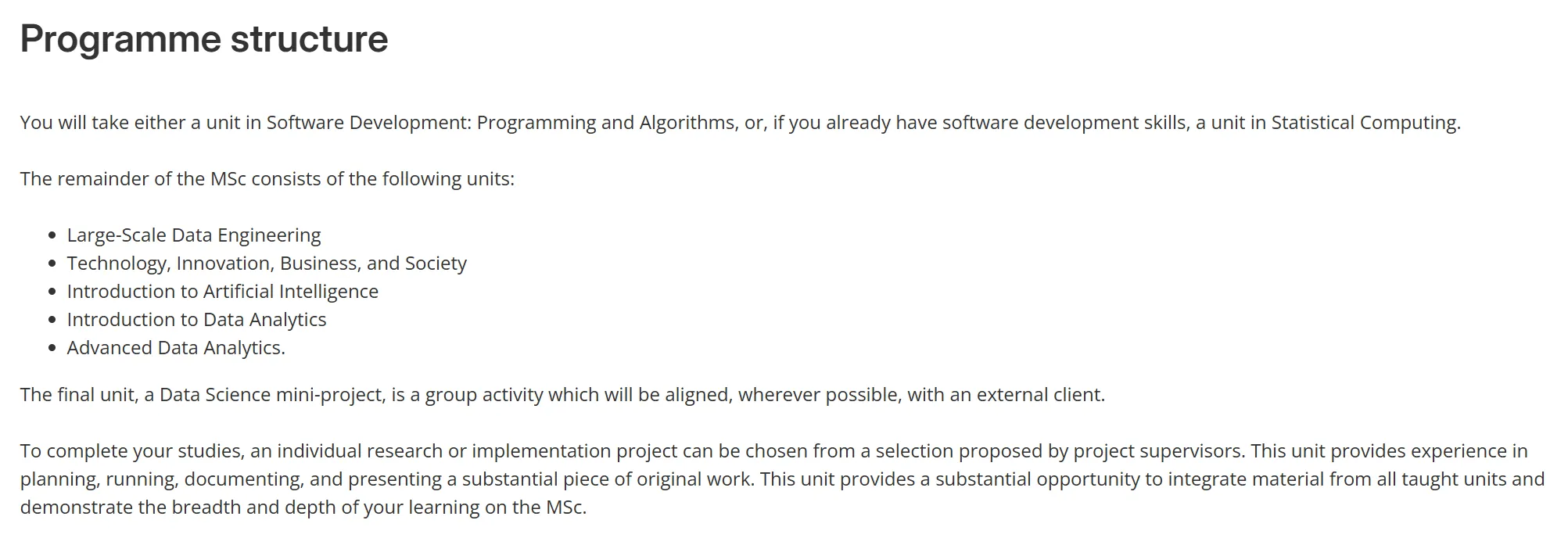
- Academic Background: Typically requires a bachelor's degree in a related field such as computer science, mathematics, statistics, physics, or other STEM disciplines. Undergraduate grades must meet a certain standard: a UK upper second-class (2:1) honours degree or equivalent, typically corresponding to a score of 80-85% or above from a recognized domestic university. Relevant work experience or project experience is advantageous.
- Language Requirements: IELTS overall score of 6.5 with no band below 6.0; TOEFL overall score of 88 with a minimum of 22 in Reading and Writing, and 21 in Listening and Speaking. Language proficiency is essential for successful academic study; good English skills help students better understand course content, participate in discussions, and complete academic tasks.
- Recommendation Letters: Two recommendation letters are required, from referees who are familiar with the applicant's academic performance and research ability. The letters should detail the applicant's strengths, professional skills, learning attitude, and potential in data science. Suitable referees include professors, academic supervisors, or internship supervisors.
- Personal Statement: The personal statement is an important document to showcase the applicant's unique personality and motivation. In the statement, applicants need to explain their interest in data science, career goals, and why they have chosen the University of Bristol's MSc Data Science program. They should also highlight their learning and practical experiences in relevant fields and the achievements they have made, demonstrating their ability and determination to complete the program.
Career Prospects
- Diverse Employment Directions
- Technology Companies: Graduates can take on roles such as data scientist, data analyst, and machine learning engineer at major tech companies. For example, at international giants like Google, Microsoft, Amazon, and domestic leaders like Alibaba, Tencent, and ByteDance, they use data science skills to solve business problems, drive product innovation, and foster business growth. Data scientists extract valuable insights from massive datasets to support company decisions; data analysts focus on data collection, cleaning, and analysis, generating reports and visualizations; machine learning engineers develop and optimize machine learning models for applications in image recognition, speech recognition, recommendation systems, etc.
- Financial Sector: There is a growing demand for data science professionals in banks, securities firms, insurance companies, and other financial institutions. Graduates can work in financial data analysis, risk assessment, and quantitative trading. By analyzing historical financial data, they predict market trends, assess credit risk, and provide a basis for investment decisions. Quantitative traders use data science algorithms to build trading models for automated trading, improving efficiency and returns.
- Healthcare Field: With the advancement of medical informatization, data science is playing an increasingly important role in healthcare. Graduates can participate in medical data analysis projects such as disease prediction, drug discovery, and medical quality assessment. By analyzing patient records and genomic data, they help doctors create personalized treatment plans, accelerate the development of new drugs, and improve healthcare service quality.
- Attractive Salaries
Data science professionals are in high demand with relatively high salaries. In the UK, the starting salary for an MSc Data Science graduate is typically around £30,000-£40,000, with significant growth potential as experience and skills increase. In China, starting salaries for data science roles in major cities are generally around 150,000-200,000 RMB per year, and experienced data scientists can earn hundreds of thousands or even higher annually.
In summary, the University of Bristol's MSc Data Science program, with its excellent teaching quality, comprehensive curriculum, reasonable admissions requirements, and broad career prospects, provides students with a great opportunity for advanced study and development in data science. In the 25fall application cycle, CheersYou(清柚教育)'s students also received offers from this program. To learn about application timelines and backgrounds, more admission cases, and other study-abroad application questions, you can also add the contact information of the CheersYou(清柚教育) teacher below for detailed information.