Johns Hopkins University, a world-class institution, offers an MS in Real Estate and Infrastructure program that attracts many students aspiring to develop their careers in this field. The MS in Real Estate and Infrastructure program at Johns Hopkins University draws on its outstanding academic resources and extensive industry connections to cultivate professionals capable of addressing complex challenges in the real estate and infrastructure sectors. The program integrates multidisciplinary knowledge covering business, engineering, urban planning, and other areas, providing students with a comprehensive and in-depth learning experience. The following sections provide a detailed interpretation from program introduction, curriculum, application requirements, to career development prospects. For more detailed information and other graduate application questions, scan the QR code below for a one-on-one consultation.
I. Program Introduction
The program typically lasts about one year, being intensive yet efficient. Students not only learn cutting-edge theoretical knowledge in the classroom but also have opportunities to participate in real projects, accumulating valuable hands-on experience. The school maintains close collaborations with numerous renowned enterprises, government agencies, and non-profit organizations, offering students abundant internship and practical opportunities, enabling them to establish close ties with the industry before graduation.
A distinctive feature of the program is its international perspective. Students come from all over the world, bringing diverse cultural backgrounds and professional experiences together to form a diverse and inclusive learning environment. This diversity promotes the collision and exchange of ideas, training students to view and solve problems from different angles, laying the groundwork for future work on a global scale.
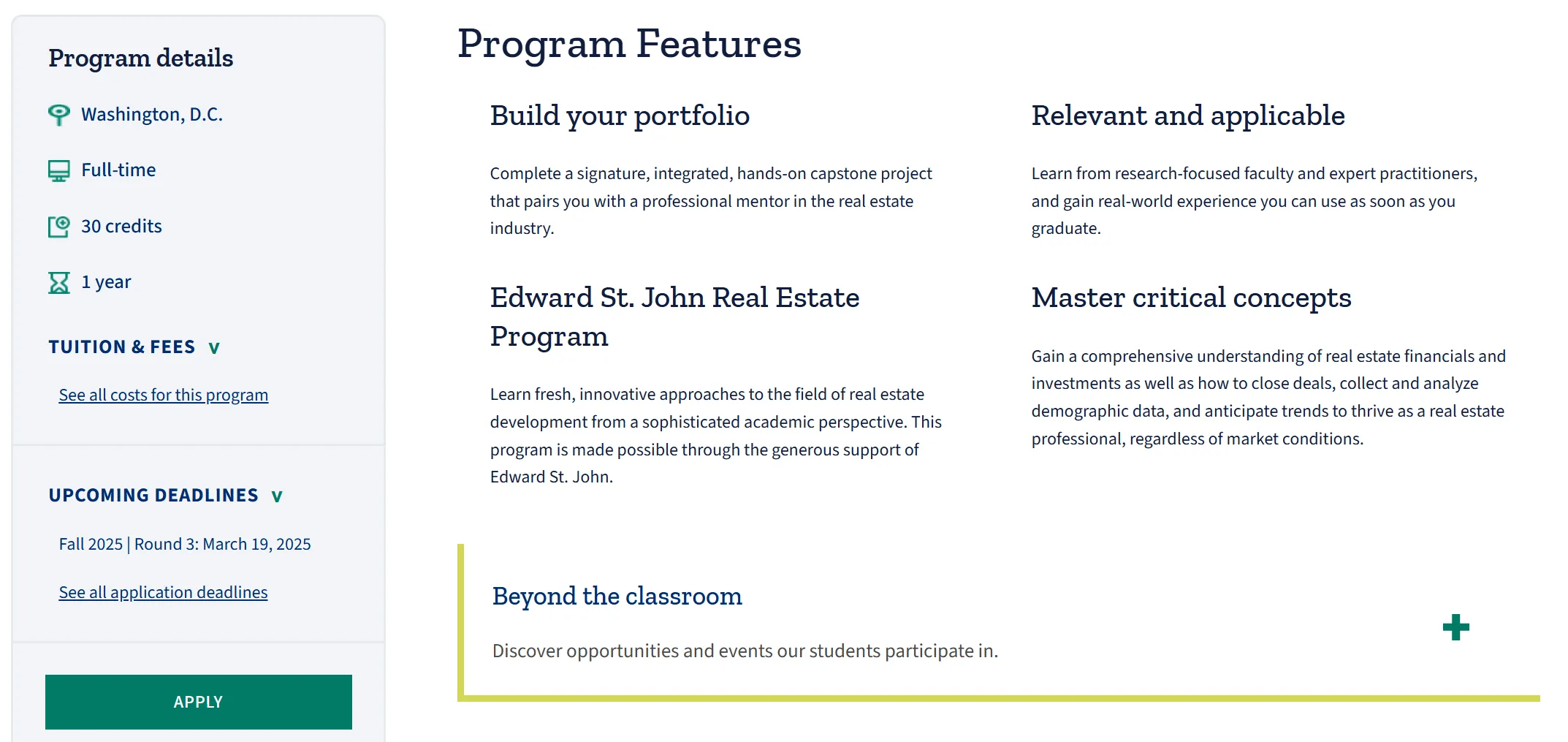
Official website link: https://carey.jhu.edu/programs/master-science-programs/ms-real-estate-in...
II. Curriculum
The curriculum of this master's program is meticulously designed, balancing theory and practice, aimed at comprehensively enhancing students' professional competence in the field of real estate and infrastructure.
(A) Core Courses
- Principles of Real Estate Development: This course is the cornerstone of the program, systematically introducing the entire process of real estate development from initial conception to final delivery. Students will learn key knowledge and skills in project site selection, market analysis, land acquisition, planning and design, construction management, marketing, and project financing. Through real case analysis and simulated project operations, students can gain an in-depth understanding of the complexity and systematic nature of real estate development.
- Real Estate Finance: Focuses on financial instruments and financing strategies in the real estate sector. The course content includes traditional bank loans, bond financing, and emerging real estate investment trusts (REITs), private equity financing, etc. Students will learn how to evaluate the costs, risks, and benefits of different financing methods, master financial analysis and modeling skills, in order to make informed financial decisions in actual projects.
- Infrastructure Planning and Management: Emphasizes the planning, design, construction, and operational management of infrastructure projects. Students will understand the characteristics and needs of various infrastructure systems such as transportation, energy, and communication, and learn project pre-planning, feasibility studies, project management methods, and operational maintenance strategies. Through real cases and project practice, students cultivate strategic thinking and practical operation capabilities in the infrastructure field.
(B) Elective Courses
- Real Estate Marketing: Delve into the marketing principles and strategies of the real estate market. Students will learn market research, target customer positioning, brand building, pricing strategies, advertising and promotion planning, and more. Through real projects and case analysis, students can master how to formulate effective marketing plans and enhance the market competitiveness of real estate projects.
- Sustainable Real Estate Development: With the global spread of sustainability concepts, this course focuses on how the real estate industry can achieve environmental, social, and economic sustainability. Students will study green building design standards, renewable energy applications, water resource management, community planning and social equity, and other practical cases, cultivating the ability to promote sustainable development in real estate development and operation.
- Urban Planning and Design: Explores the principles and methods of urban planning and design from both macro and micro perspectives. Students will learn urban development theories, land use planning, transportation planning, public space design, etc., understanding how to create livable, workable, and visitable urban environments. Through field research and design projects, students develop urban planning and design capabilities.
In addition, students can also choose elective courses in other related fields such as data analysis, risk management, project management, etc., based on personal interests and career goals, further broadening their knowledge base and skill sets.
III. Application Requirements
(A) Academic Background
Applicants typically need to hold a bachelor's degree. Although there are no strict restrictions on the undergraduate major, a background in business, engineering, mathematics, economics, urban planning, or related fields is advantageous. The undergraduate GPA is generally required to be above 3.0 (on a 4.0 scale), but in a highly competitive environment, a higher GPA will increase the chances of admission.
(B) Standardized Test Scores
- GRE/GMAT: While in some cases the school may consider waiving standardized test scores, most applicants still need to submit GRE or GMAT scores. There is no clearly fixed score requirement, but excellent scores (GRE: Verbal 155+, Quantitative 160+; GMAT: 650+) will help enhance competitiveness.
- TOEFL/IELTS: International students need to provide proof of English language proficiency. The TOEFL total score is generally required to be 100 or above, with minimum section scores of 22; the IELTS total score requirement is 7.0 or above, with no section lower than 6.5. Some students who have completed an English-taught bachelor's degree may qualify for a language exam waiver.
(C) Letters of Recommendation
Two letters of recommendation are usually required. Recommenders should be able to evaluate the applicant's academic ability, work performance, leadership potential, or other qualities relevant to graduate study. It is best if the recommenders are the applicant's university professors, internship supervisors, or work supervisors.
(D) Personal Statement
The personal statement is an important part of the application process. Applicants need to articulate their academic and career goals, explain why they are interested in the program, and how their background, experiences, and skills align with the program. The personal statement should be clear, well-organized, and showcase the applicant's unique personality and passion for the field.
(E) Resume
A detailed resume should include the applicant's educational background, work experience, internship experience, research projects, awards, extracurricular activities, and other information, highlighting experiences and achievements related to the real estate and infrastructure field.
IV. Career Development Prospects
(A) Employment Directions
- Real Estate Development Companies: Graduates can work as real estate development specialists, project managers, etc., participating in project pre-planning, land acquisition, planning and design, construction management, and marketing. With accumulating experience, there are opportunities to advance to project director or development manager, responsible for larger-scale and more complex projects.
- Real Estate Investment Institutions: In real estate investment companies, private equity funds, asset management firms, etc., graduates can engage in investment analysis, asset valuation, project screening, and portfolio management. By analyzing market trends and evaluating projects, they identify potential investment opportunities for the institution and achieve asset appreciation.
- Infrastructure Construction and Operation Enterprises: Graduates can serve as project managers, operation and maintenance managers, strategic planners in infrastructure construction companies, public utility companies, etc., participating in the construction implementation and long-term operation management of infrastructure projects to ensure project smoothness and efficient operation.
- Government Agencies and Non-Profit Organizations: In local government planning departments, housing security departments, transportation departments, and non-profit organizations, graduates can engage in policy formulation, project planning, community development, etc., serving urban development and public interest.
(B) Salary and Compensation
The salary prospects for graduates of this program are quite competitive. The specific salary level varies depending on factors such as region, work experience, company size, and industry subsector. In the United States, the annual salary for entry-level graduates generally starts at around $60,000 to $80,000. With increasing work experience and enhanced professional skills, the salary is expected to grow significantly. In large cities or hot industry sectors, the annual salary for senior professionals can exceed $100,000, or even higher. In China, the starting salary for relevant positions in first-tier cities is typically around RMB 100,000 to 150,000, and after gaining certain work experience, the salary level will increase substantially.
(C) Career Development Prospects
As global urbanization accelerates and infrastructure construction continues, the demand for professionals in the real estate and infrastructure fields will maintain steady growth. The MS program at Johns Hopkins University, with its outstanding academic reputation, rich practical teaching, and extensive industry connections, provides graduates with broad career development space. Graduates can not only find development opportunities in traditional real estate and infrastructure industries but also venture into emerging fields along with industry innovation and transformation, such as smart city construction, green real estate development, and digital transformation of infrastructure, achieving diversified career development.
In summary, the MS in Real Estate and Infrastructure program at Johns Hopkins University is a high-value educational choice. It provides students with comprehensive professional knowledge, rich practical experience, and broad career development prospects. Whether for beginners looking to start a career in the real estate and infrastructure field, or for professionals seeking career advancement or transition, it is a program worth considering. In the 25fall application season, a CheersYou(清柚教育) student also received an offer for this program.

To learn about application timelines and backgrounds, as well as more admission cases and graduate study application related questions, you can also add the contact information of a CheersYou(清柚教育) advisor below for more details.