Against the global backdrop of climate change and accelerating urbanization, Tufts University's M.S. in Environmental Policy and Planning stands out as a top-tier program at the nexus of public administration and environmental science with its dual-track model of "policy analysis + scientific practice." Offered by the Department of Urban and Environmental Policy and Planning (UEP), the program focuses on sustainable community building, environmental justice, and resource management. Graduates earn average starting salaries of $100,000–$150,000 and achieve over 80% U.S. employment rate. Below, we elaborate on the program introduction, curriculum, application requirements, and career prospects. For more details and questions about graduate school applications, you can also scan the QR code below for one-on-one consultation.

I. Program Introduction: Practice-Oriented Interdisciplinary Education
The M.S. in Environmental Policy and Planning at Tufts aims to cultivate "practical visionaries" who use scientific tools and policy design to address social and environmental challenges. Anchored in Boston’s rich non-profit and government resources, the program emphasizes three core competencies: data analysis, community engagement, and sustainable development.
-
Core Advantages:
-
Flexible Format: Offers full-time (2 years) and part-time (2-3 years) tracks; curriculum includes 12-13 courses (36-39 credits) plus a thesis or capstone project (total 42 credits).
-
Integration of Practice: Students can participate in collaborations like the UPMC (University of Pittsburgh Medical Center) project or engage in local community planning case studies.
-
Dual-Degree Options: Can be combined with programs at The Fletcher School of Law and Diplomacy, the Friedman School of Nutrition Science and Policy, etc., expanding career dimensions.
-
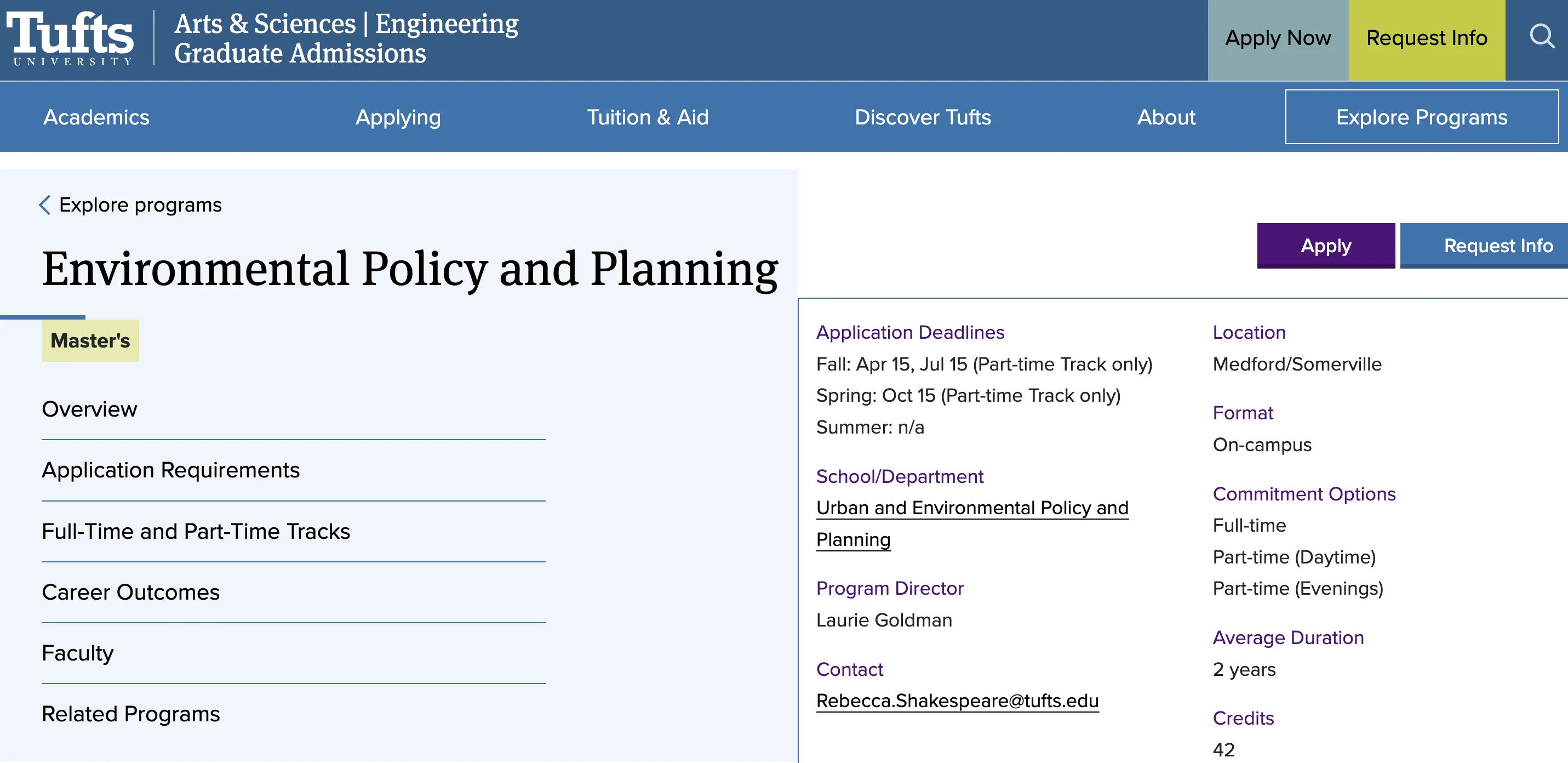
Official website: https://asegrad.tufts.edu/program/environmental-policy-and-planning-masters
II. Curriculum: Balancing Policy Science and Technical Tools
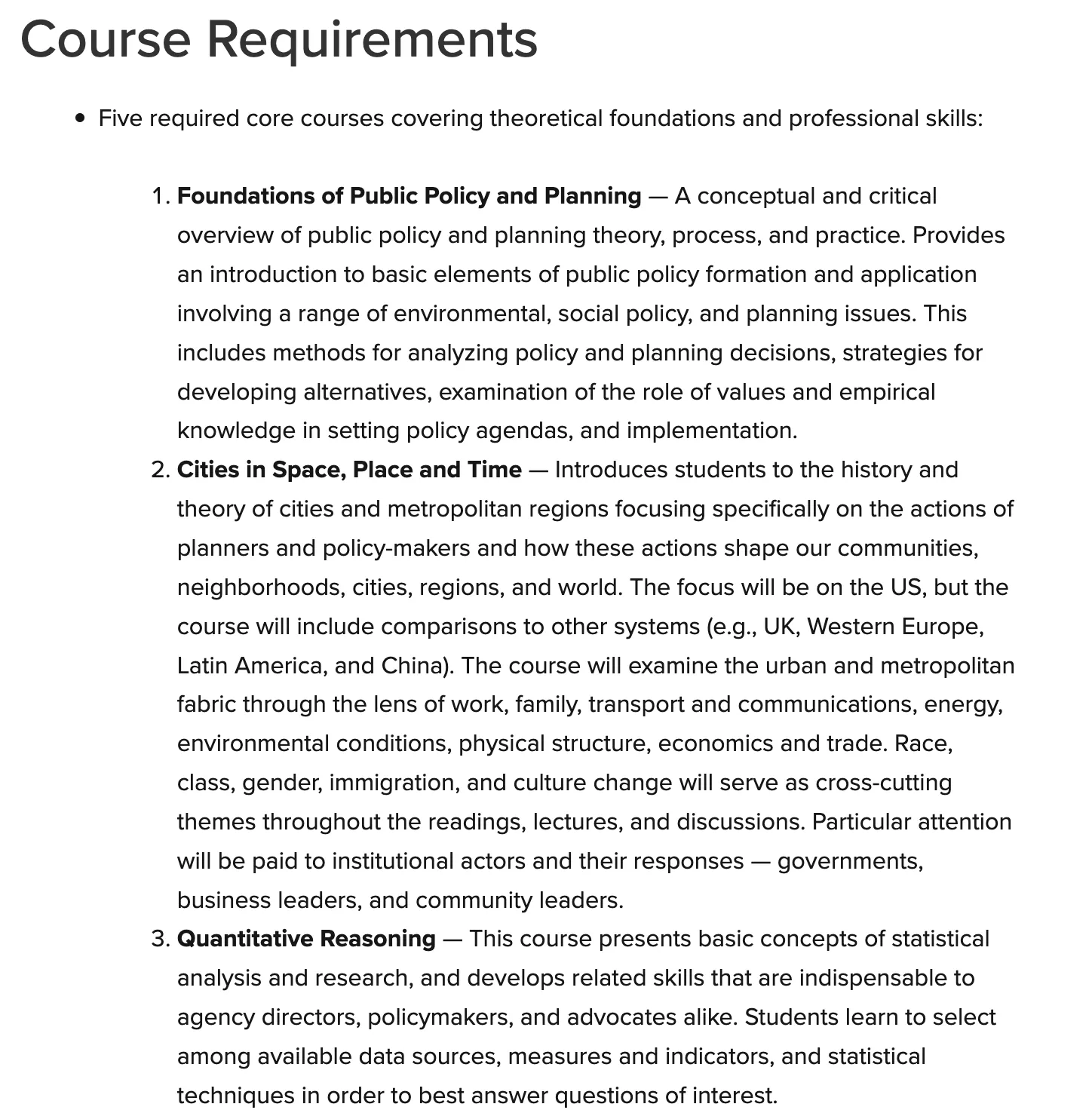
The curriculum is divided into core courses, electives, and practical modules, covering three main areas: environmental policy, urban design, and quantitative analysis:
-
Core Courses:
-
Foundations of Public Policy & Planning: Policy-making processes and social equity frameworks.
-
Quantitative Reasoning for Policy & Planning: Learn R/Python tools for policy impact assessment.
-
Land Use Planning: Explore strategies to balance urban expansion and ecological protection.
-
-
Elective Concentrations:
-
Environmental Economics: Focuses on carbon trading, resource pricing, and sustainable finance (e.g., Economics for Planning and Policy Analysis).
-
Community Development: Studies housing policy, transportation planning, and social inclusion (e.g., Housing Policy, Transportation Planning).
-
Health & Environment: Analyzes the impact of the built environment on public health (e.g., Public Health and the Built Environment).
-
-
Practical Requirements:
-
Capstone Project: Collaborate with local government or non-profits to complete a policy design or data analysis report.
-
Thesis Option: For those pursuing further research, conduct independent study and publish results.
-
III. Application Requirements: Valuing Diverse Backgrounds and Professional Potential
-
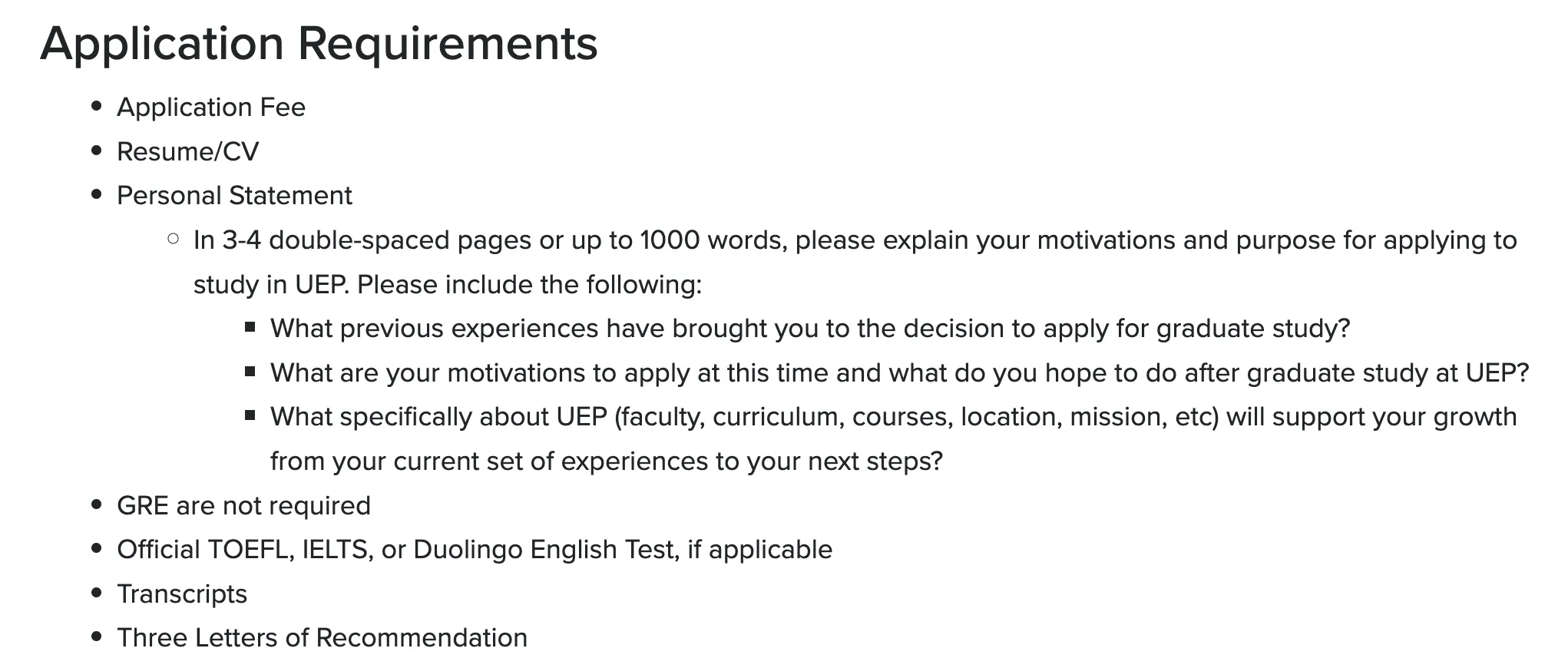
Academic Background: Bachelor’s degree or higher; no specific major required, but coursework in calculus, statistics, or environmental science is recommended. Priority is given to applicants with community service, policy research, or NGO internship experience.
-
Standardized Test Scores:
-
Language: TOEFL ≥85 or IELTS ≥6.5 (some courses require writing sub-score ≥7.0).
-
GRE: Required; recommended Quantitative ≥160.
-
-
Application Materials:
-
Personal Statement (2-4 pages, articulating career goals and environmental justice philosophy).
-
3 Letters of Recommendation (ideally from academic mentors and professional supervisors).
-
Transcripts (WES evaluation required; recommended GPA ≥3.3/4.0).
-
IV. Career Prospects: Intersection of Policy Innovation and the Green Economy
With their combined background in policy and technology, graduates find employment across the public sector, non-profits, and private enterprises:
-
Industry Distribution:
-
Government & Public Agencies: Such as the U.S. Environmental Protection Agency (EPA) and the World Bank, engaging in climate policy formulation or program evaluation.
-
Non-Profit Organizations: Join The Nature Conservancy (TNC), Greenpeace, etc., advancing sustainability initiatives.
-
Private Sector: Enter firms like AECOM or McKinsey as environmental consultants or ESG analysts.
-
-
Typical Positions:
-
Environmental Policy Analyst (average annual salary $85,000), Urban Planner ($78,000), Sustainability Manager ($110,000+).
-
-
Career Support:
-
Tufts Career Center offers resume optimization, mock interviews, and alumni network connections.
-
Boston’s rich industry resources (e.g., Massachusetts Clean Energy Center) facilitate internships and full-time opportunities.
-
Tufts University’s M.S. in Environmental Policy and Planning stands out as a popular choice in the global environmental policy field, thanks to its interdisciplinary curriculum, practice orientation, and high social impact. Whether driving the green transition or deepening community development, the program provides a career springboard that blends theory and hands-on experience.
In the 25fall application season, a CheersYou(清柚教育) student received an offer from this program. To learn about the application timeline and background, as well as more admission cases and graduate school planning issues, you can contact a CheersYou(清柚教育) advisor via the contact information below for detailed inquiries.