
Amid the wave of globalization and digital transformation, Nanyang Technological University (NTU) MSc in Applied Economics has become a hot choice in Asia’s economics field thanks to its dual-engine model of “theoretical depth + technical practice.” Leveraging NTU’s academic reputation as the 26th in the QS World University Rankings, the program focuses on econometrics, financial modeling, and policy analysis, cultivating interdisciplinary talents who can harness big data and AI to solve economic problems. Graduates boast an average starting salary of $105,000, with an employment rate in Singapore exceeding 85%, and international students can tap into Singapore’s premium job resources. Below, we elaborate on the program introduction, curriculum, admission requirements, and career development prospects. For more details and any other questions related to graduate applications, you can scan the QR code below for one-on-one consultation.

1. Program Introduction: Deep Integration of Academia and Industry
The MSc in Applied Economics at NTU is offered by the School of Social Sciences and aims to equip high-caliber professionals for the private sector, public institutions, and research fields through rigorous quantitative training. With core skill modules in econometrics, cost-benefit analysis, and financial modeling, combined with Singapore’s status as a global financial hub, the program creates a “academia-industry-policy” trinity training system.
-
Core Strengths:
-
Flexible and efficient study duration: Full-time 1 year (3 trimesters), completable in as fast as 9 months, with an intensive and practice-oriented curriculum.
-
Friendly to interdisciplinary transitions: Accepts applicants from economics, mathematics, engineering, and more; non-economics backgrounds may take preparatory courses in economics and mathematics.
-
Top research resources: Students can participate in Singapore economic policy research projects; 30% of research outcomes are published in top international journals.
-
High value for money: 2025 tuition fee is S$43,700 (approx. US$32,000), with full and half scholarship opportunities.
-
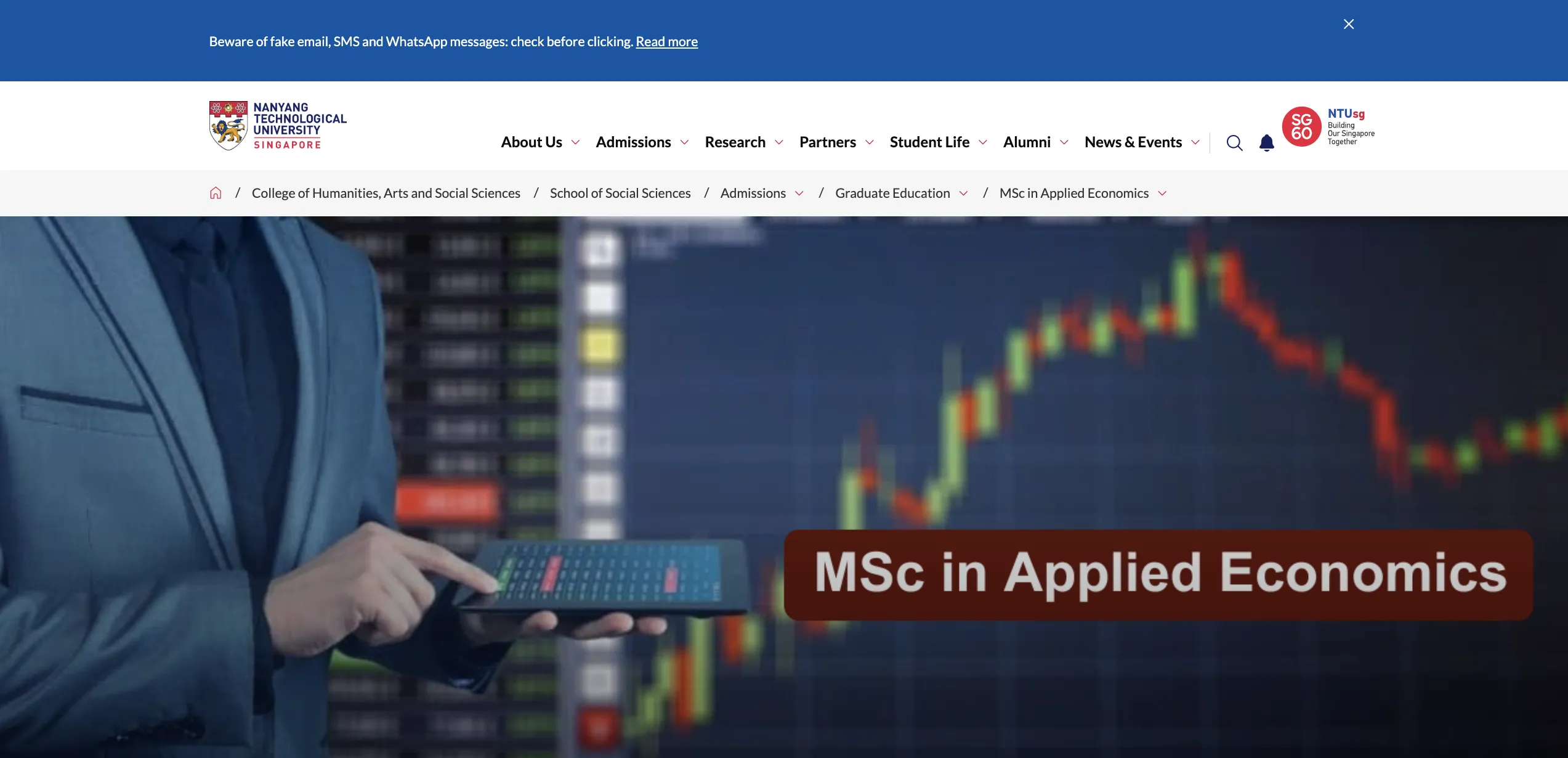
Official Website: https://www.ntu.edu.sg/sss/admissions/graduate-education/msc-in-applied-...
2. Curriculum: Deep Integration of Quantitative Skills and Policy Analysis
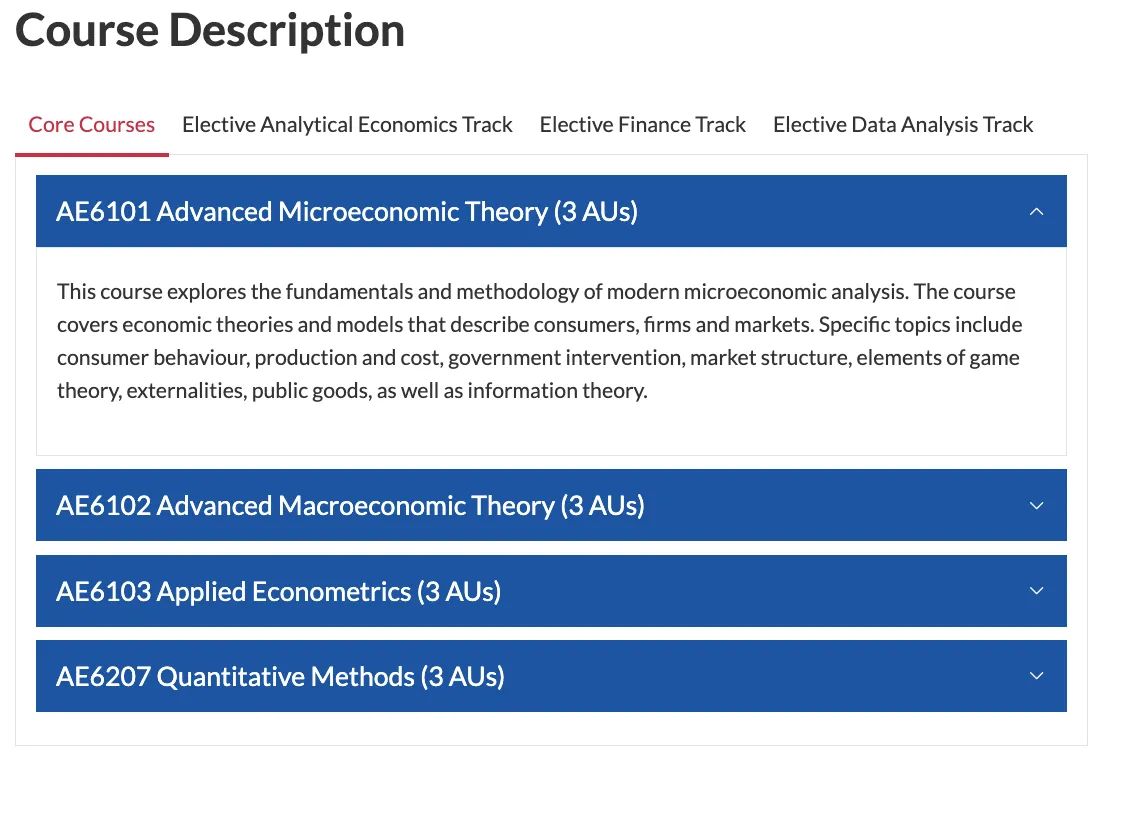
The curriculum consists of core courses, electives, and hands-on projects, covering three main directions: macroeconomic forecasting, financial data analysis, and policy evaluation:
-
Core Courses:
-
Advanced Microeconomic Theory: Analyzes consumer behavior, market structure, and game theory.
-
Applied Econometrics: Masters analysis tools such as panel data and discrete choice models, with hands-on practice in Python/R.
-
Quantitative Methods: Strengthens mathematical foundations like matrix algebra, probability and statistics, and hypothesis testing.
-
-
Elective Tracks:
-
Financial Economics: Focuses on financial econometrics, corporate finance, and portfolio management.
-
Public Policy: Studies cost-benefit analysis, behavioral economics, and energy economics to aid policy formulation.
-
Development Economics: Examines economic growth, labor economics, and international macroeconomic policy.
-
-
Practical Module:
-
Applied Research Project: Collaborates with government or enterprises to produce data analysis reports or policy recommendations.
-
Industry Internship: Recommended placements at the Monetary Authority of Singapore (MAS), DBS Bank, and other institutions to accumulate real-world experience.
-
3. Admission Requirements: Emphasis on Both Academic Potential and Career Orientation
-
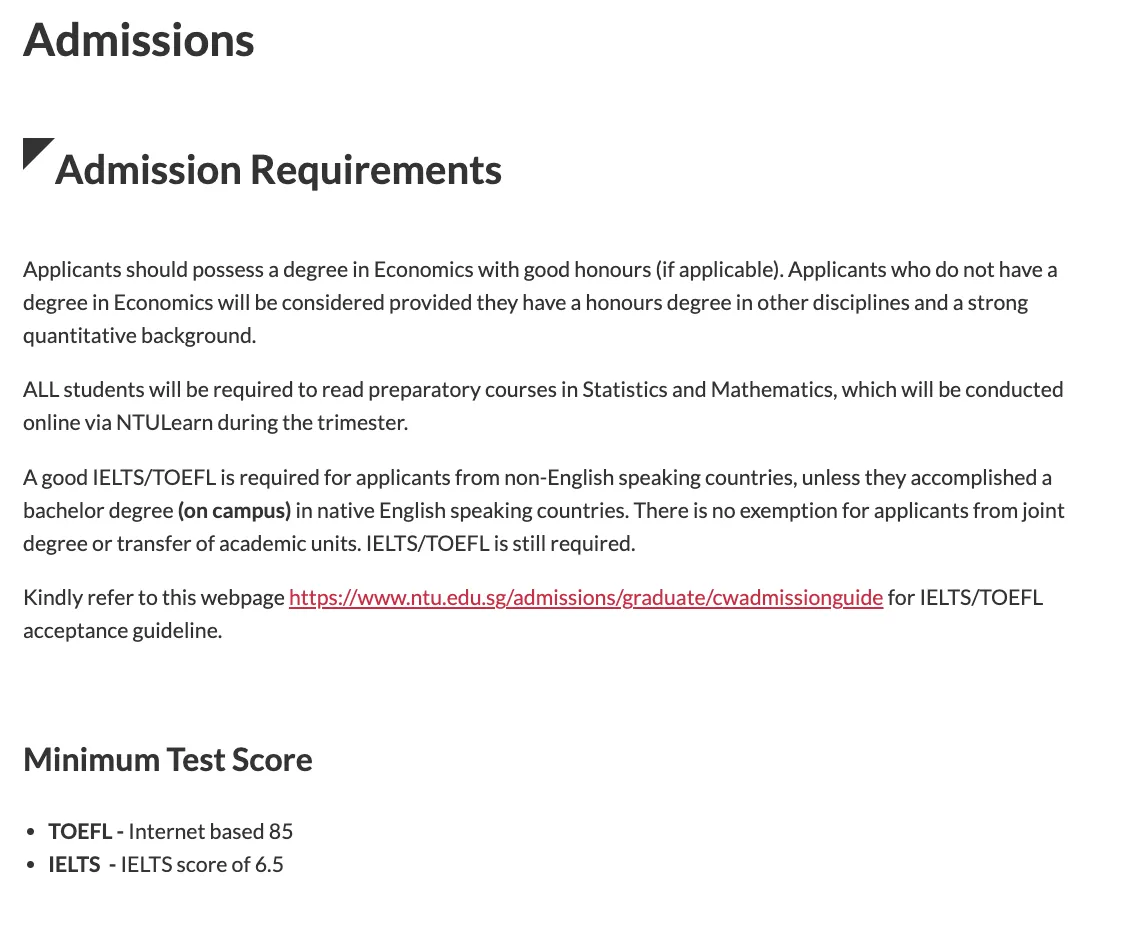
Academic Background: Bachelor’s degree or above, preferably in economics or related fields; non-economics backgrounds require foundations in calculus and statistics and completion of core preliminary courses.
-
Standardized Tests:
-
Language: TOEFL ≥85 (no sectional requirements) or IELTS ≥6.5.
-
GRE: Not mandatory, but a high score can enhance competitiveness (recommended Quantitative ≥160).
-
-
Application Materials:
-
Personal Statement (2-4 pages, must articulate career plans and interest in quantitative analysis).
-
Two Reference Letters (preferably a combination of academic advisor + internship supervisor).
-
Transcripts (WES certification may be required; recommended GPA ≥3.3/4.0)
-
4. Career Development Prospects: Dual-Track Advancement in Policy and Finance
Graduates, with solid quantitative skills and policy insights, find employment across global financial centers and policy institutions:
-
Industry Distribution:
-
Financial Institutions: Goldman Sachs, DBS Bank, etc., in risk management, financial analysis (average annual salary $100,000+).
-
Public Sector: Ministry of Trade and Industry (MTI) Singapore, World Bank, leading economic policy design and evaluation.
-
Consulting and Technology: McKinsey, Grab, etc., as economic consultants or data analysts.
-
-
Career Support:
-
NTU Career Center offers resume optimization, alumni referrals, and industry talks, including the annual Singapore FinTech Festival.
-
International students can apply for Singapore’s Personalised Employment Pass (PEP), granting a 1-year unconditional job-seeking period in Singapore.
-
In the 25fall application season, CheersYou(清柚教育) students also received offers from this program. To learn about application timelines and backgrounds, as well as more admission cases and graduate application issues, you can add the CheersYou(清柚教育) consultant contact below for detailed information.