As the most innovative Ivy League institution, Brown University's Computer Science master's program, with its dual-core model of "academic freedom + practical orientation," serves as an incubator for top global tech talent. Leveraging Brown's prestigious QS World University Rankings reputation, the program integrates cutting-edge fields such as artificial intelligence, cybersecurity, and distributed systems to cultivate versatile professionals with both technical depth and interdisciplinary perspectives. Graduates boast an average starting salary exceeding $120,000, an over 80% U.S. employment rate, and STEM designation ensuring 36 months of OPT, allowing international students to seamlessly access Silicon Valley, Boston, and other tech hubs. In the following sections, we will detail the program introduction, curriculum, admissions requirements, and career prospects.For more details and any questions about graduate applications, scan the QR code below for a one-on-one consultation.

1. Program Introduction: Deep Integration of Academic Freedom and Industry Practice
The Brown Computer Science master's is jointly offered by the School of Engineering and the Department of Computer Science, providing two pathways—Master of Science (MSc) and Cybersecurity (online)—with a focus on balancing academic exploration and career development. The program is renowned for its flexible curriculum, top-tier cross-institutional resources, and high value, consistently ranked among the top 20 computer science programs in the U.S. by U.S. News & World Report.
-
Core Advantages:
-
Highly Customizable Curriculum: Students can choose from three tracks—thesis, project, or coursework-only—to freely align with academic or career goals.
-
Cross-Institutional Resources: Students can take courses at Harvard University and the Rhode Island School of Design (RISD) at no extra cost, building skills in interdisciplinary areas like AI and human-computer interaction.
-
High-Value Tuition: Approximately $60,000 for 2025, with merit-based full scholarship opportunities; admitted students are automatically considered.
-
Industry Partnership Network: Collaborations with government agencies, Google, Microsoft, and other enterprises provide internships and real-world project resources.
-
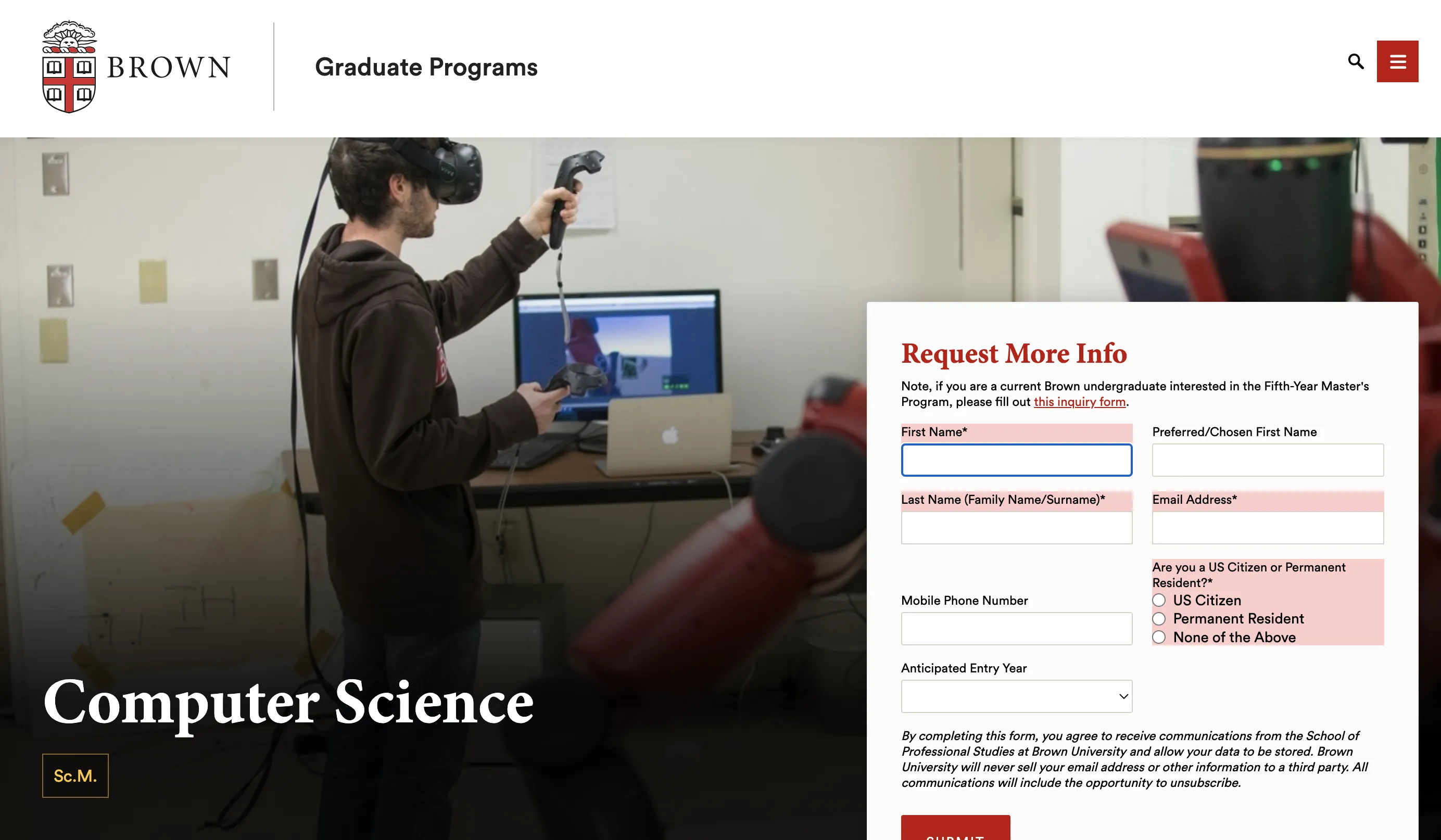
Official website: https://graduateprograms.brown.edu/graduate-program/computer-science-scm
2. Curriculum: Integration of Technical Depth and Innovative Applications
The curriculum is divided into core requirements, elective concentrations, and practical modules, covering seven major areas of computer science with an emphasis on quantitative ability and engineering practice:
-
Core Courses:
-
Algorithms and Data Structures: In-depth analysis of dynamic programming, graph theory, and complexity analysis.
-
AI & Machine Learning: Focus on deep learning, natural language processing, and reinforcement learning applications.
-
Distributed Systems: Study cloud computing, blockchain technology, and fault-tolerant system design.
-
-
Elective Concentrations:
-
Cybersecurity: Covers cryptography, penetration testing, and security policy analysis.
-
Human-Computer Interaction (HCI): Leverage RISD resources to explore user experience design and visualization technology.
-
Computational Biology: Apply algorithms to solve problems in gene sequencing and protein structure prediction.
-
-
Practical Modules:
-
Industry Internship: Recommended entry into partner companies for 6–12 weeks of full-time practice, gaining experience at Silicon Valley or East Coast tech firms.
-
Capstone Project: Work in teams to solve real industrial problems, with outcomes directly usable in job-hunting portfolios.
-
3. Admissions Requirements: Balancing Academic Potential and Diverse Backgrounds
-
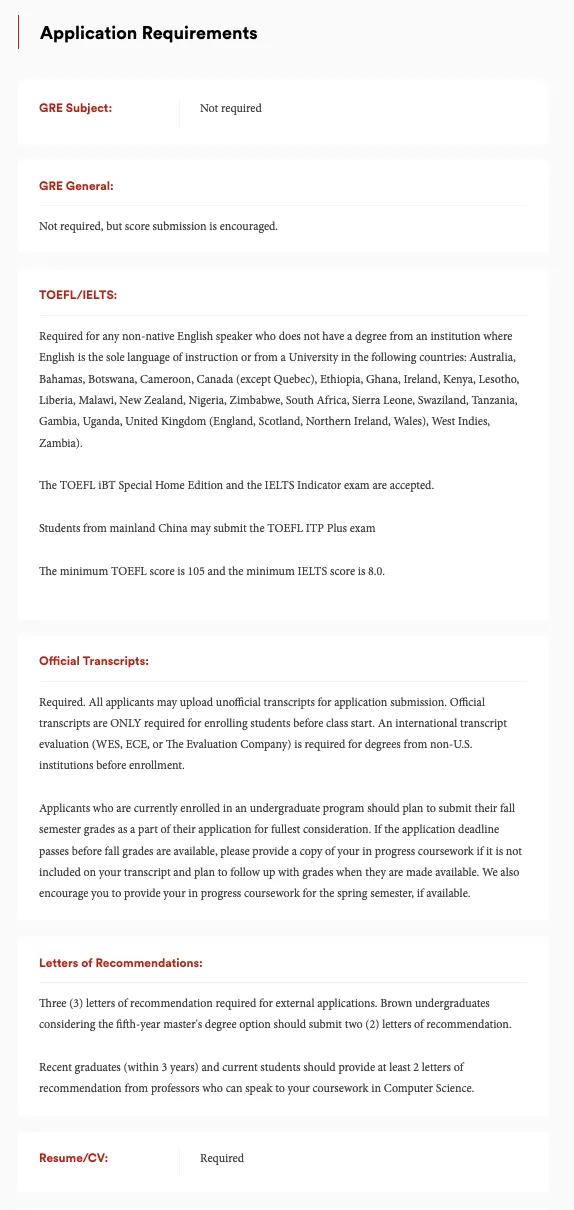
Academic Background: Bachelor's degree or higher, preferably in computer science, mathematics, engineering, or related fields. Prerequisite courses in programming, algorithms, discrete mathematics, and linear algebra are required.
-
Standardized Test Scores:
-
Language: TOEFL ≥105 (with subscores ≥25) or IELTS ≥7.5; Duolingo scores accepted (verify in advance).
-
GRE: Not required but strongly recommended; admitted students typically have a Quantitative average ≥165.
-
-
Application Materials:
-
Personal Statement (2–4 pages, explaining research interests and career goals, highlighting interdisciplinary potential).
-
3 Letters of Recommendation (at least 2 from academic advisors, including ranking of abilities and specific examples).
-
Transcripts (WES evaluation required; recommended GPA ≥3.5/4.0).
-
4. Career Prospects: A Dual Springboard to Tech Giants and Academia
Graduates, with their solid technical foundation and Ivy League prestige, are highly competitive in the U.S. job market:
-
Industry Distribution:
-
Tech Giants: Google, Microsoft, Amazon, etc., in roles such as Software Engineer or Machine Learning Engineer (average annual salary $130,000+).
-
Financial Technology: Goldman Sachs, Morgan Stanley, etc., leading quantitative trading system development.
-
Academia & Research: Around 25% of graduates pursue PhDs at top institutions like MIT and Stanford.
-
-
Career Support:
-
Career Services: Resume polishing, mock interviews, and alumni referrals; on average 30+ tech company recruiting events per year.
-
Alumni Network: Spanning tech hubs like Silicon Valley and New York; over 40% of graduates are promoted to management roles within 3 years of employment.
-
Brown University's Computer Science master's program, with its free academic atmosphere, top-notch interdisciplinary resources, and high career returns, is an ideal choice for tech elites. Whether aiming for R&D positions at tech giants or diving into academic innovation, Brown will pave your global career path.
In the 25fall application season, CheersYou(清柚教育) students have also received offers from this program. To learn about application timelines and backgrounds, more admission cases, or other graduate study-related questions, feel free to add the CheersYou(清柚教育) advisor's contact below for detailed information.