Cornell University, a globally renowned Ivy League member, not only maintains top academic standing in traditional disciplines but also demonstrates exceptional influence in the emerging cross-disciplinary frontier of biostatistics and data science. The MS in Biostatistics and Data Science (BDS) program at Weill Cornell Medicine (WCM) of Cornell University is precisely established to meet the developmental demands of today's health era. Below, we will elaborate on the BDS program from four aspects: program introduction, curriculum design, application requirements, and career development prospects. For detailed information and more questions about graduate applications, you can also scan the QR code below for one-on-one consultation.

I. Program Introduction
The MS in Biostatistics and Data Science (BDS) program at Cornell University is housed in the Department of Population Health Sciences at Weill Cornell Medicine (WCM). This program focuses on equipping students with theoretical knowledge in biostatistics and cutting-edge data science techniques to analyze complex biomedical and health data.
Program Features
- Duration and Credits: Full-time students typically complete the program in 16 months, requiring 36 credits.
- Small Class Sizes: Maintains a low student-faculty ratio, providing a personalized learning experience and continuous mentorship.
- Practice-Oriented: A capstone project runs throughout the entire learning process, allowing students to address real-world problems.
- Geographical Advantage: Located on the Upper East Side of Manhattan, New York City, adjacent to top-tier medical institutions and the biopharmaceutical industry cluster.
- Interdisciplinary Connections: Fosters close ties with multiple departments and campuses of Cornell University, promoting resource sharing.
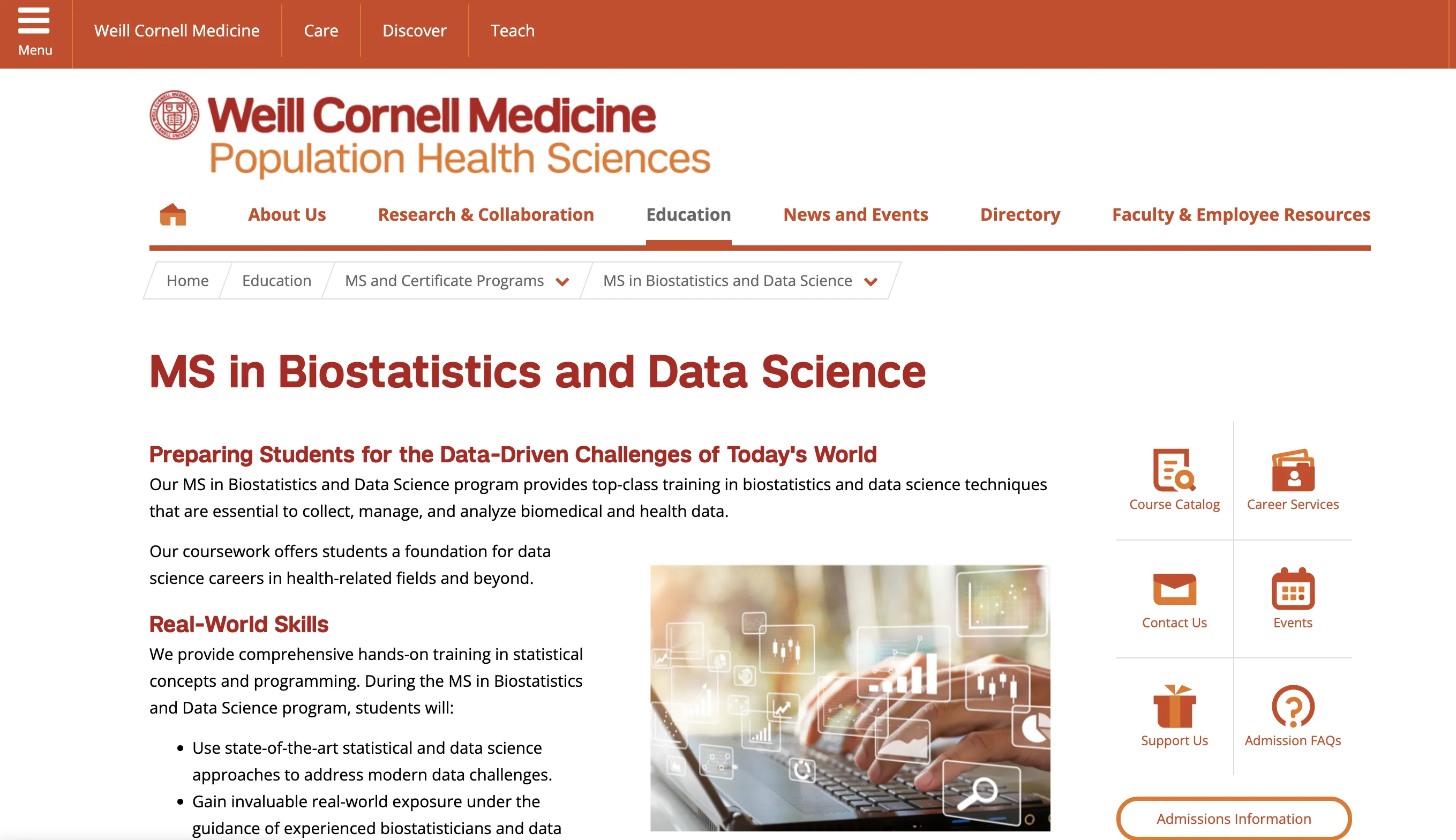
Official Website: https://phs.weill.cornell.edu/graduate-education-clinical-training/maste...
II. Curriculum Design
The curriculum is designed to balance theoretical foundations and practical skills, arranged progressively by semester. The structure mainly comprises core required courses, diverse elective courses, and the capstone project that spans the entire program.
Core Courses
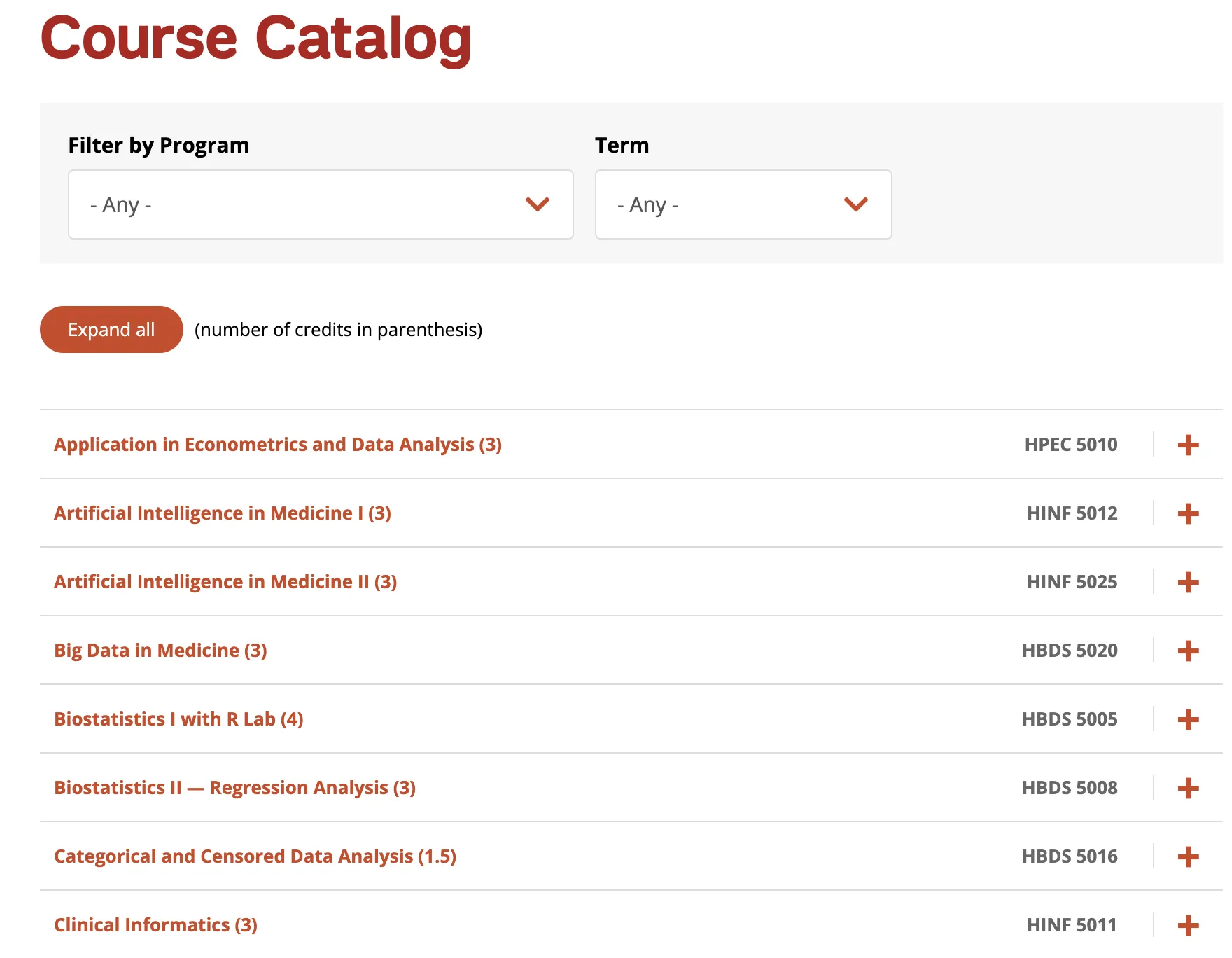
- Biostatistics Courses: Biostatistics I with R Lab, Biostatistics II - Regression Analysis, Categorical and Censored Data Analysis
- Study Design Courses: Study Design, Hierarchical Modeling & Longitudinal Data Analysis
- Data Science Courses: Data Science I (R and Python), Data Science II – Statistical Learning
- Capstone Project: Master's Project series (HCPR 9010, 9020, 9030)
Elective Courses
Students can choose from a diverse range of elective courses based on personal interests and career goals, including:
- Statistical Programming with SAS
- Intro to Health Services Research
- Data Management (SQL)
- Big Data in Medicine
- Artificial Intelligence in Medicine
- Pharmaceutical Statistics
Course Characteristics
- Emphasizes both theory and programming, using professional tools like R, Python, and SAS.
- The capstone project that runs throughout is the core of the curriculum, emphasizing real-world problem-solving.
- Offers electives in multiple directions such as big data, artificial intelligence, and health services research.
III. Application Requirements
- Academic Background: A bachelor's degree from an accredited institution of higher education; ideal majors include statistics, mathematics, applied mathematics, physics, computer science, or related engineering disciplines.
- Core Competencies:
- Strong quantitative reasoning ability (demonstrated through excellent math/statistics coursework or high GRE quantitative scores).
- Computer programming skills (experience with at least one programming language such as R, Java, Python, or SAS).
- Admitted students without R experience must complete an R preparatory course before enrollment.
- Bonus Points: Coursework or work experience in healthcare or biomedical fields.
Application Materials
- Online application form
- Official transcripts
- Personal statement
- Resume/CV
- 2-3 letters of recommendation
- International students may need to submit proof of language proficiency.
Application Timeline
Using Fall 2025 admission as an example (please refer to the latest official website information):
- Early Decision Application Deadline: December 1, 2024
- Scholarship Consideration Deadline: February 1, 2025
- Final Application Deadline: May 15, 2025
IV. Career Development Prospects
Primary Employment Sectors
- Biopharmaceutical Industry: Pharmaceutical companies, biotechnology firms.
- Healthcare Services: Hospitals, medical groups, public health agencies.
- Health Insurance Industry: Risk assessment, actuarial analysis, healthcare cost control.
- Academic and Research Institutions: Universities, medical schools, research centers.
- Health Tech Companies: AI diagnostic tools, wearable health device data analysis.
- Government Health Departments: CDC, FDA, and similar agencies.
Typical Career Roles
- Biostatistician
- Data Scientist (healthcare, pharmaceutical sectors)
- Statistical Analyst/Programmer
- Clinical Data Analyst/Manager
- Health Informatics Analyst
- Machine Learning Engineer (health sector)
In the Fall 2025 application season, students of CheersYou(清柚教育) also received offers from this program. To learn about application timelines and backgrounds, as well as more case studies and graduate application-related questions, you can also add the contact information of CheersYou(清柚教育) advisors below for detailed information.