
In the era of public health, medical research, and big data, biostatistics plays a central role. The MS in Biostatistics program at Harvard T.H. Chan School of Public Health is globally renowned for its outstanding academic reputation. Established in 1922, the Department of Biostatistics at Harvard has been dedicated to solving major challenges in public health and biomedical research through innovative statistical methods. The following provides a detailed overview of four aspects: program introduction, curriculum, application requirements, and career development prospects. For more details and application-related questions, scan the QR code below for a one-on-one consultation.

1. Program Introduction
The Harvard MS in Biostatistics program is housed within the Department of Biostatistics at T.H. Chan School of Public Health. The department maintains close collaborations with top medical and research institutions such as Harvard Medical School, Dana-Farber Cancer Institute, and Massachusetts General Hospital. The core training goal is to provide students with rigorous training in biostatistics, bioinformatics, and data science methodologies, equipping them for quantitative research roles in biomedical and health sciences.
Different Tracks and Training Directions
Harvard offers three biostatistics master's programs with different credit requirements and durations to meet the needs of students with diverse backgrounds, experiences, and career goals:
- SM42.5 (42.5 credits, typically 1-year full-time): Designed for seasoned professionals who already hold a master's or doctoral degree and have established expertise in their field, aiming to strengthen quantitative research skills.
- SM60 (60 credits, typically 1.5-year full-time): Aimed at students with an undergraduate degree in mathematical sciences or computer science and a strong interest in health sciences. The goal is to prepare graduates for applied research positions in hospitals, research institutions, pharmaceuticals, and biotech.
- SM80 (80 credits, typically 2-year full-time): Provides comprehensive skills training, ideal for those planning to pursue a PhD or seeking more in-depth preparation for advanced research positions.
Core Advantages and Resources
- Top-tier Faculty: The program boasts over seventy active faculty members who are leading scientists in their respective research fields.
- Abundant Research Opportunities: A close collaborative network with world-class medical and research institutions offers numerous opportunities to participate in cutting-edge research projects.
- Prime Location: The Boston area is a globally renowned center for biomedical and research innovation, providing incomparable advantages for internships and employment.
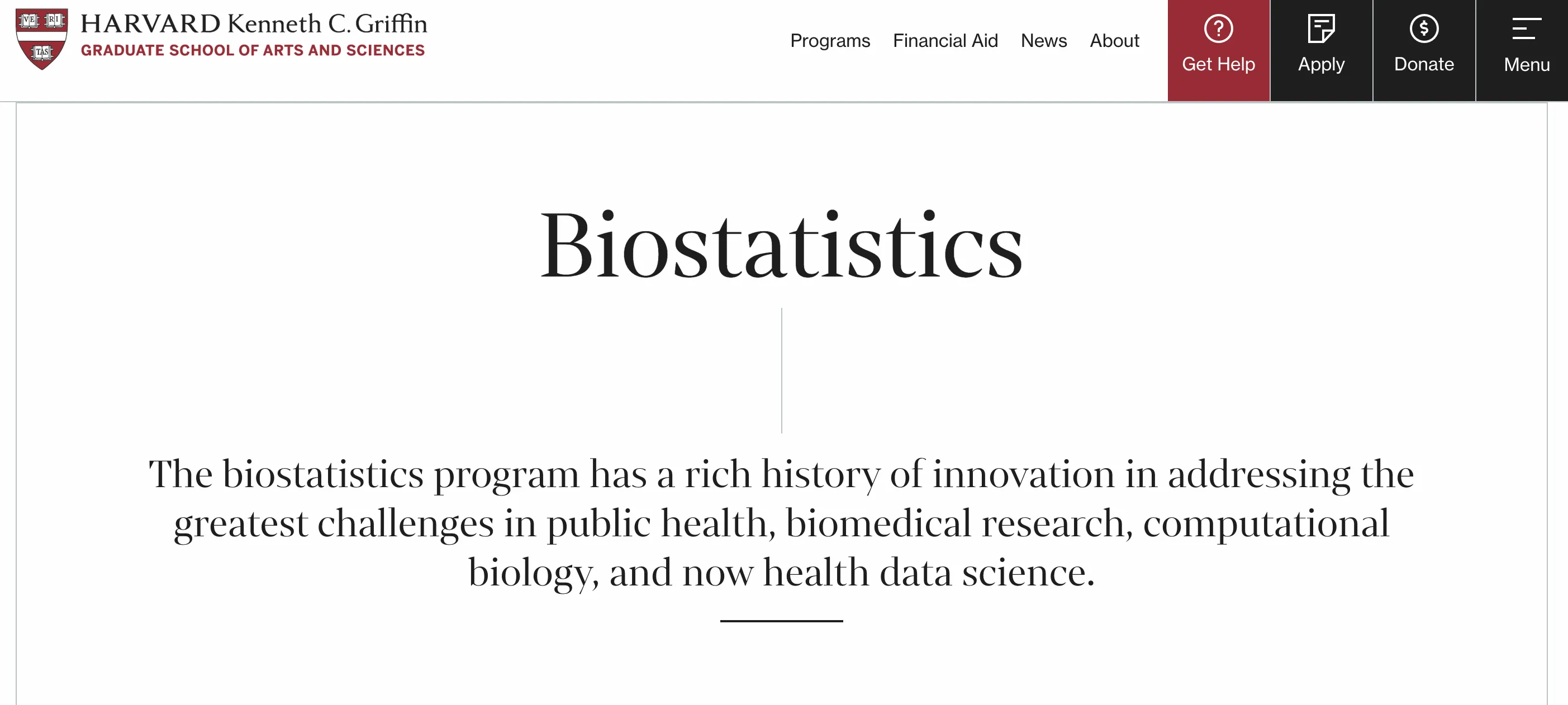
Official Website: https://gsas.harvard.edu/program/biostatistics
2. Curriculum
Core Competency Development
The biostatistics program aims to cultivate five core competencies in students:
- Methodological Innovation and Application: Develop new biostatistical methods to address complex public health problems.
- Leadership and Collaborative Design: Provide professional guidance in study design, execution, and analysis.
- Computational and Data Analysis Skills: Apply modern computational methods to analyze complex medical data.
- Interdisciplinary Communication and Collaboration: Work effectively with researchers from diverse disciplinary backgrounds.
- Teaching and Knowledge Dissemination: Effectively teach biostatistics or complete high-quality applied research.
Curriculum Structure and Requirements
SM80 (80 credits) main course requirements:
- Required Core Courses (20 credits): Includes applied regression analysis, fundamentals of statistical inference, survival analysis, longitudinal data analysis, etc.
- Biostatistics MS Core Electives (at least 35 credits): Chosen from the two-year biostatistics MS core course list, including clinical trial principles, Bayesian analysis, statistical genetics, etc.
- Free Electives: Remaining credits can be chosen from areas of interest such as biological sciences, environmental health, etc.
SM60 (60 credits) main course requirements:
- Required Core Courses (20 credits): Same as the SM80 program.
- Mid to Advanced Biostatistics Electives (at least 15 credits): At least 10 credits should have the BST prefix.
- Remaining Credits (up to 20 credits): Mainly used for thesis-related research.
Research, Practice, and Graduation Requirements
- SM80 & SM42.5: Must complete a "Culminating Experience Project."
- SM60: Must complete a master's thesis and pass an oral defense; the thesis is typically based on work during a collaborative research internship.
- General Requirements: All students must meet a cumulative GPA ≥ 2.70, and requirements in research ethics, epidemiology, and public health practice.
3. Application Requirements
Degree and Academic Background Requirements
- SM80: Applicants must hold a bachelor's degree, with a strong background in quantitative disciplines recommended.
- SM60: Typically requires an undergraduate degree in mathematical sciences or computer science, with a keen interest in health sciences.
- SM42.5: Primarily intended for professionals who have achieved significant accomplishments in research, usually holding a doctoral degree.
Standardized Test Requirements
- GRE General Test: All three SM programs require GRE scores, with particular emphasis on the quantitative reasoning section.
- English Language Proficiency: Non-native English speakers whose previous degree was not conducted entirely in English must submit TOEFL iBT or IELTS Academic scores.
Core Application Materials
- SOPHAS online application
- Official transcripts from all post-secondary institutions
- Three letters of recommendation
- Statement of purpose
- Résumé/CV
- GRE scores and English language proficiency proof (if applicable)
Application Process and Deadlines
All application materials must be submitted through SOPHAS, and the application deadline is usually December 1 each year. Admission decisions are typically released between late February and early March of the following year. Applicants may only apply to one degree program per application cycle.
Key Points: Application Material Preparation
When applying to the Harvard MS in Biostatistics program, in addition to excellent academic records and GRE scores, a strong personal statement, compelling letters of recommendation, and a resume demonstrating quantitative research abilities are crucial.
4. Career Development Prospects
Major Employment Fields
Graduates are widely distributed across academia, industry, government, and nonprofit sectors:
- Academia and Research Institutions: Top universities, medical schools, schools of public health, and specialized research institutes.
- Industry: Pharmaceutical companies, biotech firms, medical device companies, contract research organizations, etc.
- Government and Nonprofit Organizations: CDC, FDA, WHO, and other public health agencies.
- Technology and Consulting Industries: Health technology companies, data science consulting firms, insurance industry, etc.
Typical Job Positions
- Biostatistician: Responsible for clinical trial design, observational study analysis, statistical model construction.
- Data Scientist / Health Data Analyst: Analyze large-scale health and medical data.
- Researcher / Research Scientist: Engage in methodological innovation or applied research.
- Epidemiologist: Study disease distribution, influencing factors, and prevention strategies.
- Statistical Programmer: Use SAS, R, Python, etc., for data analysis.
In the 25fall application season, CheersYou(清柚教育) students also received offers for this program. To learn about application timelines and backgrounds, as well as more admission cases and study-abroad application questions, add the contact information of the CheersYou(清柚教育) advisor below.