The MSc Counselling Studies program at the University of Edinburgh, offered by the School of Health in Social Science, is an interdisciplinary master's degree that situates counselling practice within the context of social science research. The program aims to provide students with advanced academic study of counselling and psychotherapy practice and theory, with a particular emphasis on non-directive, relationally-oriented approaches, primarily psychodynamic and person-centred frameworks. The curriculum encourages students to connect theoretical learning with real-world issues and to critically reflect on counselling practice and theory within both professional and personal contexts. Below, we provide a detailed overview of the program introduction, curriculum, application requirements, and career prospects. For further details and one-on-one consultation on graduate applications, scan the QR code below.

1. Program Introduction
The MSc Counselling Studies program offers a one-year full-time or two-year part-time study mode. The curriculum includes advanced academic study of counselling and related practices, aiming to foster professional development through critical reflection. Closely aligned with professional training in counselling, the program provides students from diverse backgrounds with a critical perspective on counselling and related practices. It emphasizes the positioning of counselling practice within social science research, featuring strong connections to professional counselling training and social science research related to counselling and society.
Please note: this program does not lead to a professional qualification in counselling or psychotherapy. If you are interested in obtaining a professional qualification in counselling or psychotherapy, please refer to the University of Edinburgh's other professionally accredited programs, such as the Postgraduate Diploma in Counselling, MSc Counselling, MSc Counselling (Interpersonal Dialogue), and Doctorate in Psychotherapy and Counselling.
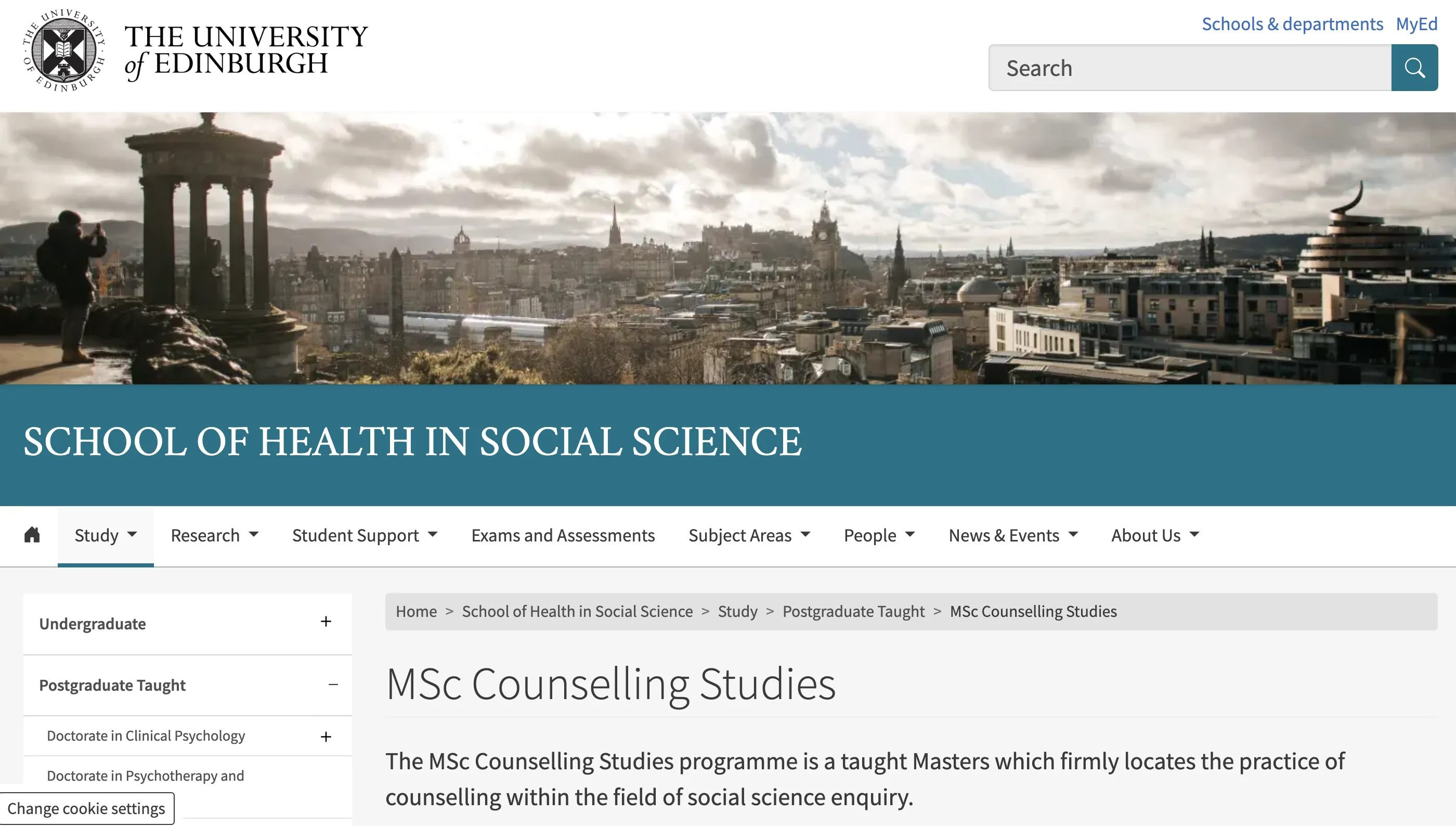
Official website: https://health.ed.ac.uk/study/postgraduate-taught/msc-counselling-studies
2. Curriculum
The program's curriculum includes the following core modules and a research project:
-
Understanding Affective Disorders (30 credits): Introduces the definition, classification, and assessment methods of affective disorders.
-
Causes and Correlates of Affective Disorders (30 credits): Explores the biological, psychological, and sociological factors contributing to affective disorders.
-
Challenges in Treating Affective Disorders (30 credits): Analyzes the limitations of current treatments and future directions.
-
Research Methods & Statistics for Studying Affective Disorders (30 credits): Teaches research design, data analysis, and statistical methods.
-
Research Project on Affective Disorders (60 credits): Under the guidance of a supervisor, students independently complete a research project related to affective disorders, building research skills.
Teaching methods include lectures, theoretical seminars, and independent study. Assessment is through essays and a research project. The postgraduate certificate element involves experiential group work, practice skills workshops, and individual tutorials, supplemented by self- and peer-assessment and portfolio work, complementing essay-based assessment. The program offers a high level of student-tutor contact and close supervision of listening practice and research, meeting both professional and academic requirements.
3. Admission Requirements
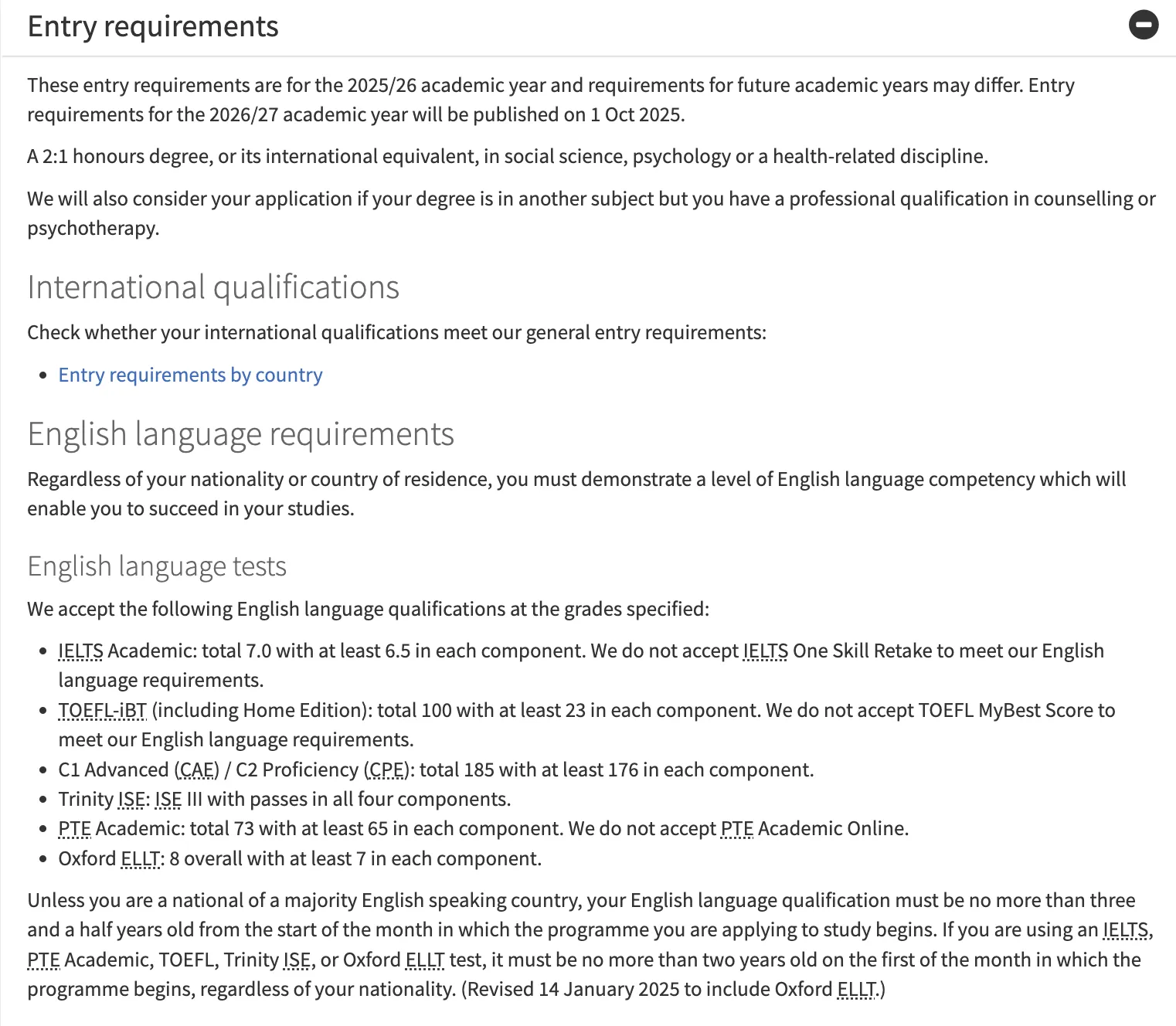
Academic Requirements
-
A UK 2:1 honours degree, or its international equivalent;
-
Or a UK 2:2 honours degree, accompanied by a strong personal statement, relevant experience, and/or references demonstrating your ability to study at postgraduate level.
Applicants should demonstrate a high level of motivation through their personal statement, explaining why they wish to study counselling, and demonstrating an understanding of counselling as well as the ability to reflect on their work in this field. Those with professional qualifications equivalent to an honours degree may also be considered.
English Language Requirements
Non-native English speakers must provide evidence of English language proficiency as follows:
-
IELTS: overall 6.5, with no sub-score below 6.0;
-
TOEFL-iBT (including Home Edition): overall 92, with no sub-score below 20;
-
PTE Academic: overall 62, with no sub-score below 59.
Please note that English language qualifications are normally valid for two years before the start of the program.
4. Career Prospects
Career Prospects
Graduates of the MSc Counselling Studies program can pursue opportunities in the following areas:
-
Education: Working in schools, universities, or educational institutions providing mental health education and support;
-
Policy development: Participating in the research and formulation of mental health-related policies;
-
Health and illness research and development: Conducting research on mental health and illness in healthcare institutions or research centres;
-
Emotional well-being and wellness: Providing emotional support and counselling services in community organizations, NGOs, or private settings;
-
Counselling: Engaging in counselling practice after obtaining relevant professional qualifications.
In addition, the degree enhances the career prospects of already qualified counsellors and practitioners. Many graduates use the MSc Counselling Studies as a foundation for further professional therapy training in the UK or overseas.
According to the UK Department for Education's Longitudinal Education Outcomes (LEO) data, MSc Counselling Studies graduates have an average salary of £27,500 within 15 months of course completion, a 5% unemployment rate, a 76% student satisfaction rate, and a 0% dropout rate.
In the 25fall application cycle, CheersYou(清柚教育) students have received offers for this program. If you’d like to learn more about application timelines and backgrounds, additional admission cases, or other graduate application questions, please add the contact information of the CheersYou(清柚教育) advisor below for more details.