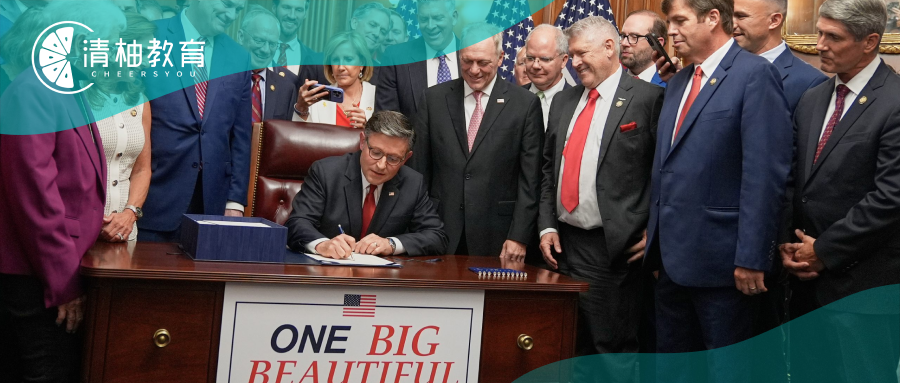
Last Friday, the U.S. "One Big Beautiful Bill" Act officially went into effect.
This 870-page bill almost completely reshapes the U.S. fiscal structure, impacts all sectors, and also affects every international student studying, working, and living in the U.S.
Source: whitehouse
Just after the bill's passage, Elon Musk posted multiple tweets mocking Trump for being "self-contradictory" and announced the formation of the "American Party," openly distancing himself from the Big and Beautiful route.
Source: CNN
On the surface, the "One Big Beautiful Bill" focuses on corporate tax reform and national fiscal restructuring, but in reality, it also deeply changes the funding flows and policy direction of the higher education and immigration systems:
-
Permanently sets the corporate tax rate at 21%, favoring technology, energy, and manufacturing sectors
-
Cuts federal medical and education spending
-
Eliminates subsidies for electric vehicles and clean energy, increases support for traditional energy
-
Raises the endowment tax rate on wealthy private universities, directly affecting scholarship and operational strategies of elite schools
-
Introduces a non-citizen remittance tax and visa fees, increasing immigration costs
This fiscal reform bill, pushed by the Trump administration and strongly opposed by Musk, will also bring certain impacts to international students, including reduced education subsidies, rising study costs, and higher visa costs.
International Students Face Multiple Challenges
Scholarship Cuts at Elite Universities
The "One Big Beautiful Bill" increases the endowment tax rate on universities with per-student endowments exceeding $500,000 from the previously symbolic 1.4% to as high as 8%, making it one of the most aggressive "financial clawback" policies against elite universities in recent years.
Source: insidehighered
This change most directly affects Ivy League schools like Harvard, Yale, Princeton, as well as private universities with large endowments such as Stanford and MIT.
Source: statista
Since endowment returns have always been an important source for these universities to pay student financial aid, faculty salaries, and research operations, the new tax regime will force them to reallocate resources. University scholarships and traditional humanities and social sciences are likely to become the first spending items to be cut.
At the same time, the bill also compresses federal subsidies within state education budgets, making things worse for already financially strained state university systems. Several university presidents openly admitted in interviews that they will be forced to make difficult trade-offs.
Source: CNBC
Some analyses point out that these policies may further intensify the "elitist" trend in the U.S. higher education system—meaning high-quality resources become even more concentrated among top students and popular majors, while students in humanities and social sciences, who tend to have lower post-graduation incomes and weaker repayment capacity, will find it more difficult to obtain student loans.
Students in high-tuition programs like medicine and law face even greater pressure. The bill's new provisions cap loans at $200,000 for medical and law students. These students, who already rely heavily on loans, will face financial difficulties and may even have to abandon their studies due to insufficient funds, making it harder to become doctors or lawyers in the future.
Source: NBC News
Study Costs Keep Climbing
Currently, the total annual cost at top U.S. private universities generally ranges from $90,000 to $100,000. With tax pass-through and subsidy cuts, $100,000 in annual tuition is likely to become the new normal.
Source: edsource
Tax increases + subsidy cuts = costs passed on to students.
The "One Big Beautiful Bill" raises the tax rate on large university endowments, forcing private schools that rely on endowment income to sustain their scholarship systems to readjust their budget structures. Some universities have already begun seriously considering measures such as "reducing financial aid" and "cutting program offerings," with annual tuition growth rates potentially breaking past the previous 3–5% benchmark.
At the same time, as federal funding for state higher education declines, many state universities are forced to increase tuition for out-of-state and international students to maintain operations.
Source: Forbes
For study-abroad families, apart from hard tuition hikes, an increasing number of new "institutional fees" are quietly adding up on the bill:
-
1% cross-border remittance tax: Applies to all non-citizen statuses (such as F-1, OPT, H-1B, L-1, etc.). Parents sending $50,000 in tuition annually will pay at least an additional $500.
-
$250 Visa Integrity Fee: All nonimmigrant visa applicants (e.g., F-1, J-1, H-1B) must pay this fee, with no exemptions.
-
$24 I-94 Form Fee: Applies to all foreign nationals required to generate an I-94 arrival/departure record, updated annually for inflation.
-
$30 EVUS Enrollment Fee: Applies to Chinese citizens holding B-1/B-2 visas, with no possibility of waiving this fee.
Source: paymentsdive
"Studying abroad is getting more expensive" is not an illusion—it is a reality brought by structural inflation and policy restructuring.
Immigration Enforcement Strengthens
The "One Big Beautiful Bill" also significantly increases investment in immigration enforcement, making ICE the highest-funded law enforcement agency in the nation:
-
$45 billion for expanding detention facilities, aiming to increase nationwide detention beds to nearly 100,000
-
$14 billion for transportation and logistical support for immigrant removals
-
$8 billion to hire 10,000 new immigration enforcement officers
Source: immigrationforum
Trump seeks to significantly increase arrests and deportations of illegal immigrants, and these appropriations come against that backdrop. In just a few months of his administration, ICE arrests have already increased by 25%.
At the same time, immigration costs are rising. The green card application fee has been raised to $1,500, and new fees have been added for immigration court appeals, starting at $900.
Going forward, U.S. immigration policy is expected to maintain a tough stance, with immigration costs likely to continue increasing.
There Is More Than One Path for Studying Abroad
Over the past two years, more and more families have begun to weigh "cost-effectiveness" and "suitability" when making study-abroad decisions.
Some choose Singapore or Hong Kong to avoid high tuition in the U.S. and UK and visa uncertainties; some apply globally, targeting Ivy League schools while also considering backup plans in Canada or Europe; others clearly aim for employment or immigration, choosing countries with more convenient pathways.
The broader environment has changed, but studying abroad has never been about blindly diving in—it’s about finding the path that suits you best.
Under the "One Big Beautiful Bill," electric vehicles, AI, education, visas, and more are all affected, with a national-level interest game behind it all.
But for us international students, more important than policy trends is this: are you already proactively planning for your own future?
Don’t panic, and don’t just coast along.
Whether you remain in the U.S. or consider other options, the premise is that you have a deep enough understanding of your own strengths, path, and pace—that is the true meaning of studying abroad.