As generative AI, large language models, machine learning, and other technologies rapidly penetrate fields such as finance, healthcare, business, and media, corporate demand for AI talent is shifting from simply "knowing how to build models" to seeking individuals who possess a solid foundation in AI technology and can effectively apply AI to specific industries.
In 2026, Columbia University's Fu Foundation School of Engineering and Applied Science (Columbia Engineering) officially launched the new:
Master of Science in Artificial Intelligence (MSAI)
Master of Science in Artificial Intelligence Program
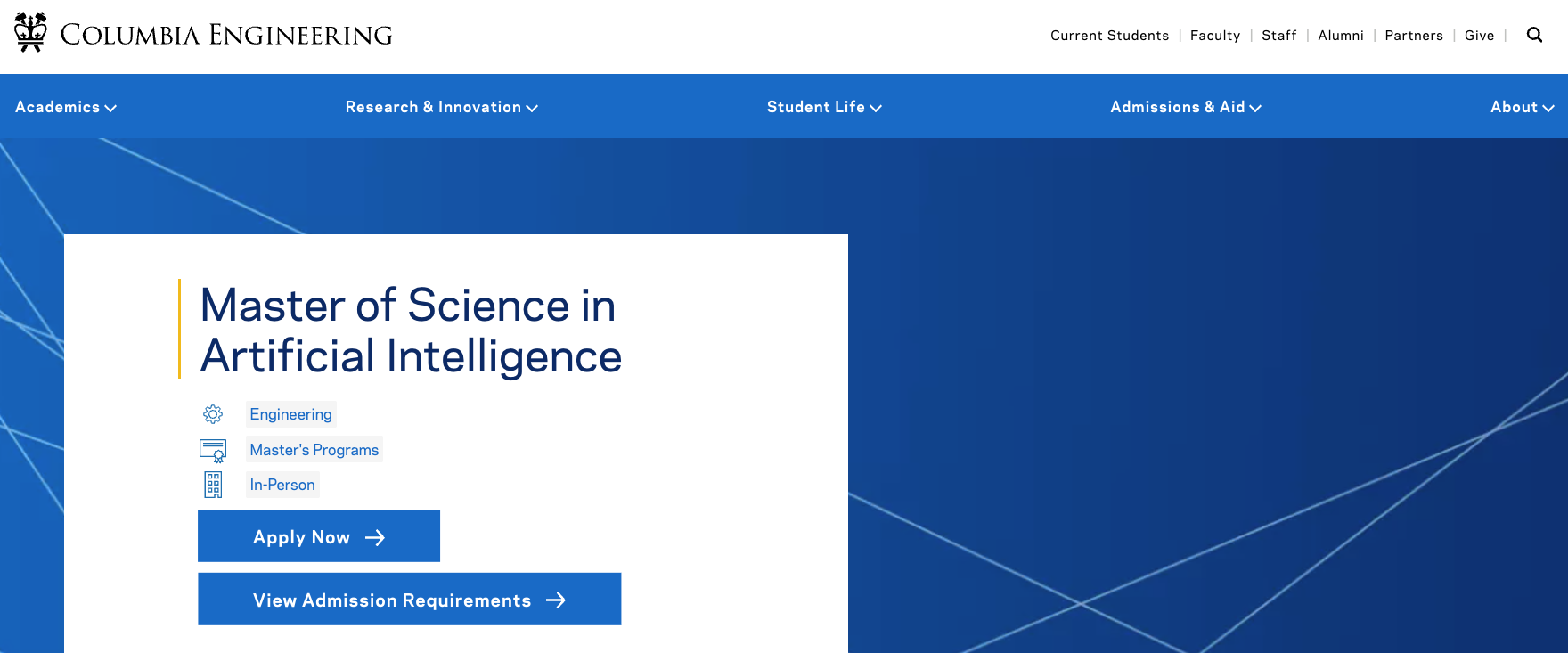
The program welcomed its inaugural class in Fall 2026. Built upon core AI courses in Computer Science and Engineering, it offers multiple specializations covering computation, robotics, finance, biomedicine, healthcare, public health, arts and media, architecture, and more.
In other words, Columbia's AI Master's program is not merely a combination of courses like Machine Learning, NLP, and Computer Vision. Instead, it aims to create an interdisciplinary training model that integrates core AI capabilities with industry-specific expertise.
For students preparing to apply for Master's programs in AI, Computer Science, Data Science, and other AI-related interdisciplinary fields, this newly launched program at Columbia deserves close attention.
CheersYou (清柚教育) x Columbia University Artificial Intelligence Successful Admission Case
| CheersYou x Columbia University Artificial Intelligence Admission Case | |
| Undergraduate Institution | New York University |
| Undergraduate Major | Computer Science |
| GPA | 3.8+ |
| GRE/GMAT | GRE 325+ |
| Admitted Program | Columbia University - Master of Science in Artificial Intelligence |
| Admission Term | 2026 Fall |

Introduction to Columbia University's Artificial Intelligence Master's Program
| Program Name | Master of Science in Artificial Intelligence (MSAI) |
| School | Columbia Engineering |
| Degree Type | Master of Science |
| Program Duration | Typically 3 semesters |
| Credit Requirements | 30 credits |
| Program Classification | STEM Program |
| Campus | New York City |
Columbia's MSAI is a full-time, on-campus, STEM-designated 30-credit Master's program.
Students enter in the Fall semester and can complete degree requirements by May, August, or December of the following year. The standard curriculum plan provided on the official website spans three semesters, so the program can generally be understood as having a three-semester framework.
As AI continues to be applied across various fields, Columbia aims to cultivate talents who possess both a solid foundation in AI and the ability to apply AI to specific professional domains. Therefore, the MSAI is not limited to a single technical direction. Instead, it combines core AI courses with different Concentrations, allowing students to pursue interdisciplinary studies based on their backgrounds and career goals.
Upon completion, students will receive a Master of Science in Artificial Intelligence degree, and their chosen Concentration will be noted on their Transcript / Diploma.
In other words, these Concentrations are not merely a few elective courses chosen by students on their own, but rather formal specializations integrated into the program's curriculum system.
Curriculum: What Do You Actually Study in Columbia's AI Master's Program?
The Columbia MSAI master's program requires the completion of 30 credits.
AI Core: 12 credits, Concentration: 12 credits, and the remaining 6 credits:
Students can choose from the following three options:
- General Electives
- Two-semester Interdisciplinary Capstone
- AI Research supervised by Columbia Engineering Faculty
In addition, all students are required to complete ENGI E4000 Professional Development and Leadership as a graduation requirement.
Four Core AI Modules
According to the three-semester course plan provided on the official website, all students first need to establish a unified foundation in AI.
Category 1: Artificial Intelligence
Students must choose one course from the following:
- COMS W4701 Artificial Intelligence
- IEOR E4010 Artificial Intelligence for Operations Research and Financial Engineering
The second course aligns more closely with the course direction of the Finance / Operations Concentration.
Category 2: Machine Learning
Students need to select one Machine Learning course:
- COMS W4771 Machine Learning
- IEOR E4525 Machine Learning for OR & FE
- ELEN E4720 Machine Learning for Signals, Information, and Data
For students who already have experience in Machine Learning, the program also allows fulfilling this requirement with certain advanced courses, including:
- Deep Learning in Biomedical Signal Processing
- Neural Networks and Deep Learning
- Deep Learning for Operations Research and Financial Engineering, etc.
This means that students do not necessarily need to start from the same foundational ML course.
If you already have a solid foundation in Machine Learning, you can proceed to more advanced Deep Learning courses based on your academic background and professional interests.
Category 3: NLP / Computer Vision
Students also need to choose one course related to Natural Language Processing or Computer Vision:
- COMS W4705 Natural Language Processing
- COMS W4731 Computer Vision I
- COMS W4732 Computer Vision II
- ELEN E4830 Image Processing and Computer Vision
In other words, after completing the foundations in Artificial Intelligence and Machine Learning, students need to further explore either Natural Language Processing or Computer Vision.
Category 4: Ethical AI
In the second semester, the program also requires students to complete one course related to Ethical AI:
- COMS W4710 Ethical and Responsible Artificial Intelligence
- ORCS E4201 Policy for Privacy Technologies
Beyond models, algorithms, and practical applications, Ethics, Privacy, and Policy related to AI have also been formally incorporated into the core curriculum.
Overall, the AI Core of Columbia's MSAI does not focus solely on a single technology. Instead, it aims to establish a relatively complete foundational framework following the sequence: AI → Machine Learning → NLP / CV → Ethical AI.
AI + X: Choose from 11 Specializations
If traditional AI or CS master's programs emphasize: "How much AI do you learn?", then Columbia's MSAI adds another layer: "Where do you intend to apply AI?"
The program currently lists 11 Concentrations on its official website:
- AI and Advanced Computing
- Robotics and Perception
- AI and Finance and Operations
- AI and Biomedical
- AI Infrastructure
- AI and UI/UX
- AI and Health and Medicine
- AI and Public Health
- AI and Arts, Creativity, and Media
- Statistical Foundation in AI
- AI and Architecture and Urbanism
The courses for these Concentrations are not designed solely by the School of Engineering. Instead, they are jointly planned by the faculty of Columbia Engineering and other collaborating schools at Columbia University. This is a key feature that distinguishes this program from many traditional AI master's degrees.
1. AI and Advanced Computing
If you wish to delve deeper into AI technology itself, this track aligns most closely with the traditional concept of "hardcore AI."
Students are required to complete four courses, including at least:
2 graduate-level Computer Science AI courses + 2 Engineering-related AI courses
Available courses cover:
- Computer Vision
- Machine Learning Theory
- Unsupervised Learning
- Causal Inference
- Neural Networks and Deep Learning
- Advanced NLP
- LLM-Based Generative AI Systems
- Scaling LLMs
- GenAI and Modern Deep Learning
- Bayesian Models in ML
- Reinforcement Learning, etc.
Additionally, within the Engineering domain, students can explore:
- Quantum Optimization and Machine Learning
- AI & Games & Markets
- Deep Learning for OR & FE
- Advanced Reinforcement Learning
- Robotics, etc.
For students aiming to pursue technical fields such as AI/ML, Generative AI, Deep Learning, NLP, and Computer Vision in the future, this Concentration offers a very high level of technical depth.
2. Robotics and Perception
This track combines AI with robotics and perception systems.
Columbia University also regards Robotics as one of the important AI application areas within its Engineering field.
It is particularly suitable for students with backgrounds in CS, Computer Engineering, Electrical Engineering, Mechanical Engineering, etc., who are interested in fields such as Robotics, Autonomous Systems, and Computer Vision.
3. AI and Finance and Operations
If you want to study AI while also aiming to enter fields related to Finance, FinTech, Quant, Operations, or Business Analytics, this Concentration is well worth considering.
Currently, students can choose four courses from the following pool:
- Agentic AI for Operations Research and Financial Engineering
- Supply Chain Analytics
- Transportation Analytics & Logistics
- AI & Games & Markets
- Business Analytics
- Monte Carlo Simulation Methods
- Foundations of Financial Technology
- AI Applications in Finance
- Deep Learning for Operations Research & Financial Engineering
- Data-Driven Decision Modeling
- Reinforcement Learning
This track effectively reflects the positioning of Columbia's MSAI program. It does not merely teach Finance students some AI tools, nor does it keep CS students confined to algorithms alone. Instead, it extends AI training directly into finance, operations, and business decision-making scenarios.
4. AI and Biomedical
The combination of AI and Biomedical Engineering further covers the applications of machine learning and deep learning in medical imaging, biological signals, genomics, and other areas.
Within the course pool of the entire MSAI program, we can already see:
- Statistical Machine Learning for Genomics
- Deep Learning in Biomedical Imaging
- Deep Learning for Biomedical Signal Processing, and other courses
5. AI Infrastructure
As AI models become increasingly complex, the computing infrastructure required to actually run these models is equally important.
This track focuses more on the systems, hardware, and computing infrastructure behind AI.
It is a better fit for students with backgrounds in Computer Engineering, EE, CS, etc., who wish to enter fields such as AI Systems, Infrastructure, and Hardware/Software Co-design.
6. AI and UI/UX
This track further integrates AI with user experience, Human-Computer Interaction, and product design.
Compared to traditional pure algorithmic AI paths, it places greater emphasis on how AI systems are ultimately understood, used, and interacted with by users.
For students interested in both Technology + Product + Design, this is a unique interdisciplinary choice.
7. AI and Health and Medicine
This is one of the key interdisciplinary tracks emphasized by Columbia University.
The program itself collaborates with multiple schools at Columbia, including medical resources such as the Vagelos College of Physicians and Surgeons.
The program aims to enable students with backgrounds in Health/Medicine and basic programming skills to further enter the field of medical AI through AI training.
8. AI and Public Health
This track combines with resources such as Columbia's Mailman School of Public Health, allowing students to further explore the applications of AI in the field of public health.
9. AI and Arts, Creativity, and Media
This is a very interesting track within Columbia's MSAI program.
Columbia extends AI applications further into fields such as Arts, Creativity, and Media, collaborating with on-campus resources like the School of the Arts.
For students hoping to enter fields such as Generative AI, Creative Technology, and AI Content, it offers a path distinct from traditional CS programs.
10. Statistical Foundation in AI
If you are more concerned with the statistics, probability, and mathematical foundations behind AI, you can choose this track.
For students with quantitative backgrounds in Statistics, Math, Applied Math, Data Science, etc., this track aligns more closely with their existing academic foundation.
11. AI and Architecture and Urbanism
Columbia also combines AI with Architecture and Urbanism.
The program collaborates with resources from schools such as the Graduate School of Architecture, Planning and Preservation (GSAPP), further expanding the application of AI into the fields of architecture and urban planning.
Application Essentials: Analysis of Columbia's AI Master's Application Requirements
What are the application materials for Columbia's AI Master's program?
According to the currently published On-campus Graduate Application Requirements by Columbia Engineering, the basic application materials include:
- All transcripts from higher education stages
- 3 Letters of Recommendation
- Personal Statement
- Resume / CV
- GRE General Test (Optional for the 2026 Admission Cycle)
- Publications (Optional)
- English language proficiency scores for international applicants, as required
- $85 application fee
- Video Interview
Letters of Recommendation
Columbia Engineering requires the submission of 3 letters of recommendation.
The school recommends that recommenders preferably be faculty members who have taught the applicant and can evaluate the applicant's:
- Academic Work
- Intellectual Ability
- Graduate Study Potential
- Program Suitability
- Ability to complete high-intensity coursework
Letters of recommendation from current or former supervisors may also be submitted.
For MSAI applicants, it is more helpful if the letters of recommendation can further demonstrate their technical skills, research capabilities, project experience, and potential in AI.
Personal Statement
Applicants are also required to submit a Personal Statement.
For the MSAI program, this section particularly needs to clearly explain: Why do you want to study AI? and: Why have you chosen this specific AI application direction?
This is because the program itself is not a uniform pure-technology training path, but emphasizes the combination of AI Core and Domain Concentration.
If you can connect your undergraduate background, technical skills, past internship and research experiences, and the Concentration you hope to pursue in the future, the overall logic of your application will be more complete.
English Language Proficiency Requirements
For international applicants who need to submit English language proficiency scores, Columbia Engineering currently accepts:
- TOEFL iBT
- IELTS Academic
- PTE Academic
- Duolingo English Test (DET)
If your undergraduate degree was completed in mainland China or other countries/regions specified on the official website, you are usually required to submit English language proficiency scores.
If you have completed or are about to complete a Master's Degree in countries with waiver policies, such as the United States, the United Kingdom, Canada, or Singapore, you may be exempt from the language test requirement.
It is recommended to confirm the specific policies according to the official website requirements for the current year when formally applying.
Career Prospects: What Can You Do After Graduating with a Master's in AI from Columbia?
The career positioning of the MSAI program also reflects the characteristic of AI + Domain.
The AI applications and career scenarios listed on the Columbia official website include:
- AI Model / Tool / System Development
- Algorithmic Trading
- Fraud Detection
- AI-driven Medical Imaging
- AI Content Generation, etc.
Combined with different Concentrations, future career directions can be further extended to:
- AI / Machine Learning
- Robotics
- Finance / FinTech
- Healthcare / Medical AI
- AI Infrastructure
- Data / Statistics
- Media / Creative AI, and other fields
Therefore, the MSAI program does not only train standardized AI Engineers. The final career direction of different students is largely influenced by their Concentration, Electives, Capstone / Research, and their original professional background.
New York Location + Columbia Career Support
The MSAI program is located in New York City. New York gathers many industries that heavily apply AI technology, such as Finance, Healthcare, Media, and Law.
Meanwhile, MSAI students can also receive career support provided by Columbia Engineering Graduate Career Placement (GCP).
The program provides students with Dedicated Career Coaches, and related services include:
- 1-on-1 Career Advising
- Resume Writing
- Networking
- Interview Preparation
- Job Search Management
Students can also participate in:
- Career Fairs
- Employer Information Sessions
- Industry Events
- Office Hours for networking with industry executives, etc.
For students who hope to enter the industry directly after graduation, in addition to the curriculum itself, the New York location and Columbia Engineering's existing Career Resources are also part of the program's overall resources.
FAQs about Columbia University's MSAI Program
1. Is a CS undergraduate degree required to apply?
No. Columbia University explicitly states that an undergraduate background in STEM is Recommended but not Required.
However, since the curriculum involves technical content such as AI, Machine Learning, Deep Learning, NLP, and Computer Vision, applicants still need to have sufficient programming and quantitative foundations.
2. Which backgrounds are more suitable for application?
From the program's positioning, technical or quantitative backgrounds such as CS, Computer Engineering, Electrical Engineering, Data Science, Statistics, Mathematics, and Operations Research are more directly aligned.
In addition, non-traditional technical backgrounds such as Healthcare, Finance, Public Health, Architecture, and Arts / Media can also apply, but applicants need to have a certain foundation in programming and quantitative skills, and be able to demonstrate their ability to complete AI-related courses.
3. Is Columbia's AI Master's program a STEM program?
Yes. The MSAI is a STEM-designated program.
4. Is GRE submission required?
The GRE is not required for the 2026 Admission Cycle. However, the policy for Fall 2027 still awaits further updates from the university.
5. What is the difference between Columbia's MSAI and Computer Science MS?
Columbia's Computer Science MS covers a broader range of computer science fields with more flexible course options, while the MSAI focuses more on artificial intelligence and its applications in various professional fields.
If you have clearly identified a desire to focus on AI and further explore directions such as Finance, Healthcare, Robotics, and Media, the MSAI training path will be more direct; if you wish to retain broader CS course options, the Computer Science MS may be more suitable.
Is Columbia University's Artificial Intelligence Program Worth Applying To?
As a new program welcoming its first cohort in Fall 2026, Columbia's MSAI is still in a very early stage of admissions.
Compared to traditional popular master's programs such as Computer Science and Data Science, which have been recruiting for many years, the MSAI has not yet formed a very fixed applicant pool and admission profile through multiple cohorts.
For future applicants, the new program itself represents a new option worth considering.
However, a new program does not mean lower entry barriers.
From the curriculum perspective, the MSAI still has strong technical attributes, while also requiring students to delve deeper into specific professional fields within their Concentration.
Therefore, it is more suitable for applicants who already have a certain foundation in programming and mathematics and wish to further develop around AI in the future; or those who already have backgrounds in fields such as Finance, Healthcare, or Biomedical sciences and wish to supplement their AI technical capabilities.
When actually applying, what is more important than simply stating that "AI is currently very popular" is to clearly explain "why AI? How do your past experiences prove that you already have the relevant foundation?" and "why is this Concentration in Columbia's MSAI suitable for your career goals?"
If these questions can form a clear main thread for your application, the program's rich Concentrations and interdisciplinary resources can also provide applicants with more personalized space.
Planning to Apply for Columbia University's AI Master's? Contact CheersYou (清柚教育)
Although Columbia's MSAI has a certain degree of openness regarding undergraduate major backgrounds, the program itself still has distinct technical and interdisciplinary attributes.
In addition to your undergraduate institution and GPA, prerequisite courses in mathematics and computer science, programming abilities, AI / Machine Learning related experiences, internship and research backgrounds, quality of personal statements, and fit with the Concentration will all affect your overall application competitiveness.
If you plan to apply for Columbia's Artificial Intelligence program, or are preparing for related master's programs in the US such as AI, Computer Science, Data Science, or Machine Learning, please feel free to contact CheersYou (清柚教育) for one-on-one consultation.
We will provide you with personalized school selection, background enhancement recommendations, and application planning by taking into account your undergraduate institution, academic background, GPA, language test scores, GRE scores, prerequisite courses, programming skills, research and internship experience, and career goals, helping you develop a more competitive application strategy.