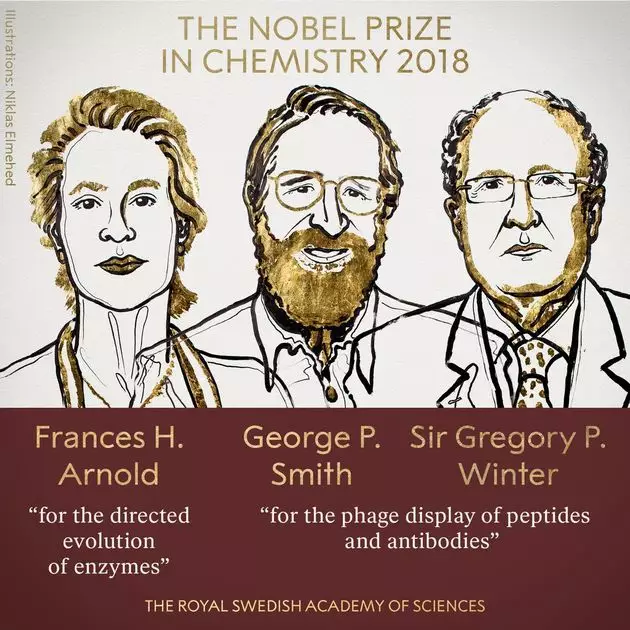
On October 3, the highly anticipated 2018 Nobel Prize in Chemistry was announced, awarded jointly to Frances H. Arnold, George P. Smith, and Sir Gregory P. Winter.
One of the 2018 Nobel Chemistry laureates, Frances H. Arnold, first achieved the directed evolution of enzymes. Enzymes are a class of special proteins that catalyze chemical reactions. Enzymes produced through directed evolution can be used to manufacture a variety of products, including biofuels and pharmaceuticals.
Let us shift our gaze from the podium of honor to this female scientist—a woman who endured the loss of her son in middle age, cancer, and the deaths of two husbands. Despite these ordeals, she pressed forward on her path to the Nobel Prize without hesitation and with integrity.
Frances Arnold was born on July 25, 1956. From a young age, Arnold was not the studious 'model child' that others compare.
She was born in Pittsburgh to a Roman Catholic military family. Her father, Dr. William Howard Arnold, a Princeton University graduate, was a nuclear physicist and a member of the National Academy of Engineering. He was also an expert in nuclear power, nuclear fuel, and nuclear waste disposal. In 2004, he was appointed by President George W. Bush to the U.S. Nuclear Waste Technical Review Board.
As a teenager, Arnold was rebellious. Protesting the Vietnam War, she hitchhiked from Pittsburgh to D.C. to join anti-war demonstrations. In high school, she moved out of her home into her own apartment and worked as a cocktail waitress at a local jazz club to earn rent money.
The 17-year-old told the club owner she was 22. 'Of course, they never checked my ID,' she said. She also drove a taxi to supplement her income.
Arnold described herself as an average student—you know, the typical 'top student' humblebrag. As expected, she was admitted to Princeton University, becoming the only female in her class. Because there weren't many required courses, she spent a lot of time studying economics, Russian, and Italian, dated an Italian postdoc, and took a gap year to Italy to build nuclear power plant components. In 1979, she earned her B.S. in mechanical and aerospace engineering from Princeton.
According to Arnold, she never intended to become a scientist; her dream was to be a diplomat or a CEO of a multinational company. But after experiencing the oil crisis and the Three Mile Island accident, she developed an interest in new energy. After graduation, she worked at the Solar Energy Research Institute, designing solar power facilities for remote areas. When Reagan took office and U.S. energy policy shifted, she returned to school and earned her Ph.D. in chemical engineering from the University of California, Berkeley.
With the rise of biotechnology, at age 29, Arnold joined the California Institute of Technology as a biochemical engineer. Her research at Caltech focused on green chemistry and alternative energy, with an emphasis on developing proteins with potential applications in medicine and energy.
At first, she was bewildered and had no idea where to start. But with extraordinary intuition and perseverance, she conducted thousands of 'cheap and fast' experiments. Her philosophy was simple: if one experiment doesn't work, then I'll do a million experiments until one does.
Some colleagues considered Arnold's brute-force approach crude, as they were conducting small-scale experiments to study the mechanisms of protein synthesis, while she was impatient and wanted to directly solve real-world problems. She argued that humans have been breeding organisms for millennia, and nature already has ways to optimize molecules—why not use them? Many peers looked down on Arnold, mocking her work as unscientific, saying that gentlemen do not engage in random, blind mutations.
Ms. Arnold shot back, 'I am neither a scientist nor a gentleman. Say what you will, but I'm the one who ends up profiting—this stuff works!'
Arnold's unconventional approach eventually bore fruit: she soon developed a protein that does not break down at high temperatures. This protein has a wide range of practical applications, such as in laundry detergents and new medicines.
Several senior researchers in the lab criticized her as arrogant. Arnold's response: 'Yes, I am genuinely arrogant—I'm not pretending at all. What I do must be important and useful, and I have not the slightest doubt about that.'
She also founded a biofuel company and took it public, but found she was still more adept at scientific research. Regretfully, she gave up her childhood dream of becoming a CEO.。。。。。
For an ordinary person, just one such experience in life would be something to treasure! Yet she juggles multiple pursuits like a circus performer, catching and tossing one ball after another with great delight—truly a winner in life.
She is an American scientist and engineer. She pioneered the method of directed evolution for creating useful biological systems, including enzymes, metabolic pathways, genetic regulatory circuits, and organisms, for which she received the 2018 Nobel Prize in Chemistry.
Her method had already been recognized by numerous awards, including the 2011 Draper Prize and the 2013 National Medal of Technology and Innovation, and she was elected to the American Academy of Arts and Sciences in 2011.
Arnold is among the rare experts elected to all three U.S. national academies: the National Academy of Sciences, the National Academy of Engineering, and the Institute of Medicine. She is a fellow of the American Association for the Advancement of Science, the American Academy of Arts and Sciences, the American Academy of Microbiology, and the American Institute for Medical and Biological Engineering. She is also a foreign member of the Royal Academy of Engineering.
Professor Arnold's Career Achievements
Elected International Fellow of the Royal Academy of Engineering (2018)
Society of Women Engineers 2017 Achievement Award
Honorary Doctor of Science from Dartmouth College (2017)
Millennium Technology Prize (2016)
Honorary Doctor of Science from ETH Zurich (2015)
Inducted into the National Inventors Hall of Fame (2014)
Emanuel Merck Lecture at Technische Universität Darmstadt, Germany (2013)
National Medal of Technology and Innovation (2013)
Eni Award (2013)
Charles Stark Draper Prize (2011)
International and Genencor Engineering Conference Enzyme Engineering Award (2007)
Recognized by President Obama as a Top Scientist and Innovator
But fate did not particularly favor this female scientist who excelled in a male-dominated field: she was diagnosed with breast cancer in 2015, lost two husbands, and lost her son in middle age—blows beyond ordinary imagination. With indomitable willpower, she forged herself into a unique presence in the scientific world.
As the first American woman to win the Nobel Prize in Chemistry, Professor Arnold is also the fifth woman in history to receive this honor.
'I meet many young people who want to plan their lives according to a menu.'
'They ask me to tell them the secret of success, but I really don't have such a menu. I usually follow my gut, and I'm fortunate to be passionate about a field full of opportunities.'
'Sometimes you need to consciously go against the flow. Most innovative things are not obvious to others at the time; you must believe in yourself. If you have a good idea, even if others tell you it's nothing special, stick with it.'
At the 2017 Caltech commencement, she told students about her mission: 'Inspired by nature, I became an engineer of the biological world, with the goal of rewriting DNA to solve the problems facing humanity.'
She also spoke about her life philosophy: 'The world is always changing, and some of those changes will be frightening and not always to your advantage. To survive and even thrive in a changing world, nature offers another great lesson: the survivors are those who at the very least adapt to change, or even better, learn to benefit from it and grow intellectually and personally. This means listening carefully and constantly learning. It means reassessing your choices throughout your life and being willing to adjust. Adapting does not mean accepting; it certainly does not mean giving up—it means taking on some of the toughest challenges as new opportunities for growth and learning.'
Nobel Prize Website's Interview with 2018 Chemistry Laureate
Frances H. Arnold
Frances H. Arnold: Hello.
Adam Smith: Oh, hello. Am I speaking with Frances Arnold?
Frances H. Arnold: You are, hi.
Adam Smith: Hi. I’m Adam Smith from Nobelprize.org. Congratulations on the award of the Nobel Prize.
Frances H. Arnold: Thank you.
Adam Smith: You sound very calm and collected in the middle of the night in Texas.
Frances H. Arnold: I’m not the least – I’m bouncing off the walls, but I’m trying to pretend to sound calm and collected.
Adam Smith: I imagine…you’re away from home, so perhaps somewhat protected from the immediate onslaught that’s going to happen today.
Frances H. Arnold: Well, I’m annoyed because I can’t reach my sons. They’re sound asleep. So, yes, I’m protected, but I’m also annoyed. They never answer the phone when mum calls.
Adam Smith: Well, not in the middle of the night at least, surely. You started as a mechanical engineer, and now I suppose you are a protein engineer. Do you think that is part of the secret of your success, that you came from a different field into biology and were able to see things differently?
Frances H. Arnold: I think there’s no doubt about that. I…I was able to look at the problem with a totally fresh set of eyes – a problem that had challenged people since the techniques were – of…of site-directed mutagenesis, for example, which won the Nobel Prize – were…were available. And I realised that the way that most people were going about protein engineering was doomed to failure.
Adam Smith: It’s a bold move though, to jump fields so radically.
Frances H. Arnold: Oh, well, I…I have four brothers and I’ve jumped into all sorts of things over my life, so learning new things has always been fun for me. Changing fields has been fun, and I still feel that way many years later.
Adam Smith: Would it be fair to say that what you do is to sort of manipulate nature’s inventiveness for our human benefit?
Frances H. Arnold: Well, I think that what I do is copying nature’s design process, right? Here…all this tremendous beauty and complexity of the biological world all comes about through this one simple, beautiful design algorithm, and what I do is use that algorithm to build new biological things. And to me it’s not…it’s obvious, it’s totally obvious that this is the way it should be done.
Adam Smith: Can you give me an example of one of your favourite things that you’ve been able to evolve?
Frances H. Arnold: Well, what I work on now is… someone asked me “What’s the funniest thing or what’s the best thing that you’ve ever done?” It’s always what I’m doing now. So what I’m going now is looking at this question of how do you evolve innovation. How does innovation happen? How do get a whole new chemical reactivity that you don’t know already exists in nature? How can I evolve a whole new species in…in essence, a whole new species of enzyme? And, so for example, making a carbon-silicon bond. Humans thought only they could do it, but we evolved an enzyme that does it better than humans do.
Adam Smith: And, absolutely, and I suppose nature’s doing this all the time. It’s coming up with new enzymes itself.
Frances H. Arnold: Of course, she is! Nature is solving all sorts of problems that we throw at her – how to degrade plastic bottles, how to degrade pesticides and herbicides and antibiotics. She creates new enzymes in response to that all the time, in real time.
Adam Smith: And I suppose that should allay the fears of people who say that humans shouldn’t be tinkering with nature. Well, nature’s tinkering with itself, so it’s not so different, really is it?
Frances H. Arnold: Well, we’ve been tinkering with nature for tens of thousands of years – look at a poodle! So we’ve created all sorts of organisms and biological things that wouldn’t be here were…were it not for us.
Adam Smith: That’s true, and poodles haven’t done much damage to us so far.
Frances H. Arnold: That’s right. And…and they solve all sorts of problems. Look at the agricultural revolution and food. Look at our farm animals. Look at our pets. These are human creations.
Adam Smith: Humanity needs science to get over the hurdles ahead.
Frances H. Arnold: That is really true. We need science and we need the smartest minds to work on these problems.
Adam Smith: You are already a member of all three National Academies of Sciences in the US; you have multiple awards. What do you think the Nobel Prize will mean to you?
Frances H. Arnold: Oh, my goodness! I don’t know yet. I haven’t had it very long.
Adam Smith: Let me rephrase the question. What does it mean to you at this moment?
Frances H. Arnold: At this moment, I’m absolutely thrilled and I can’t wait to get home and tell my sons.
Adam Smith: Really couldn’t be a better answer. Fantastic…well, we very much look forward to seeing you in Stockholm in December, and thank you very much for talking to me.
Frances H. Arnold: Thank you, Adam. OK.
Adam Smith: Bye bye.
Frances H. Arnold: Bye.