Every student goes through a period of confusion during the final two years of undergraduate studies.
Work First or Graduate School First? Is a Gap Year Needed for the Transition?
In the post-pandemic era, this has become an unavoidable dilemma for countless college graduates.
.png)
Yesterday, Meta announced its second round of mass layoffs, affecting tens of thousands.

For fresh graduates, gaining a foothold in the current unstable and unpredictable job market is becoming increasingly difficult.
Many students have likely adjusted their plans and ideas, but confusion and uncertainty about the future remain.
Here, CheersYou(清柚教育) categorizes the following scenarios so you can match your own situation, weigh the pros and cons, and make an informed decision.
Scenario 1
No job offer, planning to take a gap year to focus entirely on graduate school applications
Some students start planning relatively late and end up in the awkward position of having neither a job offer nor adequate preparation for graduate school applications.
In a tough job market, many decide to pursue further studies. However, due to a heavy academic load in the final year, some students think about preparing after graduation, devoting a full year exclusively to their applications.
But objectively speaking, this is highly discouraged for the following reasons:
1. GPA cannot be improved
During the application process, universities require many materials, but what admissions officers value most is your undergraduate academic performance, simply put, your GPA.
However, after graduation, you can no longer raise your GPA, making any effort during this period low-yield.
2. Limited GRE score improvement
The recommended preparation time for the GRE is actually 3-6 months.
Beyond that, very few students can sustain the same level of review. It's easy to forget material and hit a plateau, so the margin for score improvement is quite small.

3. It may count against you with admissions officers
Due to cultural differences, graduate school may not be seen as a must in other countries. Admissions officers in particular may not understand the choice to take a gap year solely for application preparation.
They might even view the applicant as inefficient or insufficiently proactive. So you must think carefully about how to explain to admissions officers what you did during that year.
4. Difficulty obtaining recommendation letters
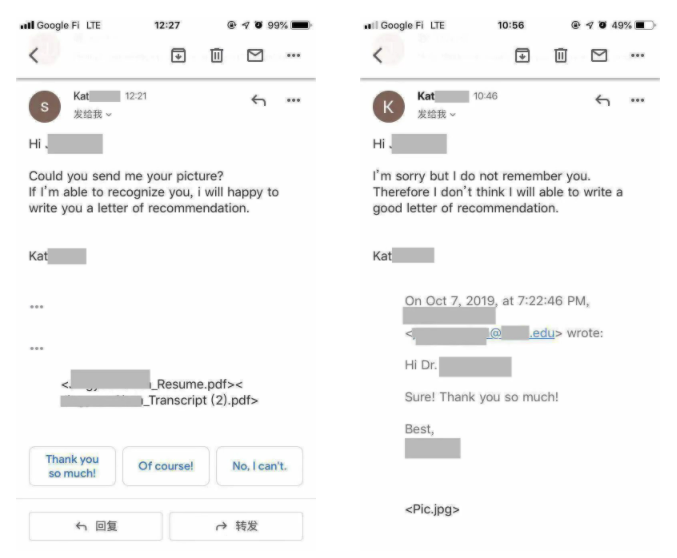
Being off campus after graduation makes it harder to secure recommendation letters from professors.
Whether at a domestic or international university, many professors teach large classes. If you don't ask for a recommendation in person, helping the professor recall your face, it's very difficult to get them to agree via email alone.
Scenario 2
No job offer yet, but hoping to work for a year before applying to graduate school
This is a situation many students struggle with.
After graduation, many aren't sure what they want to do. They think that working for a while, understanding the job market, and experiencing the work environment will give them more direction when they apply to graduate school.
But what is the reality?
Pros: This advantage is especially evident for students who lacked substantial internship experience during their undergrad. A year of work experience can add a nice touch to your application essays.
Cons: First, you can't be sure you'll find a job that strengthens your application. The current global wave of layoffs adds even more uncertainty to the job search.

If you do land a relevant job offer, here are two specific drawbacks that many students may not anticipate:
1. Work will consume a lot of time
With an 8-hour workday and no overtime, if you haven't taken the GRE yet, you may only have 2-3 hours per day to study—and that's during low-efficiency evening hours, making it hard to achieve good results.
Later, during the actual application process, it's even more challenging. You may think now that you'll have enough time, but in reality, you might not even be able to prepare one application properly.
Average weekly hours worked by U.S. employees in 2022: 34.5

2. It may be seen as a lack of integrity by employers
Typically, the time between applying to graduate school (Oct–Dec) and starting a job (Jul–Sep) is very short. This makes it difficult to obtain a recommendation letter from your employer.
Additionally, overseas companies place great importance on employee integrity and long-term development. If your employer knows you plan to leave for graduate studies, it won't be good for your career growth at the company.
Therefore, students who want to take a gap year to work before applying to graduate school should think twice. You don't want to end up without a meaningful work experience boost and lose your direction for grad school.
Scenario 3
Already have a job offer, torn between working and applying to graduate school
Here we're referring to working for 3–5 years, not just one year. In this case, working may be the better option.
For MBA applications, 3–5 years of work experience is an explicit requirement at many top business schools.
Average work experience of admitted students to the Wharton MBA program: 5 years

Even for programs without such explicit requirements, over three years of work experience is a big advantage. It shows that the applicant has a solid understanding of a field and a clear plan for the future.
This is a common path for domestic students abroad: after working for an extended period, they pursue a master's degree to facilitate a career change or promotion.
Summary
These three scenarios cover the dilemmas most students currently face.
In general, if you don't have a job offer yet, applying to graduate school sooner is definitely the better choice. After weighing all the pros and cons, the opportunity cost of a gap year often far outweighs the benefits gained from a year of work or application preparation.
If you already have a good full-time offer in a field you're interested in, don't let traditional domestic mindsets constrain you. Try working for a few years first, then use a master's program to further elevate yourself.
We hope everyone can strike a good balance, achieve success in both studies and career, and realize their dreams!