
On July 2, 2019, the Chinese Service Center for Scholarly Exchange (CSCSE) under the Ministry of Education officially published a notice titled "Announcement on Adjusting the Certification Method for Foreign Juris Doctor Certificates" on its website.

This news shook the entire study-abroad community. Many students who earned or are about to earn a JD degree in the U.S. felt wronged: after years of hard work and even financial strain to obtain a Juris Doctor, how could it be downgraded to a Master of Laws by the authorities?!
What is a JD
Juris Doctor (J.D.) is a professional doctorate degree in the U.S. legal education system, and also a first professional graduate degree. The program typically takes three years (or four years part-time) to complete, and applicants are required to hold a bachelor's degree.
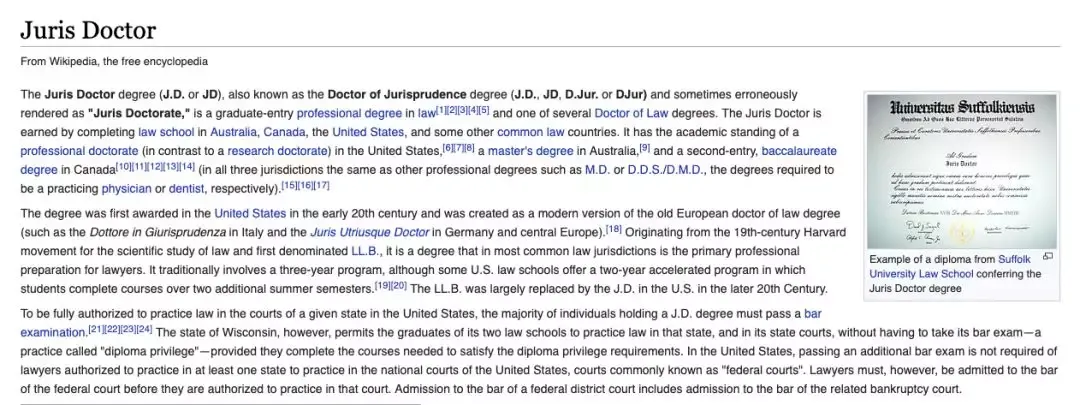
The degree aims to provide academic and professional training for those pursuing a legal career. U.S. undergraduate programs do not offer a law major; law is a postgraduate professional education, and those who complete it receive a Juris Doctor degree. In most states, a J.D. is a prerequisite for taking the bar exam and obtaining a law license.
The Juris Doctor degree first appeared at Harvard Law School and was quickly adopted by top law schools like Stanford, Berkeley, and Penn. The University of Chicago Law School was the first to fully recognize and award the J.D. degree.
Due to tradition, some law schools hesitated to award the J.D. Yale Law School long delayed making the J.D. its sole degree. By the 1960s, every law school except Yale had adopted the J.D. as the only professional law degree, and Yale followed suit in 1971.
In Hong Kong, City University first offered the J.D. in 2004, followed by Chinese University in 2006 and the University of Hong Kong in 2009.
International Academic Status of the JD
In the U.S., the Juris Doctor is recognized as a professional degree. The Chinese term "博士" can correspond to either a narrow Ph.D. or a broader category including academic and professional doctorates such as Ph.D., M.D., J.D., etc.

In the U.S., professional degrees generally require a bachelor's degree but not a master's (a significant difference from the Chinese degree system).
Academic doctorates cover various disciplines as the ultimate degree, requiring an original contribution to knowledge through a dissertation. Degrees like M.D. and J.D. are professional doctorates where original research is not a prerequisite.
Since 1997, law schools outside the U.S. have also begun awarding degrees named Juris Doctor. Given the unique nature of U.S. legal education and the absence of a distinction between academic and professional doctorates in many other countries, the classification of the JD remains highly controversial.
Currently, City University of Hong Kong, Chinese University of Hong Kong, and the University of Hong Kong classify the JD as a professional master's degree. All three offer Juris Doctor programs. Hong Kong's JD programs last two years (full-time) or three and a half years (part-time), and graduates are eligible to apply for the Postgraduate Certificate in Laws (PCLL).
Because Hong Kong's legal system differs from the U.S. system, the length, content, methods, and philosophy of JD programs at these universities differ significantly from those in the U.S. Similarly, common law jurisdictions like Australia and Canada have recently started granting JD degrees, but they vary from the U.S. JD depending on their domestic legal and degree systems.
In Canada, the JD is recognized as a graduate degree. In Australia, it is considered a master's degree because no thesis defense is required.
Previously, the JD also sparked controversy in Taiwan, where it has been translated as "法律士" or "法律博士". Under Taiwan's regulations, a "法律博士" holder with a domestic or foreign law bachelor's and a U.S. LL.M., or with a minor in law and relevant publications, may qualify for assistant professor eligibility review. However, those who only hold a U.S. JD after a non-law bachelor's are treated as having a master's for lecturer qualification review.
Impact of the New Policy
With an understanding of the JD's academic status in various countries, students are increasingly sympathetic to those studying JD in the U.S. So, what will be the actual impact of this new policy?
1. No impact on employment in the U.S.
2. Almost no impact on employment in the Chinese legal profession.
3. Impact on teaching and research positions at Chinese universities. (Academic qualifications are a hard requirement when hiring lecturers and professors and for title evaluations in Chinese universities.)
Therefore, those who have obtained or will obtain a JD should start planning for the future!
If you plan to return to China to teach at a university, it's better to earn a Ph.D. as soon as possible.
Other Law Degrees
In addition to the JD, the U.S. also offers the LL.M. (Master of Laws) and S.J.D. (Doctor of Juridical Science).
LL.M. (Master of Laws)
Commonly called "老流氓" in China, it is a one-year (or two-year in some regions) advanced law program, mainly offered in common law jurisdictions like the U.S. and U.K., at the master's level.
An LL.M. helps deepen expertise in a specific area of law, provides a comprehensive understanding of the U.S. legal system, and offers the quickest and most cost-effective path to a U.S. law license.
Applying for an LL.M. does not require the LSAT, but requires language scores like IELTS or TOEFL, as well as recommendation letters and personal statements.
S.J.D. (Doctor of Juridical Science)
Globally recognized as the true research doctorate in law, this degree is research-oriented. However, it has strong internal protectionism, favoring graduates from the same institution's LL.M. program.
The S.J.D. focuses on mastering legal research methods. Graduates have broad career prospects, with high chances of entering academia for teaching and research worldwide.
By comparison, if you don't plan to return to China for work, the JD is actually a very worthwhile choice—comprehensive U.S. legal training, fewer restrictions for bar exams, clear job prospects, and a high-value degree.
For those passionate about law, are you afraid of the JD now?