
Starting August 1 this year, the new TOEFL test format will make the test a bit easier.
New TOEFL test time will be reduced by 30 minutes to 3 hours, with the same test format and question types. In other words, it is the same fair, reliable, preferred test, just with fewer questions in the Reading, Listening, and Speaking sections.
Additionally, to help students reach their desired scores, ETS will add a MyBest Scores score to the TOEFL report.
The MyBest Scores work like this: Take the highest section scores from all your TOEFL tests in the past two years and combine them into a new total score.
For example, suppose you took the TOEFL four times in the past two years.
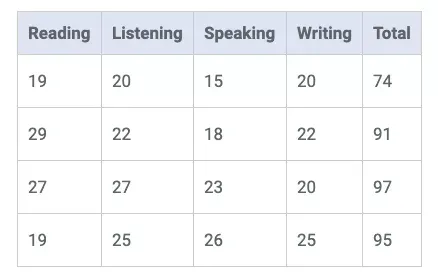
Now, on your score report, you will see the following:
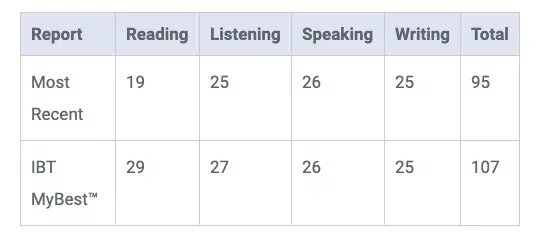
However, not all universities accept this "superscoring." ETS itself has stated that whether to accept MyBest Scores is up to the schools.
In the latest application guide, the University of California system makes it clear that while this superscoring policy does give more test-takers a chance to showcase themselves, "this change will not affect UC admissions."
Moreover, UC also states they will continue to only accept the highest single-sitting TOEFL score, and like SAT/ACT, UC does not accept superscoring.
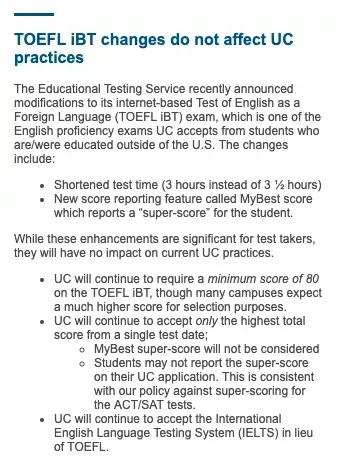
The content mainly involves three points:
1) UC minimum admission requirement is TOEFL 80, but given selectivity, many campuses expect scores well above that;
2) MyBest Scores will not be considered; only the highest single-test score is accepted, and UC also does not accept ACT/SAT superscoring;
3) UC continues to welcome international students and still accepts IELTS scores.
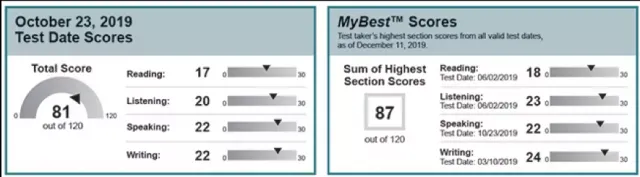
Regarding TOEFL superscoring, not only UC, but a number of other schools have also said they don't accept it.
Harvard, Columbia, Northwestern, Cornell, NYU, USC, CMU, Tufts, University of Michigan, Boston University, Ohio State, WPI, UT Austin, Clemson, Fordham, etc. have all indicated they will not accept TOEFL superscoring.
Moreover, more than half of universities have different stances on TOEFL superscoring for undergraduate and graduate programs. Even among the universities mentioned, there may be departments that treat TOEFL superscoring differently.
Some helpful peers contacted multiple colleges, business schools, engineering schools, etc., and found that the proportion clearly accepting superscoring was no higher than 30%. STEM fields, especially many CS programs, are relatively more open to TOEFL superscoring.
Therefore, although ETS introduced this new policy, many US institutions currently still do not accept it. Different universities have different approaches, and within the same university, different programs may have different attitudes.
If you are unsure about a program's stance on TOEFL superscoring and can't find information on the official website, the best method is always to directly email the target department for clarification. Because even lists compiled by others online can have discrepancies.
Of course, the safest approach is still to prepare well for the test. Since you have to take it anyway, why not aim to score well in a single TOEFL attempt, saving the hassle of worrying about superscoring.
We hope all students achieve great scores and get into their dream schools!