
Students preparing to apply to U.S. graduate schools know that there are four key factors: GPA, GRE/GMAT, application documents, and recommendation letters.
Among these, GPA, GRE/GMAT, and application documents may be troublesome, but at least they are within your control. Recommendation letters, however, are in the hands of professors or employers! So recommendation letters become a headache for many. Today, CheersYou(清柚教育) is sharing some tips on recommendation letters.
Who should you ask for recommendation letters?
Generally, graduate schools require two to three recommendation letters, depending on the school and program. For more academic-oriented programs, three letters from professors are recommended; for more practice-oriented programs, two from professors and one from a work supervisor are suggested.
Regarding professors, you should definitely choose those related to your field of study: the best option is a professor with whom you have done research or a project, because having worked together, the professor will understand your capabilities and strengths better; next is a professor in whose class you got an A and who knows you relatively well—what counts as relatively well? For example, if you run into the professor at the supermarket and they can call you by name; finally, a professor in whose class you got an A but who is not familiar with you.
Therefore, for sophomores and juniors, CheersYou(清柚教育) suggests that if you have the opportunity, you can do research or projects with professors. Additionally, make good use of professors' office hours to ask questions and make yourself known; the key is to let the professor remember you. Of course, the most crucial thing is to study hard—only by getting an A in a key major course can you confidently ask for a recommendation letter!
When should you ask for recommendation letters?
The typical application submission period is from November to February, so you need to ensure that professors or internship supervisors complete the recommendation letters before November.
According to the experience of CheersYou(清柚教育) consultants, for popular majors, popular courses, or popular professors, it is recommended to send an email to the professor now to request the recommendation letter.
Because these popular professors often have dozens of students asking them for recommendation letters. If you wait until September when school starts, you may end up well down their waiting list. So, don't hesitate—the sooner you get a positive response from the professor, the better!
How to ask a professor for a recommendation letter?
Generally, you start by sending an email, stating that you have done research with the professor before, or that you took a certain class with them and earned a good grade. Express your admiration for the professor and thank them for their past help.
Then, explain that you want to pursue your dream of applying to a graduate program in a certain field and hope the professor can write a few recommendation letters for you. Your attitude must be very sincere.
If you are on campus, ask the professor if you can meet in person to discuss. If the professor does not reply to your email for a long time, you can find out their office hours after the semester starts and walk in during those hours to make your request.
Later, the professor may ask for your transcript, resume, list of schools, or even personal statement. It is best to provide these promptly so the professor can write the most accurate recommendation letter.
Note: You must clearly communicate the application deadline to the professor. Some professors tend to procrastinate. If there is no movement as the deadline approaches, you need to follow up very politely. CheersYou(清柚教育) provides a bad example that almost annoyed the professor: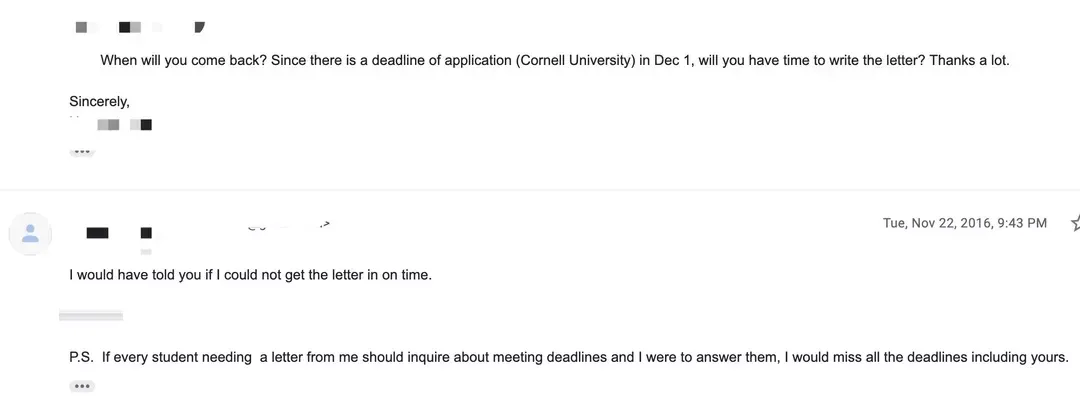
Never, ever fake recommendation letters
This is a huge red flag! Many graduate schools are now strictly checking for fake recommendation letters. Once caught, a series of rejection letters is unavoidable. On the graduate application website, you need to submit the recommender's email address, and this email is critical:
Absolutely, positively must use a company email or the professor's official university .edu email!
Before, many students used @163.com, @qq.com, or @gmail.com for their recommenders. In such cases, admissions offices would immediately recognize that the recommendation was not submitted officially by a company or professor, and your application would likely be doomed.
Graduate admissions offices are becoming increasingly sophisticated, and their anti-fraud methods now involve checking IP addresses. Below is an email from Columbia University's admissions office shared by a student who previously consulted CheersYou(清柚教育):
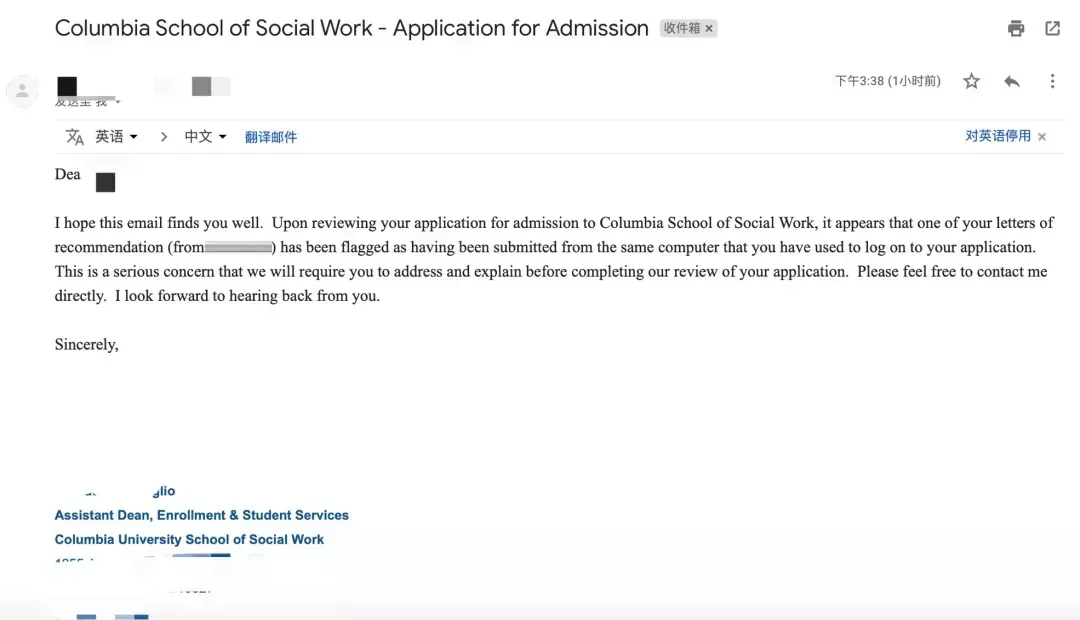
The email indicates that the IP address used to submit the recommendation letter was the same as the one used to submit the application, raising suspicion of a fake recommendation. With Columbia and other schools scrutinizing recommendation letter authenticity so closely, CheersYou(清柚教育) strongly advises every student not to take any chances!
Finally, we wish all Fall 2020 applicants success in obtaining recommendation letters and thorough preparation for your graduate applications!