As the annual back-to-school season arrives, many new students are packing their bags, ready to embark on a brand-new journey.
However, after receiving the offer and getting the visa, it's natural to start worrying: Will everything go smoothly at entry? Below, CheersYou(清柚教育) will walk you through the U.S. entry process.
Pre-departure Preparation
Before boarding, double-check your passport, SEVIS I-20 or DS-2019 form, admission offer, I-901 payment receipt, medical exam record, financial documents, passport photos, etc. (Documents must be kept with you; it's best to make copies of important papers and never put them in your checked baggage.)
On the Plane
It's a good idea to carry a pen with you to fill out the forms distributed by flight attendants. Since 2013, the U.S. has eliminated the paper I-94 arrival/departure form, so you only need to complete the CF-6059 Customs Declaration Form.
The form must be filled out in capital English letters, one per family—but only immediate family members may share one form; extended relatives and friends must each complete separate forms.
Most in-flight magazines provide Chinese translations for each field, which you can use as a reference. If you still have questions, feel free to ask a flight attendant for help.
The form includes personal information (name, date of birth, address of hotel/destination in the U.S., passport issuing country, passport number, countries you have lived in, countries visited before this trip, flight number, and more).
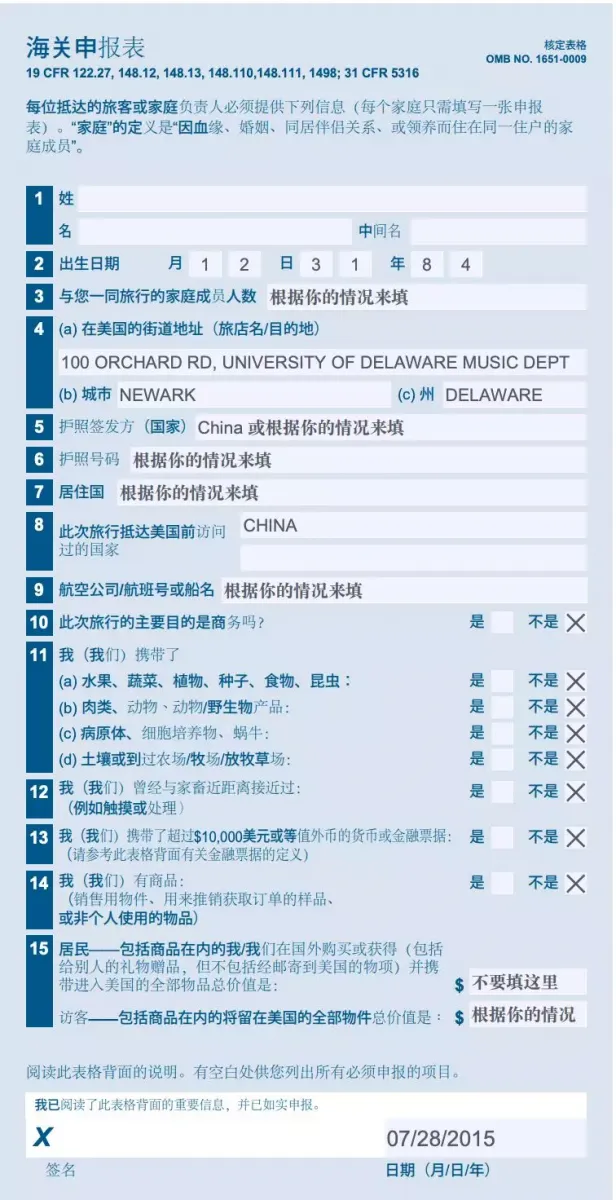
Filling-out tips:
-
Simply write your name in pinyin.
-
"Number of family members traveling with you" does not include yourself. For example, a family of three would report "2" as the number accompanying you.
-
"Countries visited on this trip prior to U.S. arrival" refers to this journey only, not past trips. For instance, if you spent a few days in Japan before flying to the U.S., you would fill in "JAPAN."
-
Answer truthfully whether you are carrying prohibited items such as fruits, vegetables, or meat. Customs officers may open your luggage for inspection, so make sure the items you carry match exactly what you declare on the form.
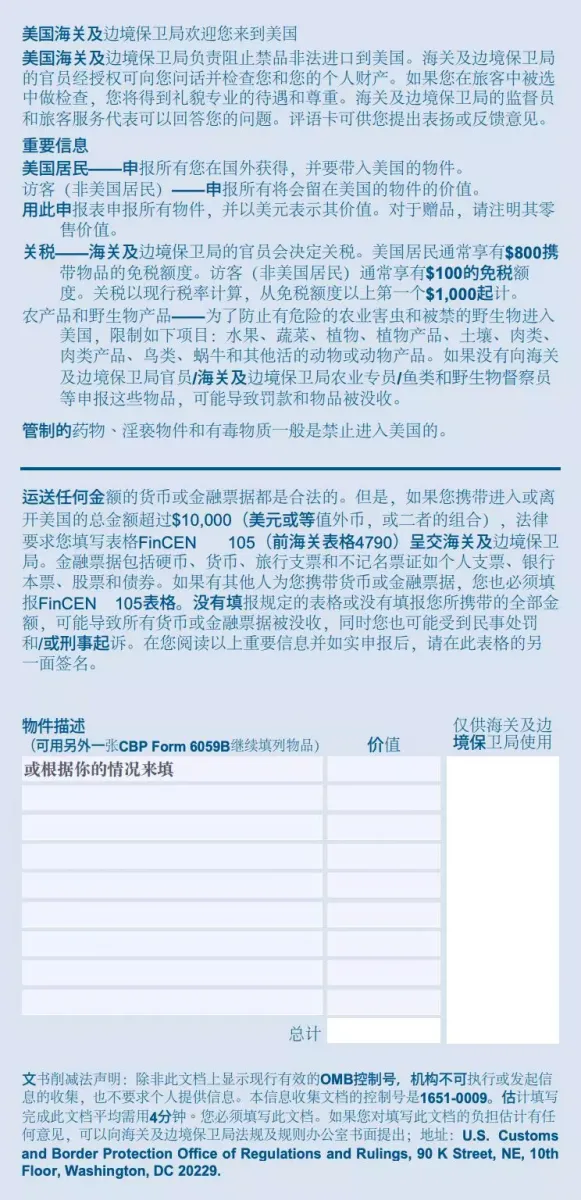
Items restricted from entry or requiring declaration by U.S. Customs:
1. Food and meat products
2. Fruits, vegetables, plants, plant seeds, and soil
3. Medicines
(You may bring some common medicines like cold medicine or daily supplements, but quantities must not exceed personal use. Western and Chinese medicines should be kept in original packaging with instructions in both Chinese and English or ingredient labels. For prescription drugs, carry the doctor's prescription.)
4. Currency and gold items
(If you are carrying currency or monetary instruments exceeding $10,000 per family, you must voluntarily declare them to customs.)
5. Items violating intellectual property rights or registered trademarks
(Any item that unlawfully uses a federally registered trademark or infringes copyright is prohibited, including counterfeit clothing, bags, toys, artwork, books, software, and audio/video products. Violators will have their items confiscated.)
6. Fish and wildlife
7. Pets
8. Biological products
9. Textiles and clothing
(Generally, there is no limit on the quantity of textiles and clothing for personal use or gifts. However, if they exceed your personal duty-free allowance, you must pay tax on the excess.)
10. Cultural artifacts and antiques
11. Drug paraphernalia
12. Firearms
13. Game/hunting trophies
At Customs
After disembarking, many students' only wish is to get through customs quickly and avoid being sent to the "small dark room."
What is the "small dark room"?
Although the name sounds scary—like a dark, sunless cell—the "small dark room" is neither dark nor small. It is actually a reception room of the U.S. Customs and Border Protection (CBP), where officers conduct secondary inspections to re-verify a traveler's identity. It earned its nickname because many people who enter end up being denied entry and deported.
Reasons you might be sent to secondary inspection or deported:
1. Disrespectful or rude remarks
Even if the officers ask many tricky questions, never show impatience or offend them, as this can lead to secondary inspection due to unclear entry intentions.
2. Unauthorized employment or suspected unauthorized employment
One female student once mentioned in a Facebook chat that she would help a restaurant attract customers. Customs deemed this as involvement in unauthorized employment. Despite her repeated explanations that she received no pay, she was still deported.
3. Sensitive words on social media
Before disembarking, check your social media. Try to avoid having words like "sponsor switch," "work," or "get immigration status" in your chat history.
4. Poor English & appearing overly nervous
If an officer repeats a question several times and the student still struggles to understand or gives irrelevant answers, this can arouse suspicion and lead to being sent to secondary inspection on grounds of "insufficient English proficiency."
5. Insufficient credits & poor grades
Customs officers sometimes ask detailed questions about your academic performance. A low GPA or not having enrolled in enough credits for the semester can be grounds for denied entry.
Answer calmly when questioned by customs officers
In reality, the chance of an international student being sent to secondary inspection is very slim. As long as you answer officers' questions properly at customs, you can pass through without worry.
Three fundamental questions are typically asked: What is the purpose of your visit to the U.S.? Which school will you attend? How will you cover your tuition? If all goes well, the interview lasts 5–10 minutes. You will then be asked to scan your fingerprints, have a digital photo taken on the spot, and finally get your passport stamped.
If you encounter an officer with a bad attitude, do not panic. Their thorough questioning is simply to verify your identity and purpose of entry. No matter what, stay calm and composed.