
The long-awaited 2020 U.S. News Best Colleges rankings were officially released on September 9 this year!
U.S. News rankings consider a variety of factors, including acceptance rates, student-faculty ratios, standardized test scores, research output, and employment outcomes.
The U.S. News ranking metrics are fair and authoritative, making it the most valued and referenced list by students and parents.
After last year's volatile ranking changes and the minor incident at the end of July this year where data misreporting led to the cancellation of some schools' 2019 rankings, what new trends does the 2020 national university ranking reveal?
First, let's look at this year's ranking methodology:
Graduation and retention rates: 22%
Social mobility: 5%
Graduation rate performance: 8%
Expert opinion: 20%
Faculty resources: 20%
Student selectivity: 10%
Financial resources: 10%
Alumni giving rate: 5%
National Universities in the U.S. offer a full range of majors, have large student populations, emphasize research, and award multiple degrees, making them the primary focus for students and parents.
U.S. News rankings have always based university classification on the Carnegie Classification of Institutions of Higher Education. Since the system was updated in 2018, this year's rankings may also reflect changes. For example, institutions previously classified as regional universities may now enter the rankings as National Universities.
CheersYou(清柚教育) is here to unveil the new U.S. News 2020 ranking data and analyze this year's ranking changes.
Top 50 U.S. National Universities
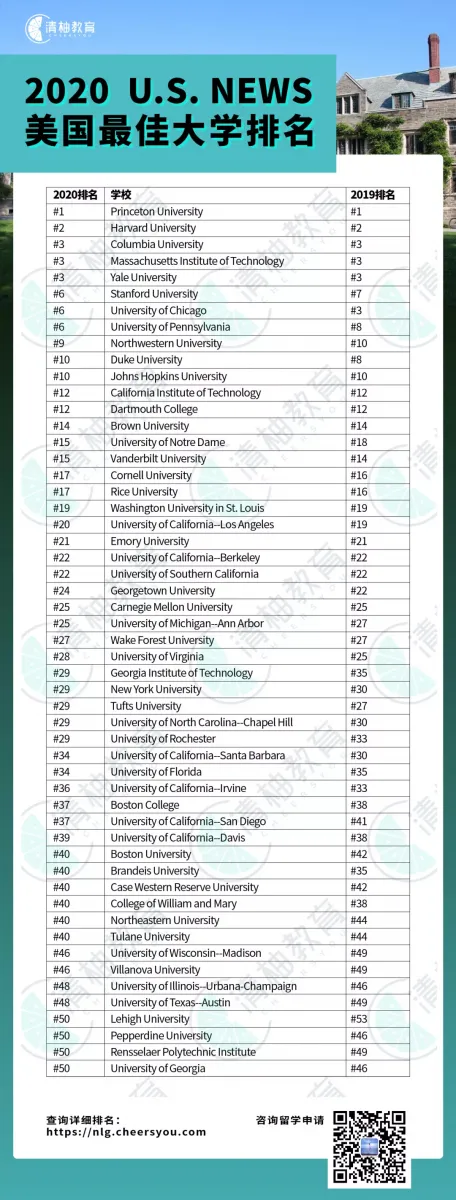
Click here to view the full rankings on the official website
Visit the CheersYou(清柚教育) official website to see the full rankings
This year's Top 10 universities remain the same as last year, but their rankings have shifted. The University of Chicago dropped from 3rd to 6th; Stanford University moved up one spot to 6th; the University of Pennsylvania jumped two spots to tie with Chicago and Stanford at 6th; Northwestern rose one to 9th, while Duke University fell two spots to 10th.
In the Top 30, Georgia Institute of Technology and the University of Rochester are new entrants this year. Georgia Tech showed strong momentum, rising six spots to 29th and tying with New York University; the University of Rochester also moved up four places to 30th.
In the Top 50, Lehigh University cracked the top 50 this year; Boston College and Boston University both saw slight improvements; Northeastern University and Tulane University also successfully entered the top 40.
The UC system, which staged a dramatic comeback last year, saw its rankings slide this year. UCLA dropped one spot but remains in the Top 20 and is still the highest-ranked UC campus; UC Berkeley, after this year's data misreporting controversy and cancellation of its 2019 ranking, was unaffected for 2020 and continues at 22nd; UCSB, UCI, and UCD all declined; UCSD rose into the top 40.
Rankings are still for reference only. They should not be the sole basis for college applications. When choosing a U.S. university, you should also consider curriculum, campus culture, cost, school location, and campus life to make a more reasonable and personalized choice.