
According to a report by the Chronicle of Higher Education, applications to U.S. business schools have declined for four consecutive years.Statistics show that in 2018, the top 10 business schools saw a decrease of 3,400 applications, an overall decline of 5.9%.
Dartmouth's Tuck School of Business saw a 22.5% drop in applications in 2019, Duke's Fuqua School of Business fell 14.6%, and Stanford Graduate School of Business declined 6%.
The renowned Wharton School at the University of Pennsylvania was also affected, declining 5.4% from 2018. The University of Chicago Booth School of Business saw a 3.4% increase this year, but not enough to offset the 8.2% drop in 2018.
Amid such a downturn in MBA, in May, the Gies College of Business at the University of Illinois Urbana-Champaign announced the cancellation of its full-time MBA program. Other schools that have recently closed their MBA programs include the University of Iowa, Virginia Tech, and Wake Forest University.
.jpeg)
What is an MBA
The MBA (Master of Business Administration) program, typically offered by university business schools, covers areas such as management, economics, finance, accounting, law, and more.
Its goal is to cultivate practical, interdisciplinary, and application-oriented senior management talent capable of meeting the work demands of high-level management in business enterprises and economic management departments.
MBA is a type of master's degree, but the training objectives differ: the former develops industry management talent, while the latter develops technical experts.
MBA programs generally require at least 2 years of work experience, and even more than other business master's programs, they emphasize leadership, overall quality, work experience, and industry understanding.
Reasons for the Decline in MBA Applications
Rising Tuition:
The high cost of MBA is well-known. For example, at Wharton, the annual tuition alone reaches nearly 500,000 RMB.
For entrepreneurs, the cost of an MBA could launch a new product, not to mention the high opportunity cost of taking two years away from the rapidly changing tech world to return to school.
The dean of Yale School of Management also stated: even in a recession, the high tuition costs would not lead to double-digit growth in MBA applications.
.jpeg)
Economic Stability and Startup Boom:
In recent years, the tech industry has gradually replaced consulting and finance as the top choice for graduates from leading universities. The strong U.S. economy has also made more people willing to stay in their jobs.
In the 21st century's rapid development, with the rise of numerous startups, entrepreneurship has taken root in many people's minds. They increasingly realize that mastering practical skills is more important than a prestigious degree.
OPT Duration:
Compared to STEM master's programs, MBA's one-year OPT period means that international MBA graduates have little time advantage in job hunting in the U.S.
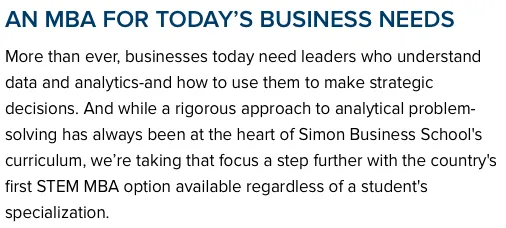
In this context, some MBA programs are transitioning to STEM. For example, the Simon Business School at the University of Rochester became the first business school last year to offer full STEM designation for its full-time MBA program.
MBA Admission Requirements Rise Even as Applications Fall
Logically, if a school receives fewer applications, the admission scores might drop.
But in fact, among these top-ranked U.S. universities, more than half reported average admission scores higher than last year.
MIT Sloan raised its average GMAT score to 728; the University of Michigan Ross School of Business hit a record high of 720; and UCLA Anderson set a record of 719.
Columbia Business School saw its average GMAT score jump 8 points last year to a record 732, matching Stanford GSB, Wharton, and Northwestern Kellogg for the first time. Although it dropped 5 points to 727 this year, admission requirements remain high.
Although application numbers are falling and acceptance rates are rising, this does not mean MBA programs will easily lower their admission standards. Top MBA programs, in particular, still carefully select applicants' backgrounds.
Business Master's vs. MBA
Besides the MBA, there are many business master's programs available in the U.S. for those interested in business. Compared to the MBA's strict work experience requirements, business master's programs are more academically focused.
At the same time, more and more business master's programs are being STEM-certified, also offering the 3-year OPT opportunity. Examples include Columbia's Business Analytics, JHU's Finance, Rochester's Marketing Analytics, as well as popular interdisciplinary programs like Financial Engineering and Financial Mathematics.
.jpeg)
For most master's applicants, especially recent undergraduates, business master's programs are a more suitable choice in terms of curriculum and application requirements.
Finally, we hope that when choosing a major, you won't just follow the crowd, but follow your heart. The greatest happiness in life is doing what you love.