

When preparing application materials, many students focus solely on improving their standardized test scores, investing significant time and money to boost their stats, often overlooking the essay. In the eyes of some students and parents, the essay seems less important.
What they don't realize is that schools today increasingly value a student's overall ability, with the essay carrying enormous weight. Especially for graduate applicants, the essay can sometimes directly determine your success or failure.
Graduate Application Essays
The requirements for graduate and undergraduate applications are different, because during high school, most students have relatively similar experiences, and aside from extracurriculars, they may not have extensive internship or work experience.
However, at the graduate application stage, the distinctiveness of your personal experiences becomes apparent. This is when you need to showcase the professional nature of your past experiences in your essay and how they align with the graduate program.
Graduate application personal statements lean more toward a Statement of Purpose, emphasizing purpose—that is, your motivation for applying to this field of study.
In fact, most schools have the same requirements for the personal statement, which should include the following three points:
1. Why do you want to apply for this program?
2. What are your future goals?
3. Are you qualified to apply for this program?
Therefore, a personal statement mainly covers three aspects: origin of interest, personal ability, and future plans—namely, motivation, qualifications, and planning.
How Graduate Schools View Application Essays
Specifically, each university, down to individual schools and programs, may have different focuses for the essay, and some schools' graduate program essays can be more challenging.
For example, Duke's Fuqua School of Business has the 'classic quirky' essay prompt: 25 Random Things About Yourself, which requires students to strike a perfect balance between conciseness, creativity, and personalization in their essay.
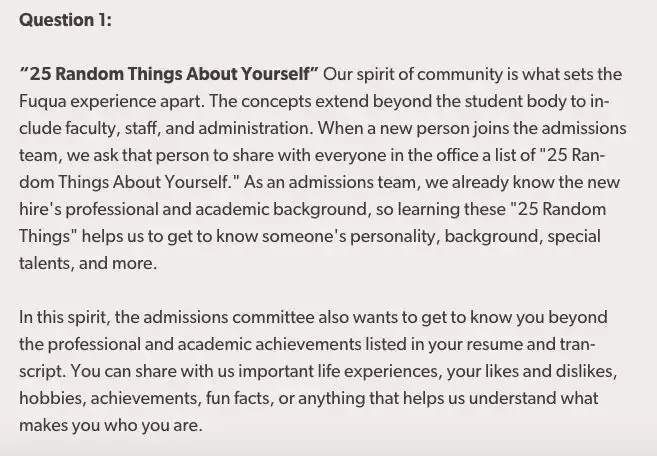
The essay is an important way for admissions officers to get to know you beyond your scores. Simply put, schools want to understand who you are, your background, and what makes you compelling. They don't just want to see your standardized test numbers; they want to see a real, three-dimensional person.
For instance, if a student chooses to apply for a graduate program different from their undergraduate major, the importance of the essay is self-evident. The student can use the essay to explain the reasons for changing fields and express their passionate interest in the target program. Admissions officers often use the essay to determine whether you are a good fit for admission.
Common Essay Writing Mistakes
1. Confusing the Personal Statement and CV
Don't turn your personal statement into an extended version of your CV. Try not to include content from your CV in your PS; if you must, approach it from a different angle.
For example, if your CV mentions a research project you consider important, then in your PS, discuss what you learned from it, what methods you used to solve what problems, etc. The PS and CV are complementary, so try to avoid repetition.
2. Using One Essay for All Applications
Many students write their essays using a template, thinking one essay is enough to apply to multiple schools or even multiple programs. This idea is completely wrong. Based on the specific school and program you're applying to, your essay must be adjusted according to their requirements.
3. Overly Lengthy Content
When writing their essay, many people simply cram all their experiences into it without any focus, let alone integrating the unique features of the school and program.
In fact, a good essay is not just a list of words but a layered telling of your story with an emphasis on details. Only such an essay can truly move people.
How to Write a Great Essay
To write a great essay, you first need to understand what admissions officers are looking for and what they want to see.
Overall, graduate schools want to learn the following three things from your application essay:
- What do you want to learn at the graduate level?
- Why do you want to study this field?
- Why is their school the best choice for you?
Therefore, the essay content can be divided into six sections:
Motivation: Why do you want to apply to graduate school? What is your driving force?
Summary of undergraduate achievements: Describe your undergraduate experiences, including research participation and any relevant awards.
Detailed account of practical experiences: What internships and work experiences have you had?
Understanding of the industry and career goals: Your insights into the industry and your professional ambitions.
Reasons for choosing the school and program: Be specific—why this school and this program?
Demonstration of commitment: The 'why school' part, ideally emphasizing that this school has always been your dream school, making it clear that you are determined to attend.
Graduate essay writing is never just about constructing a story; more importantly, it's about telling your story vividly and convincingly to others, with solid reasoning and evidence. Never list too many examples, as that will only cause admissions officers to lose interest.
As admissions committee members read hundreds of personal statements each day, the challenge for most students is how to impress them quickly and keep them interested in reading further.
I hope everyone recognizes the importance of the essay and devotes more time to crafting it. If you have any questions about the essay, be sure to consult professionals.
Don't just go the DIY route and waste time and opportunities. The study-abroad journey is long and arduous; I hope everyone succeeds as soon as possible.