
With up to 36 months of OPT and high-paying, high-benefit job prospects, STEM majors have been the top choice for international students applying to U.S. universities.
In recent years, the U.S. has also emphasized the "return on investment" of college education, steering the campus atmosphere toward "technical" and "vocational" orientation.
This has created a problem: education is being simplified into mere job preparation, gradually losing its true essence. Under such a trend, STEM majors are gaining more and more popularity, while liberal arts are increasingly viewed as unworthy and even scorned.
"STEM students have better job prospects and higher incomes than liberal arts students."
Does this familiar conventional view hold up against reality?
Is There a Shortage or Surplus of STEM Talent?
According to a recent LinkedIn report, there is a nationwide shortage of over 150,000 data science workers, especially acute in major cities like New York, San Francisco, and Los Angeles.
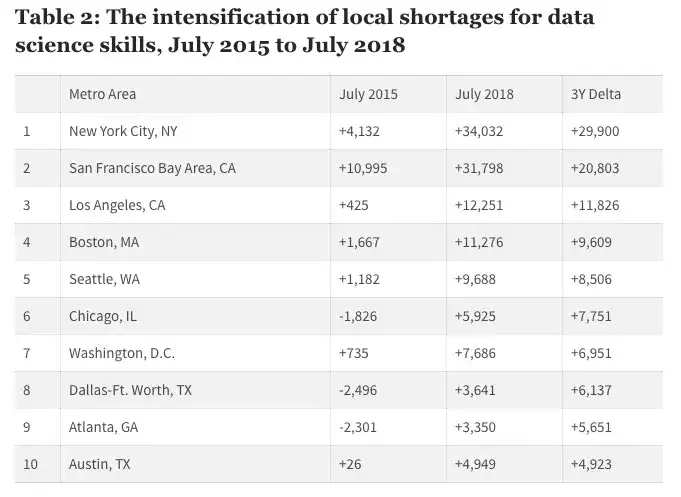
After taking office, former President Obama consistently emphasized the cultivation of STEM talent, highlighting STEM education as key to strengthening U.S. leadership. American universities have also been rapidly launching and certifying more and more STEM programs.
Based on this, does it seem that the U.S. really lacks STEM talent?
However, a U.S. Department of Labor report points out that high demand and undersupply of STEM talent exist only in specific jobs such as software developer, data scientist, and petroleum engineer. For other positions, there is no so-called "crisis"; instead, supply is ample or even excessive!

A U.S. Department of Commerce statistics report also notes that each year, the number of STEM degrees awarded by U.S. colleges exceeds the available jobs in the market, while the proportion of STEM graduates employed outside STEM fields is as high as 75%.
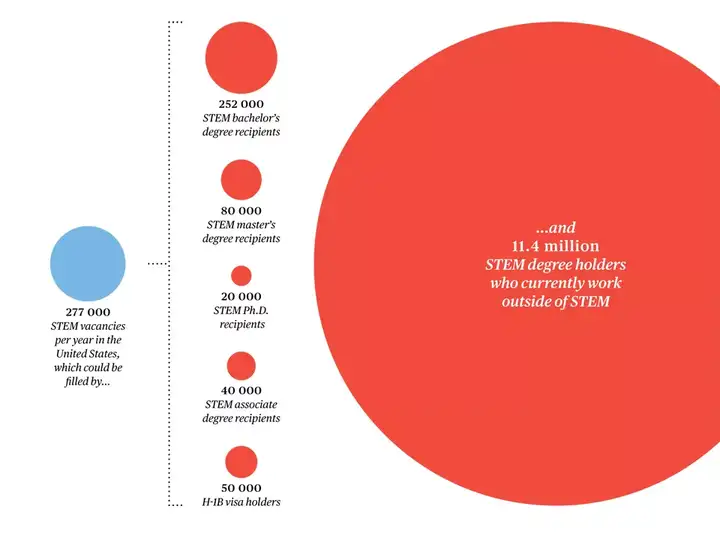
Overall, if there truly is a crisis in the STEM field, it is a shortage of talent with genuine skills and abundant experience, not a shortage of candidates holding STEM degrees.
Is the Job Outlook for STEM Really That Bright?
The three-year OPT period is the primary factor attracting international students to STEM programs. But when it comes to job prospects, is STEM really as legendary as claimed?
For the first job, STEM graduates do have an advantage. Skills-centric STEM graduates can secure employment faster, and their entry-level salaries are higher than those of non-STEM fresh graduates.
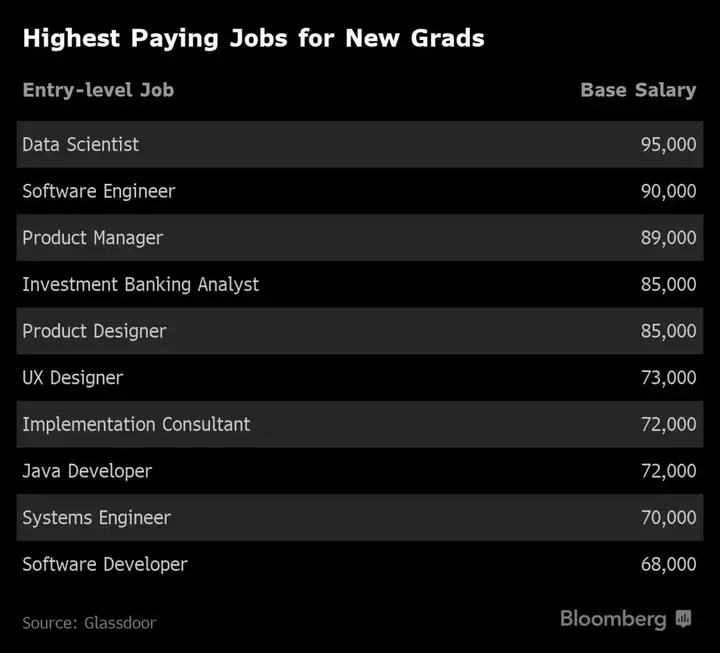
However, later career stages are more complex. The advantage gap for STEM majors actually begins to narrow after the first job.
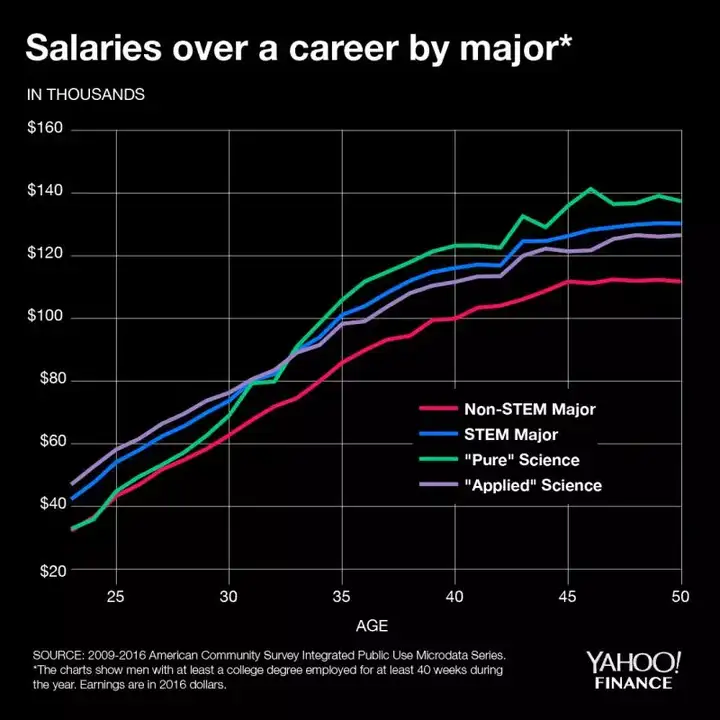
According to the U.S. Census Bureau's Community Survey, by age 40, the average salary for male graduates in computer/engineering fields is $124,458, while for social sciences/history graduates it surpasses that of STEM graduates, reaching $131,154.
In the early career stage, the salary gap between STEM and non-STEM is even more pronounced for women, though both gaps narrow gradually in mid- to late career.
More importantly, by age 40, over half of those with STEM degrees are no longer working in STEM fields.
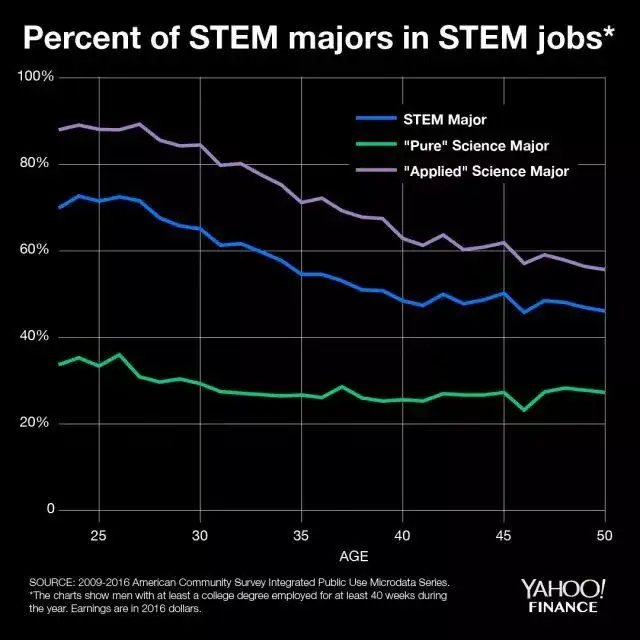
In the STEM world, success depends not on seniority but on the advancement of skills and ideas. In an era of rapid technological evolution, your “cutting-edge technology” may soon become obsolete.
This requires STEM professionals to constantly maintain the awareness of learning new knowledge and technologies—things that the newest class of STEM graduates may have already learned in school.
On one side are mid-career professionals who need to re-skill and demand higher salaries; on the other are fresh graduates with the latest knowledge and skills, requiring lower salaries. Most employers, it seems, will ultimately choose the latter.
This means that once STEM professionals lose their core skill edge, they are extremely vulnerable to being phased out by the market.
Are Liberal Arts Degrees Really Worthless?
Today’s STEM industry is increasingly characterized by a mismatch between education and the workplace.
Having an engineering degree does not guarantee that you will become an outstanding candidate. To improve work efficiency, companies also focus on life skills such as logic, analysis, and problem-solving.
Current STEM candidates may not lack professional background, but they may lack the ability to think critically and absorb information.

Although liberal arts professionals start more slowly, they gradually catch up with their STEM peers over time. At the same time, a liberal arts education excellently cultivates the aforementioned valuable "soft skills" such as problem-solving, critical thinking, and adaptability. These skills are difficult to quantify in the short term but possess long-term value across various industries.
Moreover, as professionals age and their salaries and responsibilities increase, they tend to transition into managerial and leadership roles. Since STEM salary growth slows down, many STEM workers move into management positions, which are well-compensated and do not always require specialized technical skills.
In such managerial and leadership roles, liberal arts graduates may be more capable, as these jobs require skills like communication, empathy, and abstract, creative problem-solving—areas where liberal arts students excel.
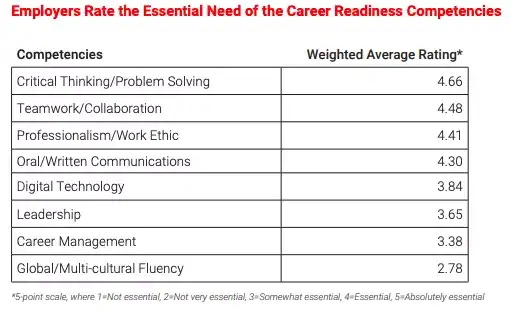
The highest mid-career salaries belong to business and management professionals, or those with specific advanced degrees like law. Liberal arts students often find it easier to enter such fields, thereby narrowing the gap with STEM graduates.
There Are No Good or Bad Majors
Liberal arts have their own value, and many liberal arts programs are now integrating with STEM in interdisciplinary ways for better development.
STEM graduates remain top earners over the course of their careers, and most schools also require STEM students to take liberal arts courses to maintain a well-rounded education.
What concerns U.S. educators now is that college education is increasingly resembling vocational training, emphasizing career and technical preparation while neglecting holistic and long-term personal development.
This is something all current students should be wary of. There is no inherent good or bad in choosing a major; what matters most is whether the program you pursue genuinely benefits your comprehensive future development.