
With the advent of the big data era, companies both domestic and international are increasingly valuing data statistics, and statistics has gradually become a hot major for study abroad. Today, CheersYou(清柚教育) introduces statistics to students.
What is Statistics?
Statistics is a branch of applied mathematics that covers the collection, analysis, interpretation, presentation, and organization of data, using mathematical modeling and analysis to provide a basis and reference for relevant decisions. It emphasizes solving practical problems and values students' ability to apply statistical software and their hands-on skills.
Statistics widely absorbs and integrates new theories from other disciplines, continuously developing new applied techniques and methods, and is widely used in many fields:
Biostatistics
This field explores how to design, sample, analyze, organize data, and draw inferences in biological experimental research.
Financial Statistics
This field mainly focuses on how the statistical departments of central banks and various financial institutions investigate, collect, organize, and analyze data on financial business activities, thereby providing statistical information and consulting opinions, and conducting financial statistical management and supervision.
Applied Statistics
This field mainly studies the application of general theories and methods of statistics in various fields such as society, nature, economy, and engineering. It is an interdisciplinary field formed between statistics and other disciplines.
Mathematical Statistics
This field applies the analytical results of probability theory to further study statistical data, revealing internal patterns by observing the frequency of certain phenomena, and making corresponding judgments and predictions by constructing mathematical models.
Career Prospects in Statistics
In China, statistics is gradually becoming one of the hottest majors. Statistics graduates have a solid background in mathematics and economics, and can engage in statistical surveys, statistical information management, quantitative analysis, market research, quality control, and the development, application, and management of high-tech products in enterprises, institutions, and economic, financial, and management departments, or work as senior professionals in research and education institutions.
High-quality statistical professionals with overseas study backgrounds have more advantages and competitiveness. In terms of overseas employment, statistics is even better than in China. The U.S. business environment is very mature, and various industries attach great importance to data analysis, which is a strength of statistics graduates.
According to data provided by the American Statistical Association (ASA), the industries recruiting statistics graduates in the United States are mainly concentrated in the following:
-
Health and Medicine
-
Public Health
-
Business and Industry
-
Computer Science
-
Economics
-
Engineering
-
Finance
-
Insurance
-
Manufacturing
-
Marketing
-
Quality Improvement
-
Risk Assessment s
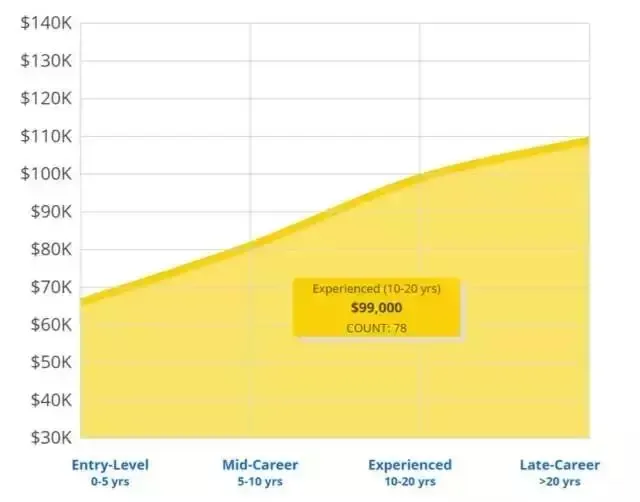
Statistics graduates in the U.S. entering statistics and related industries generally start with an annual salary of around $65,000, can reach $80,000 in mid-career, and later can reach $110,000.
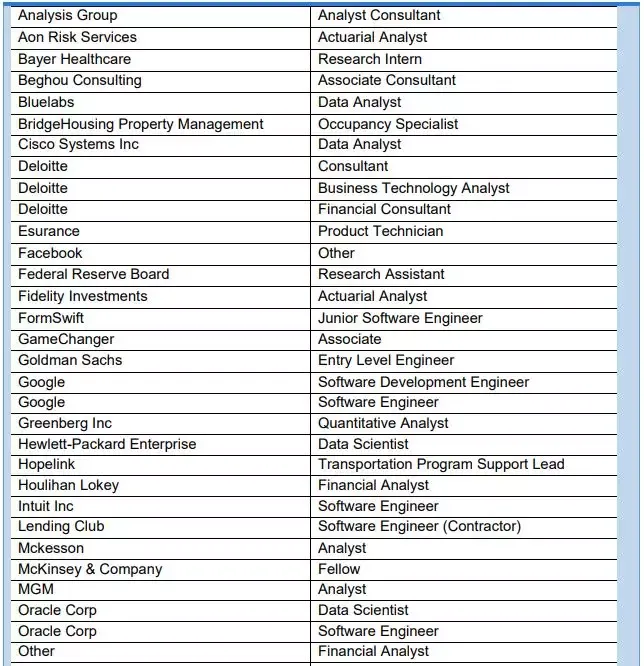
According to data from the official website of the University of California, Berkeley, graduates of the Master's in Statistics program are successfully employed at major companies such as Amazon, Citigroup, JP Morgan, Microsoft, Deloitte, Uber, etc., working as data/quantitative/product analysts.
The average salary for graduates is $80,871.
Recommended Management Programs
Cornell University
MPS in Applied Statistics
The MPS program is housed in the Department of Statistics and Data Science at Cornell University, designed for students who wish to pursue careers in business, industry, government, or scientific analysis. This program offers courses in modern data analysis skills, and currently, among Ivy League schools, only Cornell offers this program.
The program has two tracks:
-
Emphasis on statistical analysis skills
-
Data science, which, compared to track one, focuses more on computer science learning
Curriculum:
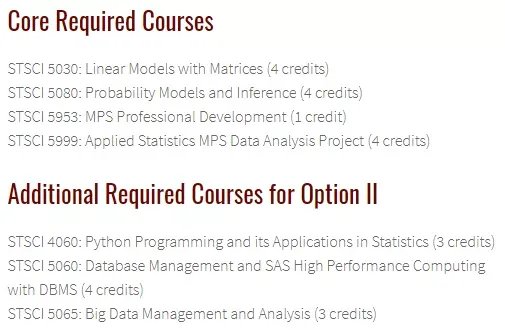
Required and elective courses total at least 30 credits. Each semester, students may take at most one elective course for the MPS degree. The graduation requirement is a GPA of 2.5 or higher in MPS degree courses.
Basic application requirements:
· At least two academic recommendation letters
· Personal Statement
· Resume (optional)
· TOEFL (minimum scores: Listening 15, Writing 20, Reading 20, Speaking 22) / IELTS (overall minimum 7.0)
Application deadline: Fall admission deadline is February 1
University of California, Los Angeles - MAS
This program integrates the fundamental ideas of quantitative analysis with modern computational science methods. Students will master the principles of statistics, and the courses taught will provide them with the skills needed to work as quantitative professionals in business, engineering, healthcare, financial services, science, and computer-related industries, as well as government and non-profit organizations.
Curriculum:
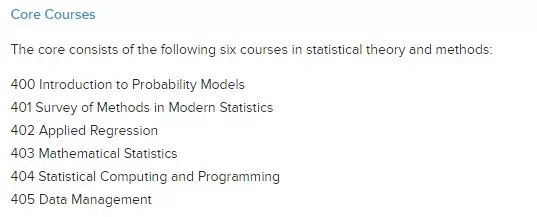
MAS students must complete at least 44 units of coursework. The Master of Applied Statistics program has a set of six required core courses. In addition, students will take at least five electives emphasizing statistical modeling and programming.
Basic application requirements:
· Minimum GPA 3.0
· Resume
· Two recommendation letters
· Personal Statement
· Accept GRE (no minimum score requirement)
· TOEFL/IELTS
Application deadline: The deadline is March 1
Washington University in St. Louis
MA in Statistics
This program is offered by the College of Arts & Sciences at Washington University in St. Louis, providing flexible and extensive elective and applied courses, emphasizing statistical analysis in fields such as mathematics, computer science, engineering, practical investigation, biostatistics, economics, and business.
Curriculum:
The MA in Statistics program requires a total of 36 credits, including required courses, thesis/internship, and electives. Students must complete the following five required math courses or their equivalents:
Math 493 and 494 (Probability and Mathematical Statistics)
Math 5061 and 5062 (Statistical Theory)
Math 5071 or Math 439 (Linear Statistical Models)
Math 459 Bayesian Statistics
and Math 475 (Statistical Computing)
or a suitable elective approved by the department
Application requirements:
· Personal Statement
· Resume
· Three recommendation letters
· GRE required, GMAT not accepted
· TOEFL required
Application deadline:
December 15, 2019
Background Requirements for Statistics Majors
Statistics master's programs have certain requirements for undergraduate background. It is best to have a certain mathematical foundation, especially for students with majors in statistics, mathematics, actuarial science, applied mathematics, etc., as they have an advantage in applications. Applicants' mathematical background is also required, and it is best that they have taken relevant math courses.
Cornell University's MPS program explicitly requires: applicants should have an undergraduate major with a "quantitative" orientation, such as statistics/mathematics/engineering/physics/agriculture/biological/natural or computer science.
And it requires the following mathematical background for applicants:
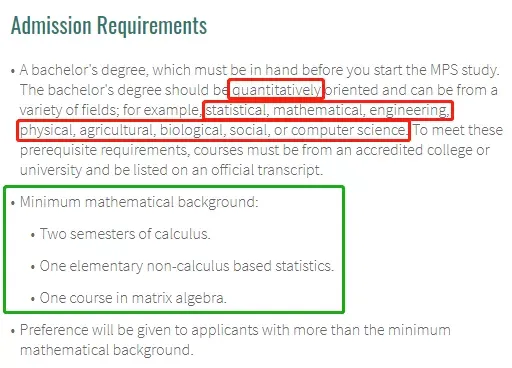
If students have taken advanced mathematics courses such as advanced math, linear algebra, calculus, probability and statistics, etc., with excellent grades, and have strong statistics-related internships, they can also apply to transfer to a statistics program.
In addition to a mathematical foundation, students must also be able to proficiently use computer software, such as BATLAB, SAS, SPSS, etc.
Application Season 2019–2020: CheersYou(清柚教育) Students Have Received Multiple Offers from Top Statistics Programs! Click the link to read their application stories
Student M, MSU, Actuarial Science, Columbia University Applied Statistics: Giving up the Legendary “Universal” Major and Taking a More Suitable Application Path, Finally Admitted to Columbia University
Student L, UCI, Mathematics, University of Michigan Ann Arbor Applied Statistics: Without Any Relevant Internship Background, Receiving High-Ranked Program Offers One After Another
Student G, Nankai University, Mathematics, Columbia University Statistics: From Anxiety to Zen, Finally a Turnaround Harvesting an Ivy League Offer!