Statistics—a hot major in recent years. With the advent of the "artificial intelligence" and "big data" era, statistics graduates have quickly become "high-demand talents," and their future prospects are immeasurable.
Statistics not only offers high starting salaries (master's graduates can earn $60,000–80,000 annually) and great job prospects, but it also doesn't require the various certifications that business degrees demand. It's a versatile field; graduates can enter a wide range of industries and quickly join the ranks of sought-after professionals.

In the birthplace of fundamental sciences, the United Kingdom, statistics has a history spanning over 300 years. The world’s most renowned statistical society—the Royal Statistical Society (RSS)—is based in the UK.
Many UK universities offer statistics programs, and some even have dedicated statistics departments. Let’s take a closer look at the specific details of statistics programs at UK universities!
Introduction to UK Statistics Master's Programs
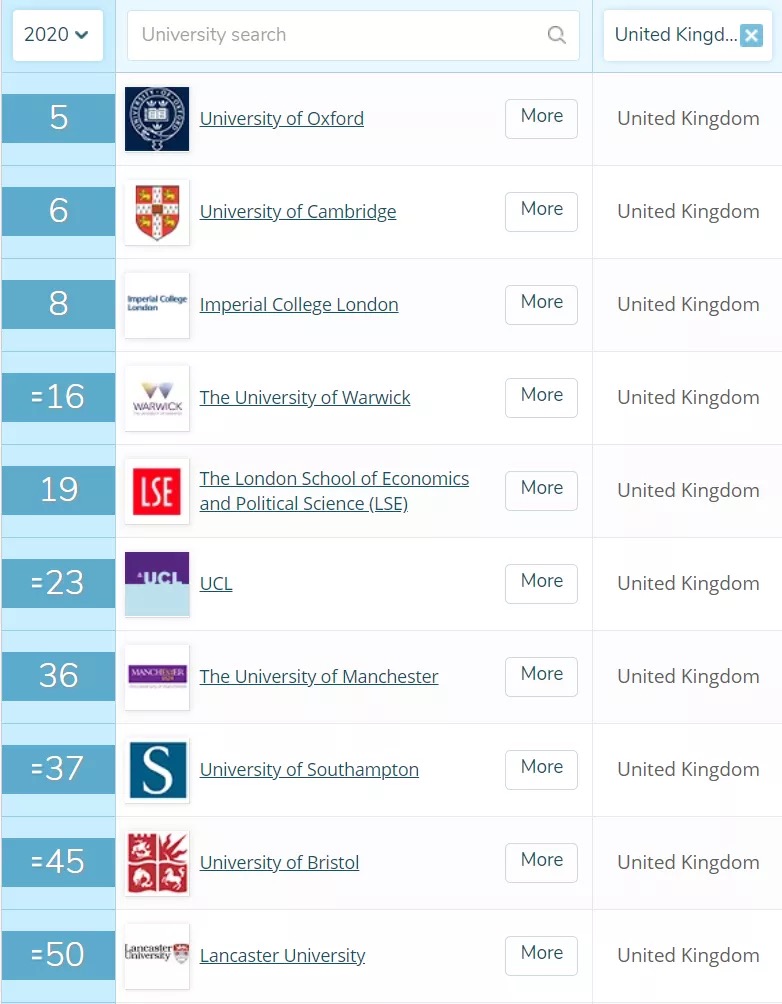
QS 2020 Statistics & Operational Research Ranking
Since its origins in the 17th century, statistics has evolved into an indispensable part of decision-making across all disciplines.
Statistics focuses on data, building mathematical models through probability theory and using appropriate methods to reason and predict based on relevant data. As times change, statistics has become increasingly vital, serving as a foundation for research in many fields.
As a branch of applied mathematics, statistics covers a wide range of specializations, enabling graduates to enter finance, healthcare, internet technology, and many other sectors. UK master's programs in statistics generally fall into the following categories:
-
Statistics
-
Statistics with Finance
-
Statistics with Applications in Medicine
-
Statistics with Applications to Finance
-
Operational Research and Applied Statistics
-
Social Research Methods and Statistics
-
Statistics and Computational Finance
Background Requirements for UK Statistics Master's
Compared to other subjects, statistics has relatively high background requirements for applicants, and the specific requirements vary by institution. Generally, applicants with undergraduate degrees in mathematics, statistics, or related fields are preferred.
Background Requirements: Due to the academic nature of statistics, applicants are expected to have an undergraduate background in statistics or a related subject (such as mathematics, engineering, physics, or computer science).
Grade Requirements: Strict thresholds exist based on the applicant's Chinese undergraduate university background. For students from 985/211 institutions, an average score of 80+ is required, while for those from non-985/211 institutions, 85–90+ is needed.
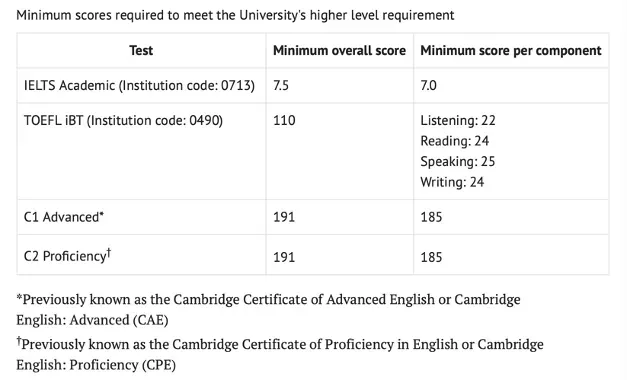
Language Requirements: The baseline IELTS requirement is 6.5, with no sub-score below 6.0. Top institutions have higher requirements; for example, Oxford explicitly states a minimum IELTS score of 7.5, with no sub-score below 7.0.
University of Oxford Language Requirements
Recommended UK Universities for Statistics Master's
University of Oxford
Oxford University
As the UK's largest research hub and a world-leading institution, Oxford has been renowned for centuries for its outstanding achievements in education, research, medicine, mathematics, economics, and history. Oxford also holds the most research patents of any UK academic institution, with over a hundred affiliated companies, making it a "blessed place" for employment.
Oxford's statistics-related programs include:
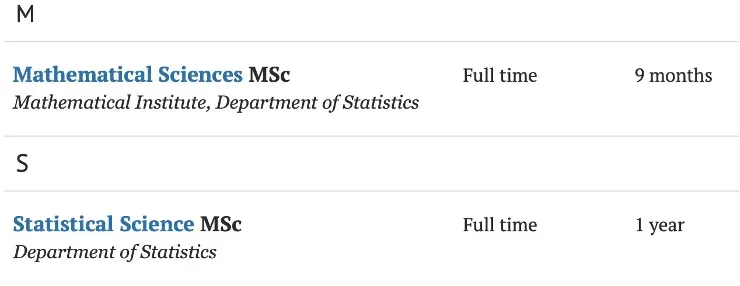
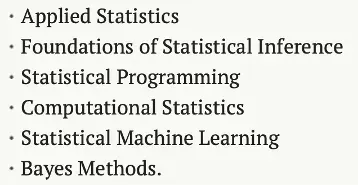
Oxford’s statistics programs aim to train students to solve real-world statistical problems, with a curriculum leaning towards computer and engineering applications. The curriculum is updated annually; for the 2020-2021 academic year, the core courses are as follows:
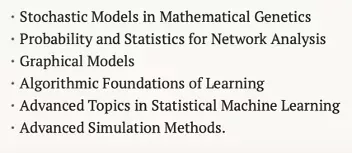
Elective courses are as follows:
Oxford requires applicants for this program to hold a first-class or strong upper second-class undergraduate honours degree in mathematics or statistics. GRE/GMAT scores are not required, but admission is highly competitive, and most successful applicants have outstanding academic records.
For applicants with a US bachelor's degree, a minimum GPA of 3.6/4.0 is required.
Official link:
https://www.ox.ac.uk/admissions/graduate/courses/msc-statistical-science
Imperial College London
Imperial College London
Located in central London, this world top-10 university is internationally renowned for its excellent teaching and research. IC’s curriculum is practical and flexible, yet highly quantitative, demanding a strong quantitative background from applicants.
Imperial’s statistics-related programs include:
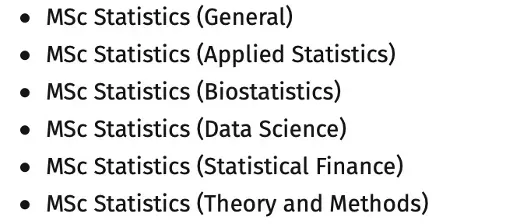
Students must complete five core modules—applied statistics, computational statistics, fundamentals of statistical inference, statistical probability, and a statistical research project—along with relevant elective modules. From May to September, students no longer attend lectures but instead work on a research project with a supervisor.
It’s worth noting that IC also offers a highly popular statistics program in financial statistics (Statistical Finance), which has excellent employment prospects.
Official link:
https://www.imperial.ac.uk/study/pg/mathematics/statistics/
University of Manchester
University of Manchester
Manchester’s statistics program aims to build a solid foundation for students planning advanced research in statistics, providing an excellent development platform. Graduates often enter finance, healthcare, pharmaceuticals, and industry, as well as local and national government.
Additionally, Manchester’s statistics faculty includes a highly respected Chinese professor, Professor Jianxin Pan. Professor Pan is a professor in the Department of Mathematics (Statistics Group) at the University of Manchester and an honorary researcher in the university’s medical school; he is an internationally renowned statistics expert.
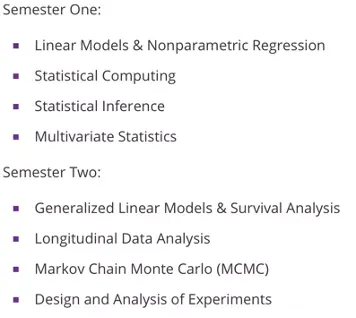
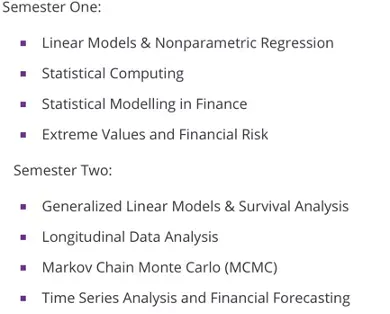
Manchester’s postgraduate programs consist of two 12-week semesters, with the statistics major split into two pathways: statistics and financial statistics.
The statistics curriculum is as follows:
The financial statistics curriculum is as follows:
Official link:
https://www.manchester.ac.uk/study/masters/courses/list/02362/msc-statis...
University of Southampton
University of Southampton
While Southampton’s overall ranking may not be exceptionally high, its statistics program is very strong, ranking 8th in the UK in the QS Statistics subject ranking.
Like Manchester, Southampton’s statistics program is led by a Chinese professor, Professor Wei Liu. Professor Liu has extensive teaching experience in statistics; after earning his PhD in statistics in 1990, he was immediately appointed as a permanent lecturer at the University of Southampton.
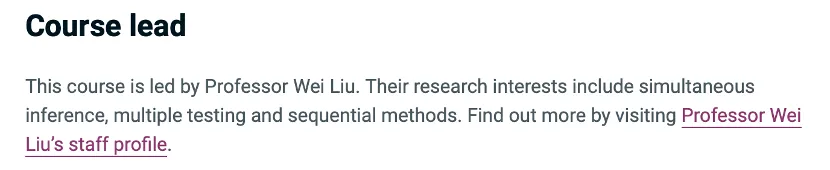
The one-year program includes a three-month period for a 30-credit research project. Alongside core academic modules, students also learn statistical software, time management, and basic research skills.
Southampton’s statistics module structure:
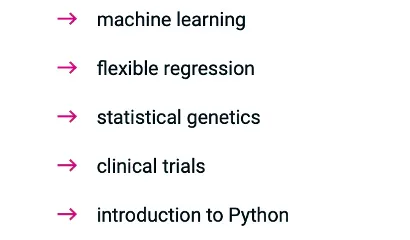
Southampton’s statistics program emphasizes practical skills, developing students’ data processing abilities and modeling competencies using statistical methods. Graduates are employed across a wide range of sectors, including banking, insurance, pharmaceuticals, and government.
Official link:
https://www.southampton.ac.uk/courses/statistics-masters-msc#about
That’s all for the introduction to statistics programs for today. With the rise of the internet age, statistics and big data analytics are becoming increasingly popular. But with so many hot majors, which one should you choose?
For more personalized advice and tailored school selection, click the official website’s customer service button in the bottom right corner to add a CheersYou(清柚教育) education consultant for a free consultation!