
Five or six years ago, NYU's Financial Engineering program was a little-known master's project.
The program wasn't well-regarded, the school was dismissed as "diploma mill," and its Brooklyn campus made it an option that students applying to financial engineering often skipped entirely.
Fast forward to 2021, and NYU MFE has become a powerhouse in the financial engineering study abroad landscape. Application numbers hit new records every year, waitlists are handed out capriciously, and a large number of outright rejections occur. NYU MFE has undergone a dramatic transformation into an arrogant, overhyped program...
What exactly happened to make NYU's Financial Engineering so inflated?
A Nouveau Riche-Style Rise
Starting in 2016, NYU's Financial Engineering began its ascent. The engineering school it belonged to received a $100 million donation from alumni the Tandon family, becoming an overnight sensation.
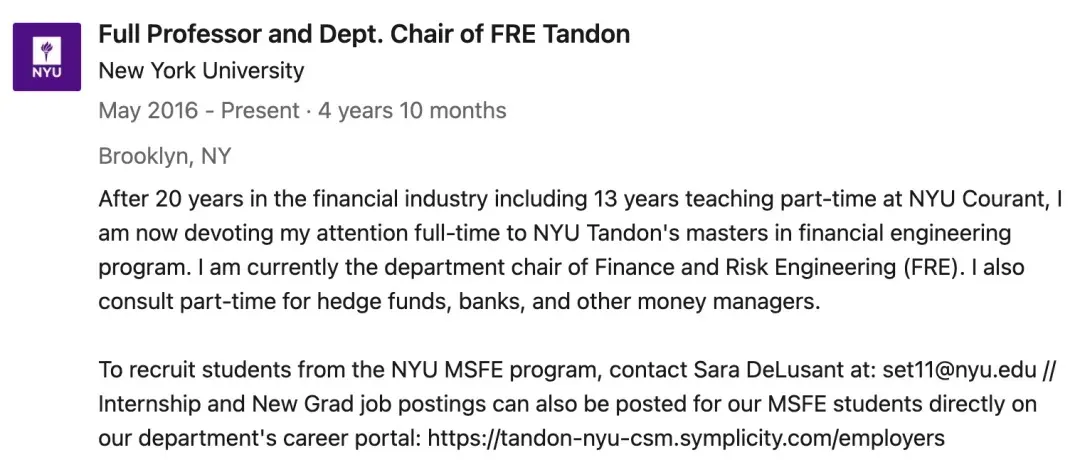
That same year, Peter Carr, former chair of NYU Courant's Mathematical Finance program and a former industry heavyweight at Morgan Stanley and Bloomberg, took over as department chair. Under his leadership, NYU MFE truly took off, becoming the king of value in financial engineering and an unshakeable industry benchmark.
Peter Carr LinkedIn
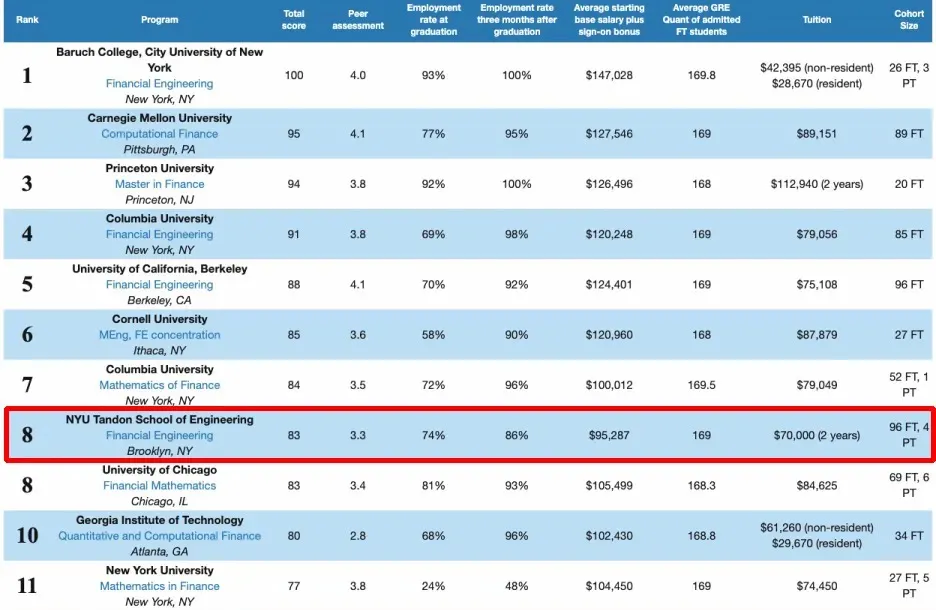
Today, NYU Tandon School of Engineering's MFE program crushes MIT on QuantNet, surpassing its own sister program in Mathematical Finance and solidly ranking in the Top 10 among financial engineering programs.
QuantNet 2021 Rankings
Peter Carr frequently engages on QuantNet forums to promote the program, truly sparing no effort to elevate NYU MFE.
Peter Carr's "interaction" regarding accusations that NYU MFE "fake reviews" on QuantNet

From a initially lackluster program to a hot commodity with ever-rising applications in just a few years, it makes one wonder:
Is NYU MFE's marketing and PR just too good, or are financial engineering applicants blindly following the herd?
Application Difficulty Spikes Year After Year—What's the Point?
As NYU MFE's popularity surged, so did its admission difficulty. Top-tier candidates treat it as a safety, average applicants hope to ride its coattails, and lower-tier candidates want to take a shot.
NYU MFE's applicant pool grows every year, and the admission standards have become increasingly absurd.
COVID impacting admissions? NYU MFE says there's no shortage of candidates.
3.9 GPA secure for admission? NYU MFE says not necessarily.
Generous scholarships? NYU MFE says not anymore.
……
These days, the most common responses from NYU MFE are not admission letters, but waitlists and rejections. The program isn't worried about enrollment; it's overwhelmed by too many applicants and struggles to choose.
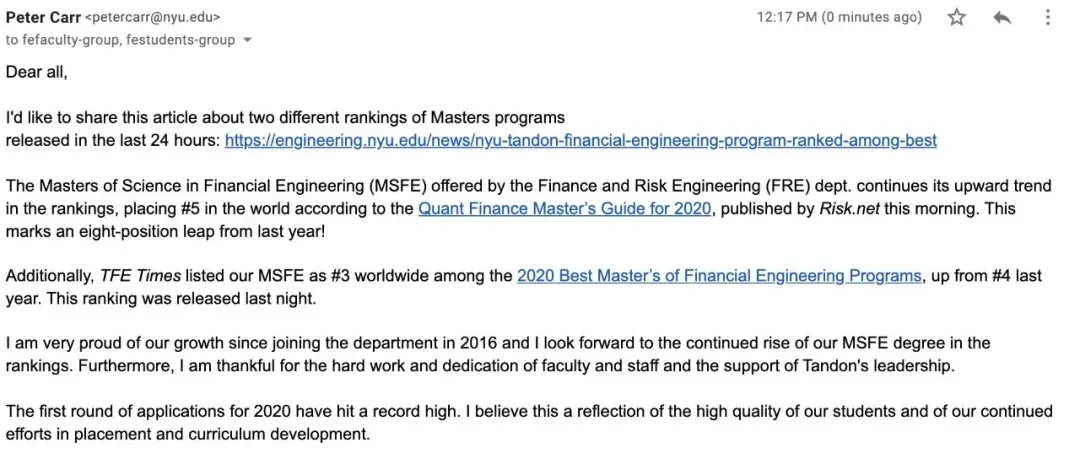
During the Fall 2020 application cycle, Peter Carr sent a mass email to faculty and students announcing a record-high number of applications.
NYU MFE mass email to faculty and students
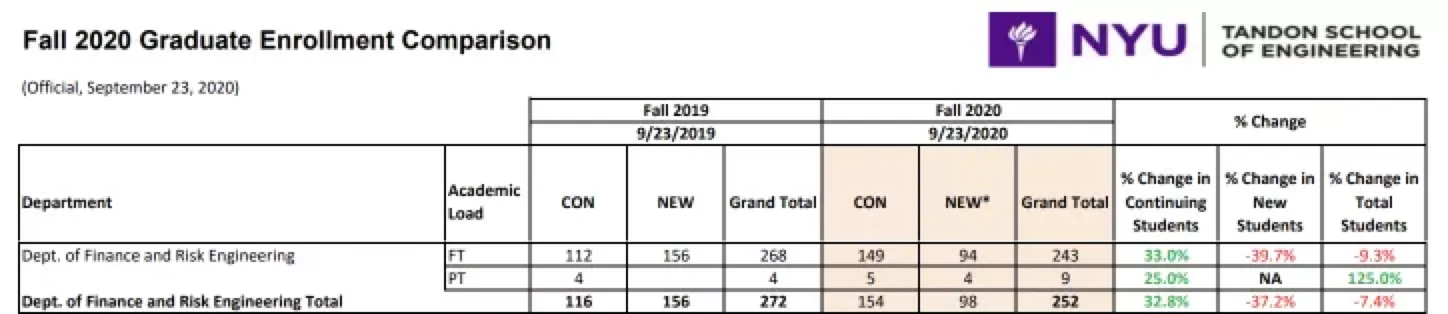
Yet the final Fall 2020 data shows NYU MFE admitted only 98 students, a 39.7% drop from Fall 2019.
With such a massive applicant pool, the admission numbers have regressed to levels unseen since five years ago. NYU MFE, this is a bit much...
NYU MFE historical enrollment data

Many strong applicants placed on the waitlist wonder if NYU MFE admissions now uses a random lottery...
Seeing the struggles of previous applicants, many prospective students are starting to question: Does the soaring admission difficulty truly reflect the program's current caliber?
Can NYU MFE Stand the Test of Time?
Indeed, NYU MFE's improvement in recent years is undeniable, and it's widely recognized as a high-value program.
But is this high value merely bait to attract students with low tuition and scholarships, or does it genuinely help students excel after graduation and launch thriving careers?
Not to mention whether financial engineering itself will remain a hot trend, NYU MFE, frankly, still lacks the long-standing reputation of more established programs.
“Low tuition and easily available scholarships, but the curriculum is not as rigorous as established programs like CMU or Columbia, and may not optimally strengthen quant skills,” is a common criticism from online commenters.
QuantNet user comments on NYU MFE
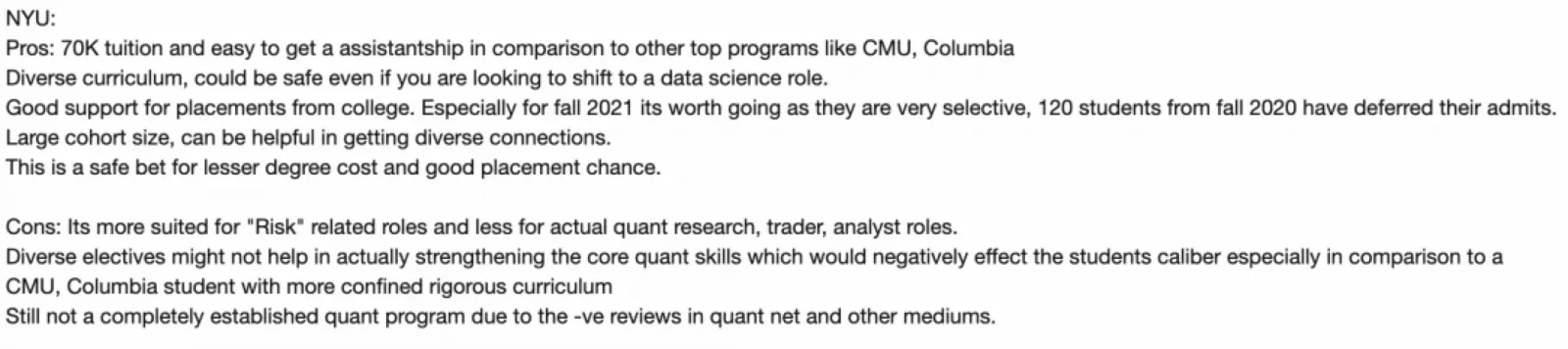
According to job-search experiences of some NYU MFE graduates, the program's career support has not kept pace with its own popularity.
NYU MFE's earlier enrollment expansions didn't synchronize well with resource allocation, leading to a situation of too many students and too few resources. Later enrollment cuts didn't seem to effectively solve the problem. NYU MFE students, truth be told, don't find it easy to land good jobs in the US.
The program markets itself as career-oriented, but to some extent, it reflects the American "teach to the test" approach—job hunting for the sake of job hunting, neglecting the intrinsic value of graduate education.
Compare NYU's own Tandon MFE and Courant Mathematical Finance: a 74% versus 24% employment rate looks impressive on paper, but when it comes to target schools, large firms still prefer Mathematical Finance; MFE is often not even on the list.
NYU Mathematical Finance co-hosts an annual Career Fair with IAQF International Association for Quantitative Finance
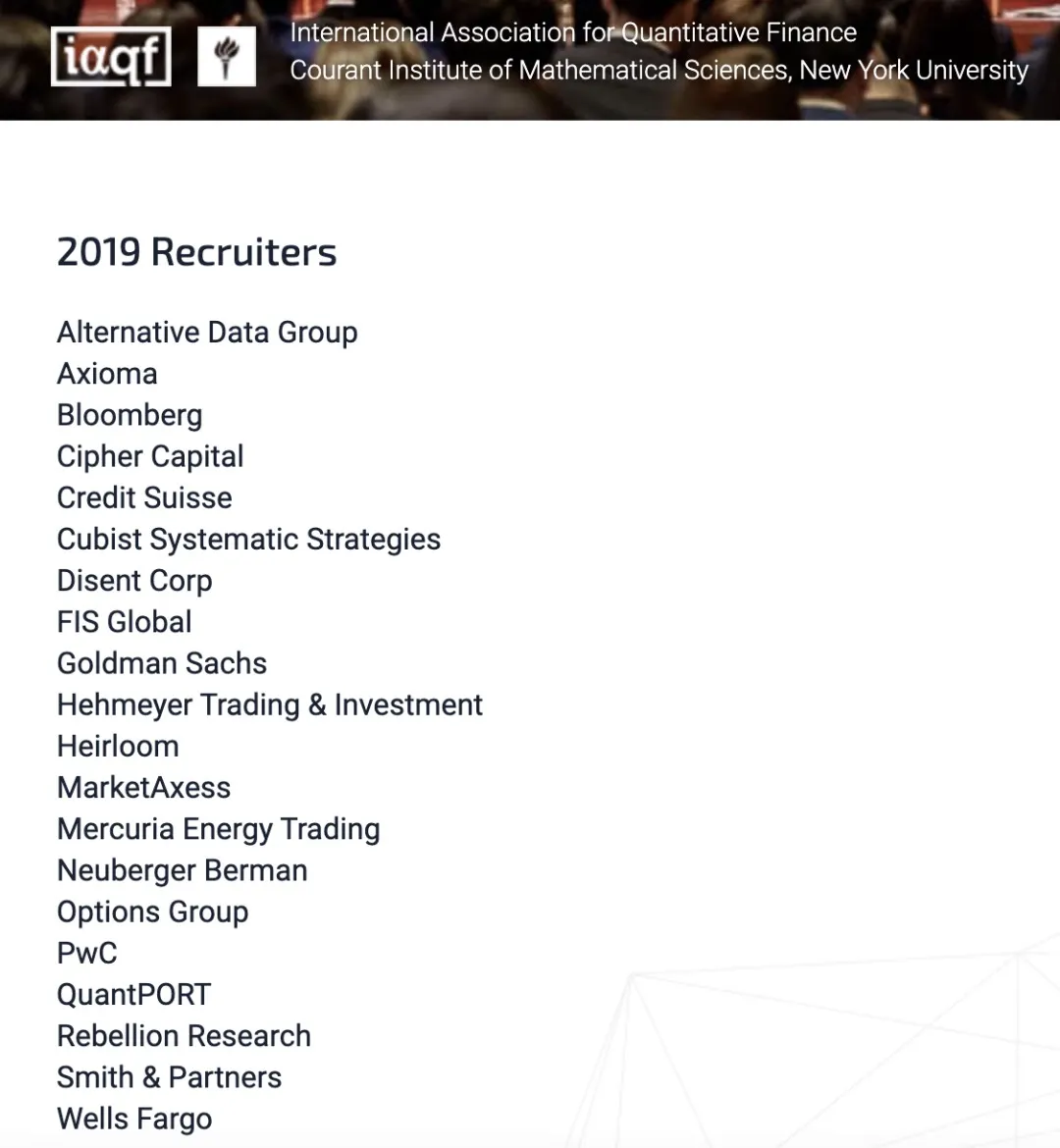
Online forum comparison between NYU MFE and Mathematical Finance

Looking at long-term career development, many early graduates from CMU's MFE program have already reached VP roles, while NYU MFE graduates from the same cohort may still be struggling at entry level.
If NYU MFE's career support only helps you find a job, not a good job, would students with high expectations still be satisfied?
NYU MFE employment data
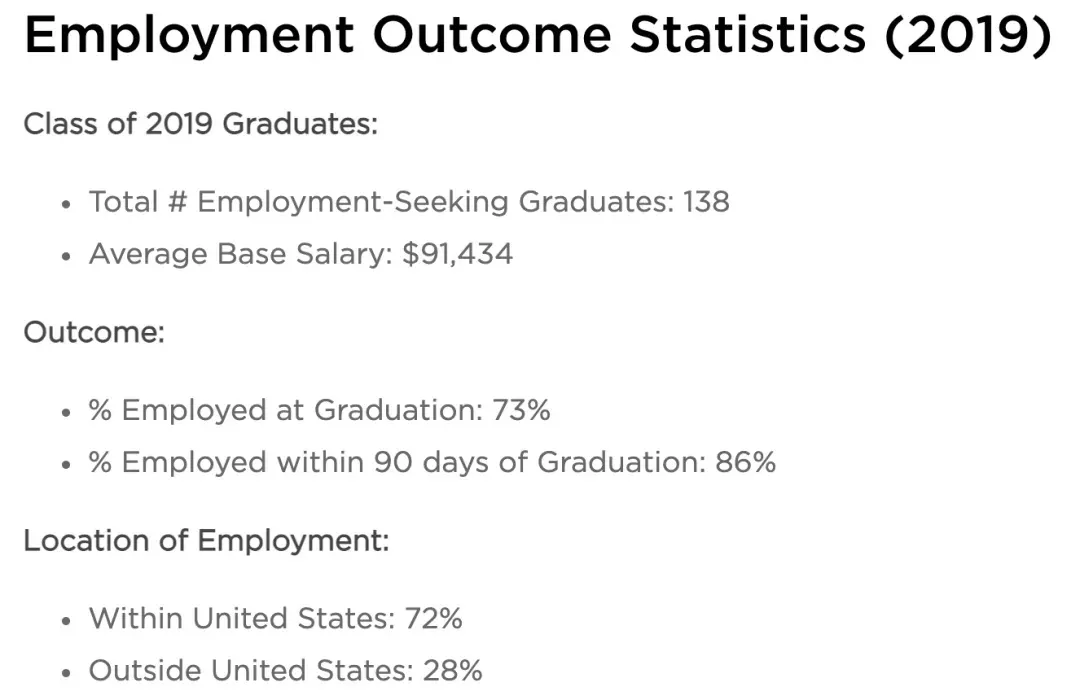
NYU MFE has not had enough time to mature, and its true value remains to be seen. We hope it withstands the test of time and continues to thrive in the future.
Looking at long-term career development, many early graduates from CMU's MFE program have already reached VP roles, while NYU MFE graduates from the same cohort may still be struggling at entry level.
If NYU MFE's career support only helps you find a job, not a good job, would students with high expectations still be satisfied?
Choose Schools Rationally, Avoid Blind Herd Mentality
Objective data, when packaged, can become "subjective truth." The ultimate learning outcomes and career development depend on the fit between you and the program, as well as your continuous effort.
Focusing solely on cold program statistics when applying and blindly selecting schools is an unwise approach.
This isn't limited to financial engineering or mathematical finance; many popular programs like BA/DS in recent years also see applicants fixating only on the "bright prospects" advertised on program websites, while overlooking whether they are truly a good fit.
This is a key point for today's applicants to note. Whether it's the school's own marketing or various rankings on the market, these are merely reference data and should not be the sole basis for university selection.
Study abroad applications also require "slow and steady work" and a "tailored approach." Only through meticulous planning and targeted assessment can the schools you select truly be your dream schools.
The new application season has quietly begun. I wish every applicant the best in finding the program that suits them best and ultimately receiving that admission offer!