UK universities are really getting better at making money—master’s degrees can now be “sold in pieces.”
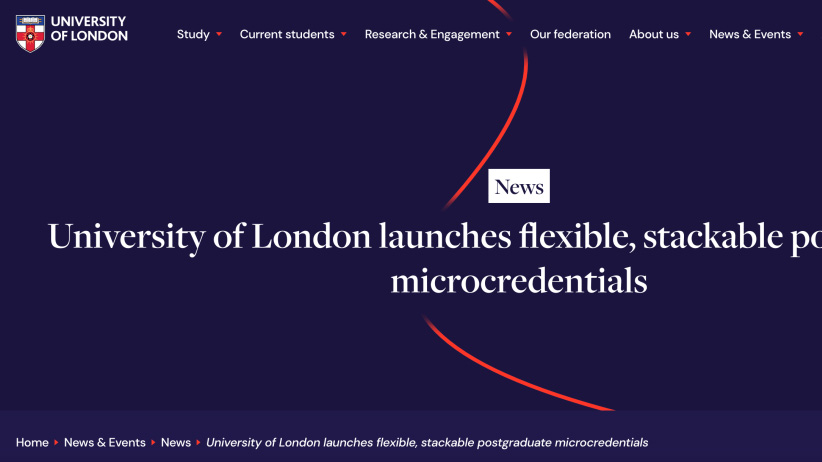
Recently, the University of London (a federation of London universities) officially announced a brand-new study model:
Stackable Courses
Source: University of London
To put it simply, in the future you’ll be able to take a master’s course by course and eventually piece together a complete degree.
The news set off a firestorm in both the UK local and international student communities, because it has the potential to reshape the structure of UK master’s programs.
What Are “Stackable Courses”?
So what exactly are “Stackable Courses”?
The traditional UK master's model is familiar to everyone:
-
One-time application
-
Complete in one year
-
Earn 180 credits to finish the degree
The University of London’s new model breaks the master’s into smaller modules:
• Around 15 credits each
• Cost approximately £495
• Delivered online
• Start anytime
• Earn credits upon passing the exam
This gives students total freedom of choice—you can take just one course to upgrade a specific skill; take a few courses as short-term learning; or work while accumulating credits over time, eventually piecing together a full 180-credit master’s degree.
It sounds pretty good—you decide how much to learn, when to learn, and for how long.
Source: THE
Currently, micro-credential courses under the academic direction of St George’s, University of London are already online. In the coming months, other member institutions will also roll out more courses. The first batch includes:
-
Project Management for Supply Chain Professionals
-
Supply Chain Finance and Risk Management
-
Business Forecasting and Data Analysis
-
Core Concepts in Supply Chain Management
-
Supply Chain Innovation and Technology
UCL has also followed suit, and three micro-credential courses under its guidance are now available on the University of London’s global digital campus:
-
Financial Accounting Frameworks
-
Management Accounting Frameworks
-
Fundamentals of Financial Management
Officials have also hinted that more broad subject categories may launch in the future, including accounting, business management, and other professional skills courses.
Why Is the UK Doing This?
So, why is the UK doing this?
The core context is the UK government’s Lifelong Learning Entitlement.
In simple terms, students will in the future be able to access loan entitlement equivalent to four years of study, but they won’t need to use it all at once. Instead, you can study for a while, then work, and later come back to take more courses and gradually complete your degree.
This means a degree is no longer a “one-off deal,” but a long-term investment that can be digested in stages.
It must be admitted that the UK is truly at the global forefront in the industrialization of education. It’s not simply raising tuition fees, but directly redesigning education rules and restructuring the degree system to create new “growth points.”
And on the university side, they quickly sniffed out the huge business opportunity—
• Can attract more working professionals who cannot take time off to study full-time
• Students can work while studying, making learning more flexible
• Breaking courses into modules lowers the entry barrier
• Less pressure to recruit a set number of students at once
• More stable and diversified revenue streams that can grow continuously
Can This “Pieced-Together Master’s” Get Credential Recognition in China?
However, the question most concerning for international students is: can this “pieced-together master’s” be recognized by the Chinese Service Center for Scholarly Exchange (CSCSE)?
According to current policy, the answer is very clear—only complete degree programs recognized by the Ministry of Education can obtain CSCSE certification.
That is to say, individual modules, course certificates, statements of learning, micro-credentials, and short online courses are all outside the scope of certification.
To obtain certification, you must:
1. Complete a full master’s program recognized by the Ministry of Education
2. All modules must come from the official curriculum of that program
3. Meet the institution’s requirements for a “complete degree”
4. The online proportion must not exceed the CSCSE’s limits
Moreover, Stackable Courses are currently mostly fully online, flexibly enrolled, and resemble professional skills courses—characteristics that inherently make it difficult for them to meet CSCSE certification standards.
So in the short term, the “study-and-accumulate” approach does not hold significant value for international students and cannot replace a formal master’s.
Not long ago, the overseas credential recognition system also underwent a major overhaul. The Ministry of Education has clearly strengthened its scrutiny of foreign qualifications, and many overseas universities’ “diploma mill” master’s and doctoral programs have been directly blacklisted from certification. The certification application system has also been significantly revamped, making credential verification an incredibly tough process!
Source: Chinese Service Center for Scholarly Exchange (CSCSE), Ministry of Education
This reform can be called the “strictest ever”! Not only has the certification opportunity been limited to once per year, but the chance for review and appeal has also been reduced to just once, significantly raising the certification threshold and review standards.
Source: Chinese Service Center for Scholarly Exchange (CSCSE), Ministry of Education
The days when you could get certification just by submitting materials are history! Going forward, the focus will no longer be solely on document completeness; reviews will pay more attention to teaching cycles, academic substance, and program authenticity, with intensified verification efforts!
Source: Chinese Service Center for Scholarly Exchange (CSCSE), Ministry of Education
Diploma mill degrees, extensive remote courses during the pandemic, and academically controversial programs at some institutions will all face stricter scrutiny.
Global higher education is accelerating toward more flexible and commercialized models, but also a phase that is more complex and harder to navigate.
For students preparing to study abroad, the future application path is no longer a simple “choose a country, get a degree”—program formats will become increasingly diverse, course structures more fragmented, and the boundary between online and offline constantly blurred. As choices multiply, so do the risks.
In such an environment, we need to stay vigilant and discerning. What is truly worth investing time and money in are schools and programs with stable faculty quality, mature training systems, clear degree qualifications, and that appear on the Ministry of Education’s approved list.
We hope everyone can avoid pitfalls, make rational judgments, and take charge of their own study abroad planning.