
Every graduation season, the employment reports released by prestigious universities become key "barometers" closely watched in the study-abroad community.
Recently, the University of Pennsylvania released the employment report for the Class of 2025.
Source: UPenn
As one of the top Ivy League schools in the U.S., UPenn's employment data has long been regarded as a key benchmark for the global high-end talent market. The career paths and salary trends of its graduates often reflect the overall direction of the current job market to a certain extent.
This year's report, however, signals a notable development:
While traditional popular sectors like finance and consulting still dominate, graduate salary growth is no longer as impressive as in previous years, and the job market as a whole is showing signs of cooling.
Has the UPenn High-Salary Myth Been Shattered?
According to data released by UPenn Career Services, this year's report tracked the employment, salaries, and post-graduation education plans of the Class of 2025, marking the first time in years that both the average and median starting salaries for UPenn graduates experienced a slight decline.
The median starting salary for the Class of 2025 dropped 1.5% from the previous year, from $105,000 to $103,418, while the average starting salary also edged down slightly, from $101,175 to $101,125.
Source: Upenn Career Services
In previous years, even amid economic fluctuations, UPenn graduates' starting salaries had maintained a moderate annual increase of 2%-4%, but this 2025 report breaks that trend.
Notably, this marks the first time that both the average and median starting salaries have declined simultaneously since the UPenn Career Services began publishing graduate data.
While the university did not provide an explicit explanation for this shift, it is not entirely surprising when considering the broader U.S. job market performance over the past two years.
The tech sector continues to undergo adjustments, with multiple Silicon Valley companies scaling back campus recruitment efforts, while hiring in finance and consulting has become more cautious, and some leading institutions have even slowed their graduate recruitment pace.
Source: Layoffs.fyi
In such a market environment, graduate salary growth has naturally been affected to some degree.
However, this does not mean that UPenn graduates' competitiveness has declined. On the contrary, against a generally pressured job market backdrop, the $103,000 median starting salary for the Class of 2025 remains at an extremely high level, far exceeding the average income of U.S. bachelor's degree graduates.
A $40k Starting Salary Gap and Post-Graduation Destinations by School
There are significant differences in starting salaries across schools. Among the Class of 2025, the School of Engineering and Applied Science reported the highest median and average starting salaries, with a median of $122,500 and an average of $132,508.
Since 2021 (the first year with available graduate employment data), SEAS has consistently topped the list.
Source: Upenn Career Services
The Wharton School's median salary stood at $110,000, with an average of $111,819, ranking second only to the School of Engineering and Applied Science.
The College of Arts and Sciences reported a median salary of $88,000 and an average of $85,814; the School of Nursing had a median of $85,280 and an average of $88,414.
Additionally, 72.5% of graduates chose to enter the workforce directly, while 18.5% pursued further education.
Source: Upenn Career Services
For those pursuing graduate degrees, engineering was the most popular field, accounting for 30.2% of all graduate students, followed by medicine at 15.8% and nursing at 10.1%.
Over the past five years, engineering and medicine have consistently been the two most popular graduate fields at the University of Pennsylvania.
Source: Upenn Career Services
The University of Pennsylvania enrolled the largest number of graduate students, with 142 students. It was followed by Harvard University (65), Columbia University (58), and Stanford University (43).
Source: Upenn Career Services
Among graduate students, 56.2% pursued master's degrees, 41% pursued doctoral degrees, and 2.8% pursued other degrees.
The Most Popular Employers Among UPenn Students?
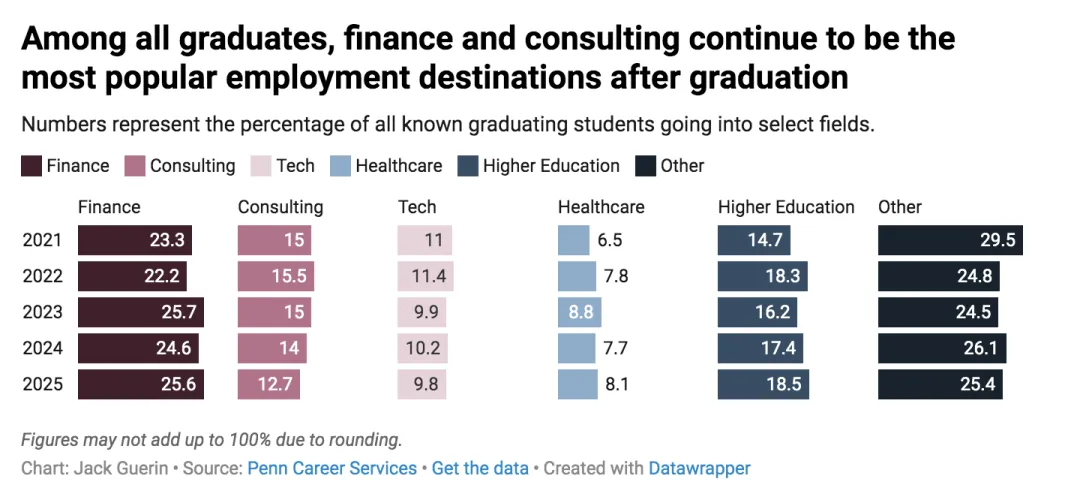
As in previous years, financial services and consulting remained the most popular career paths for graduates, together accounting for as much as 25.6% of employment.
As one of the top target schools for financial institutions in the U.S., UPenn continues to demonstrate a strong advantage in feeding talent into investment banking, asset management, private equity, and related fields.
Source: Upenn Career Services
The most favored employers among the Class of 2025 were primarily consulting and financial services firms, with Boston Consulting Group, Goldman Sachs, McKinsey & Company, and Morgan Stanley occupying four of the top five spots.
Source: Upenn Career Services
Beyond these top giants, the other employers on the top ten list are equally prestigious, with the Hospital of the University of Pennsylvania and the Children's Hospital of Philadelphia also making the top ten.
The Employment Landscape is Changing
In fact, this shift is not unique to UPenn.
Over the past two years, both the U.S. and domestic job markets have been undergoing structural adjustments.
In the U.S. market, the prolonged high-interest-rate environment, tighter corporate cost control, and the ongoing wave of tech layoffs have markedly slowed the growth of white-collar positions.
Some studies indicate that U.S. companies' demand for fresh graduates has declined, with job openings in popular tracks like finance, technology, and marketing even falling below pre-pandemic levels.
At the same time, the rapid development of AI technology is also reshaping corporate talent needs. Companies are increasingly inclined to hire interdisciplinary talents who can integrate business logic, data analysis, and technical tools.
This explains why, in recent years, Business Analytics, Applied Analytics, Technology Management, Information Systems and other cross-disciplinary programs have been steadily gaining popularity.
Beyond changes in the overseas job market, the domestic market in China is also sending new signals.
In April 2026, the State-owned Assets Supervision and Administration Commission of the State Council officially established a new bureau-level unit called the Bureau of Overseas State-owned Assets, as an internal body to coordinate the management of central enterprises' overseas assets and businesses.
Source: State-owned Assets Supervision and Administration Commission of the State Council
The bureau includes specialized divisions for international operations, risk prevention, supervision and governance, and emergency management, with clear division of responsibilities and a complete system.
This development is worth the attention of international students. In recent years, whether central enterprises, state-owned enterprises, or government-related institutions, the demand for professionals with international backgrounds has been steadily increasing.
On one hand, as Chinese companies continue to advance their global expansion strategies, they need talent familiar with international markets, overseas laws and regulations, and cross-cultural communication. On the other hand, the increasingly complex international situation has elevated the importance of areas like overseas asset management and international investment risk control.
Consequently, more and more international students are turning their attention to directions such as state-owned enterprises, central enterprises, public institutions, and selective transfer programs.
For students planning their futures, regardless of whether they choose to develop their careers overseas or return to China, the most effective way to cope with change is always to plan ahead, explore proactively, and continuously enhance their core competitiveness.
After all, what determines your career development is never a single employment report or the momentary ups and downs of a particular industry, but rather, in an era of constant change, whether you possess the ability to keep learning, keep growing, and seize opportunities.