
In recent years, with the rapid development of artificial intelligence, big data, and digital marketing, marketing has long ceased to be merely about brand promotion or advertising creativity. Instead, it has gradually evolved into an interdisciplinary field that integrates data science, consumer behavior, and business decision-making.
Against this backdrop, an increasing number of top business schools are deeply integrating data analytics, machine learning, and marketing strategy to cultivate a new generation of marketing professionals capable of driving business decisions through data.
Among these programs, the Master of Science in Marketing Science (MSM) offered by Columbia Business School stands out as one of the most representative Marketing Analytics programs in the United States.
Unlike traditional Master's programs in Marketing, this program places greater emphasis on quantitative analysis, data modeling, and consumer insights, aiming to cultivate Analytical Marketers (data-driven marketing professionals) who possess both business acumen and technical skills.
CheersYou (清柚教育) x Columbia Marketing Science Successful Admission Cases
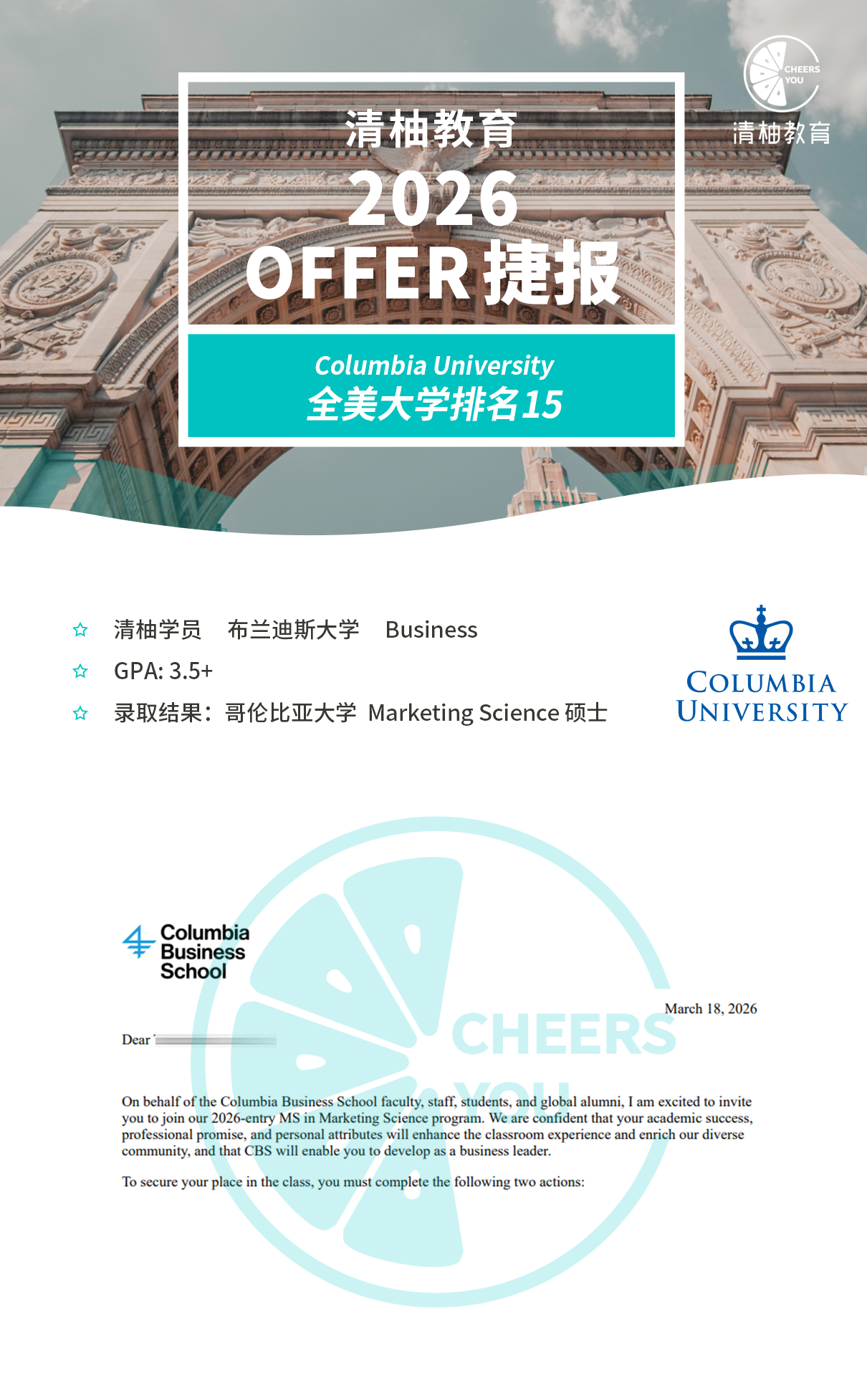
| CheersYou x Columbia Marketing Science Admission Case | |
| Undergraduate Institution | Brandeis University |
| Undergraduate Major | Business |
| GPA | 3.5+ |
| GRE/GMAT | GRE 325+ |
| Admitted Program | Columbia University - Master of Science in Marketing Science |
| Admission Term | 2026 Fall |
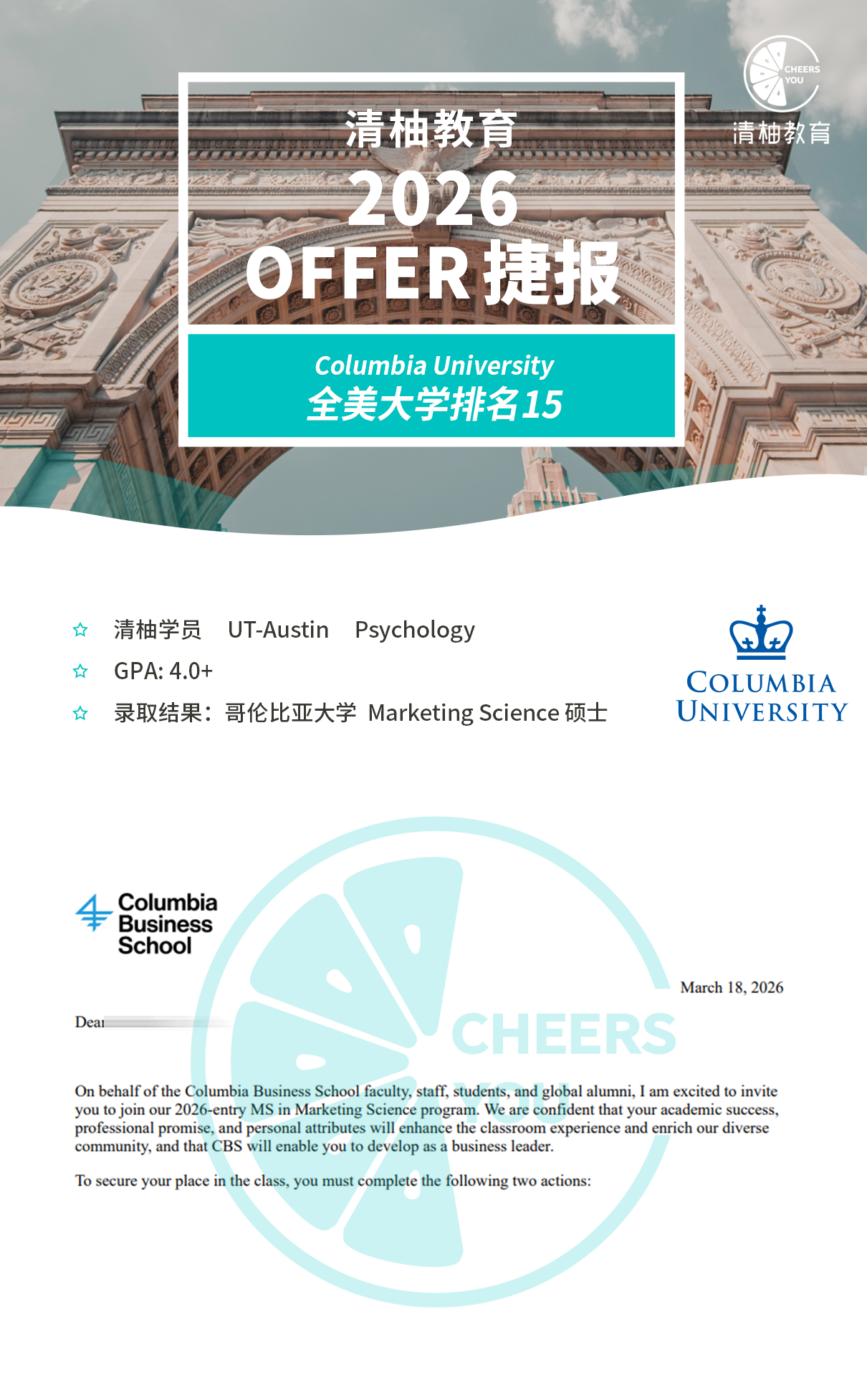
| CheersYou x Columbia Marketing Science Admission Case | |
| Undergraduate Institution | The University of Texas at Austin (UT-Austin) |
| Undergraduate Major | Psychology |
| GPA | 4.0+ |
| GRE/GMAT | GRE 325+ |
| Admitted Program | Columbia University - Master of Science in Marketing Science |
| Admission Term | 2026 Fall |
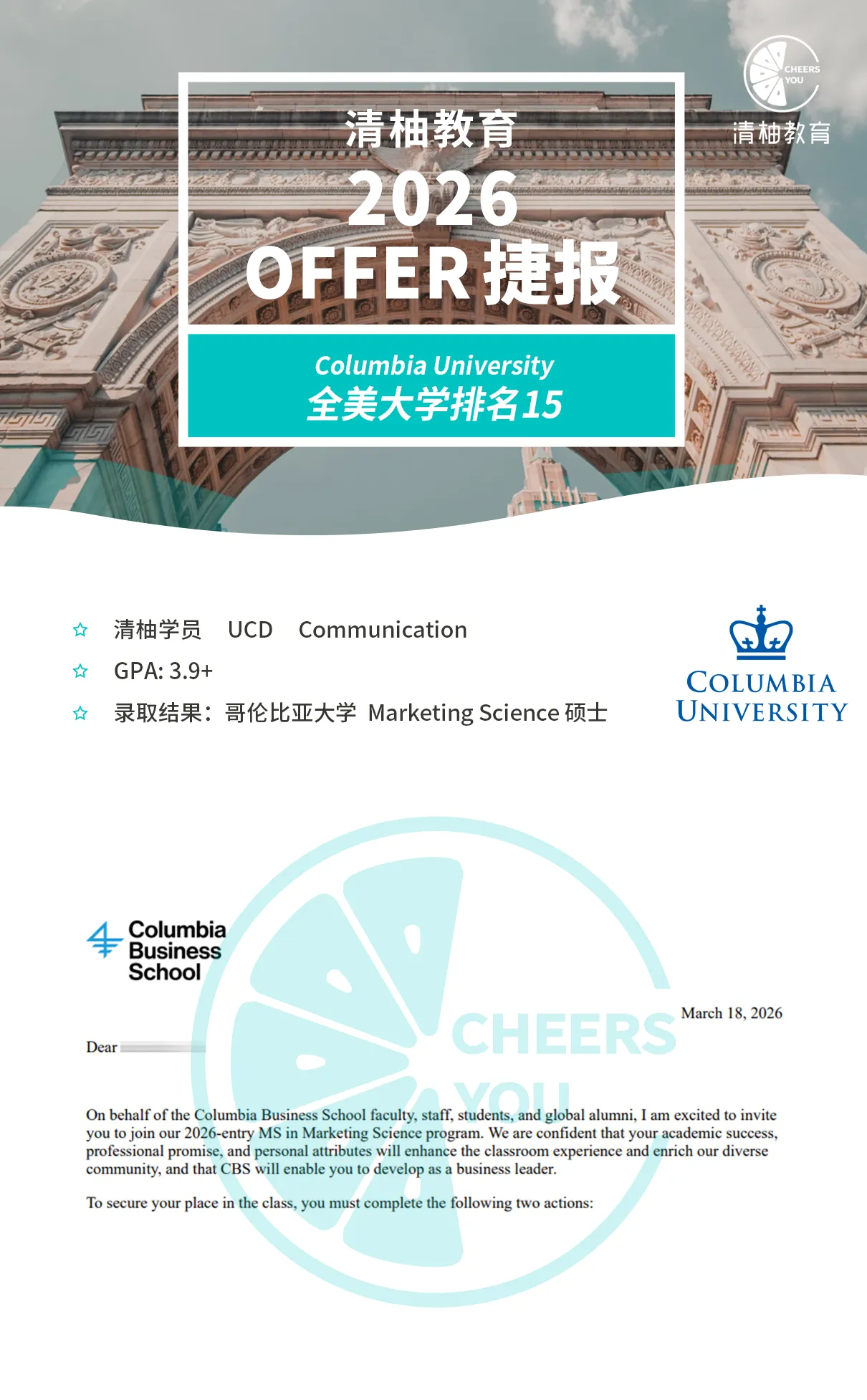
| CheersYou x Columbia University Marketing Science Admission Case | |
| Undergraduate Institution | University of California, Davis (UC Davis) |
| Undergraduate Major | Communication |
| GPA | 3.9+ |
| GRE/GMAT | GRE 325+ |
| Admitted Program | Columbia University - Master of Science in Marketing Science |
| Admission Term | Fall 2026 |
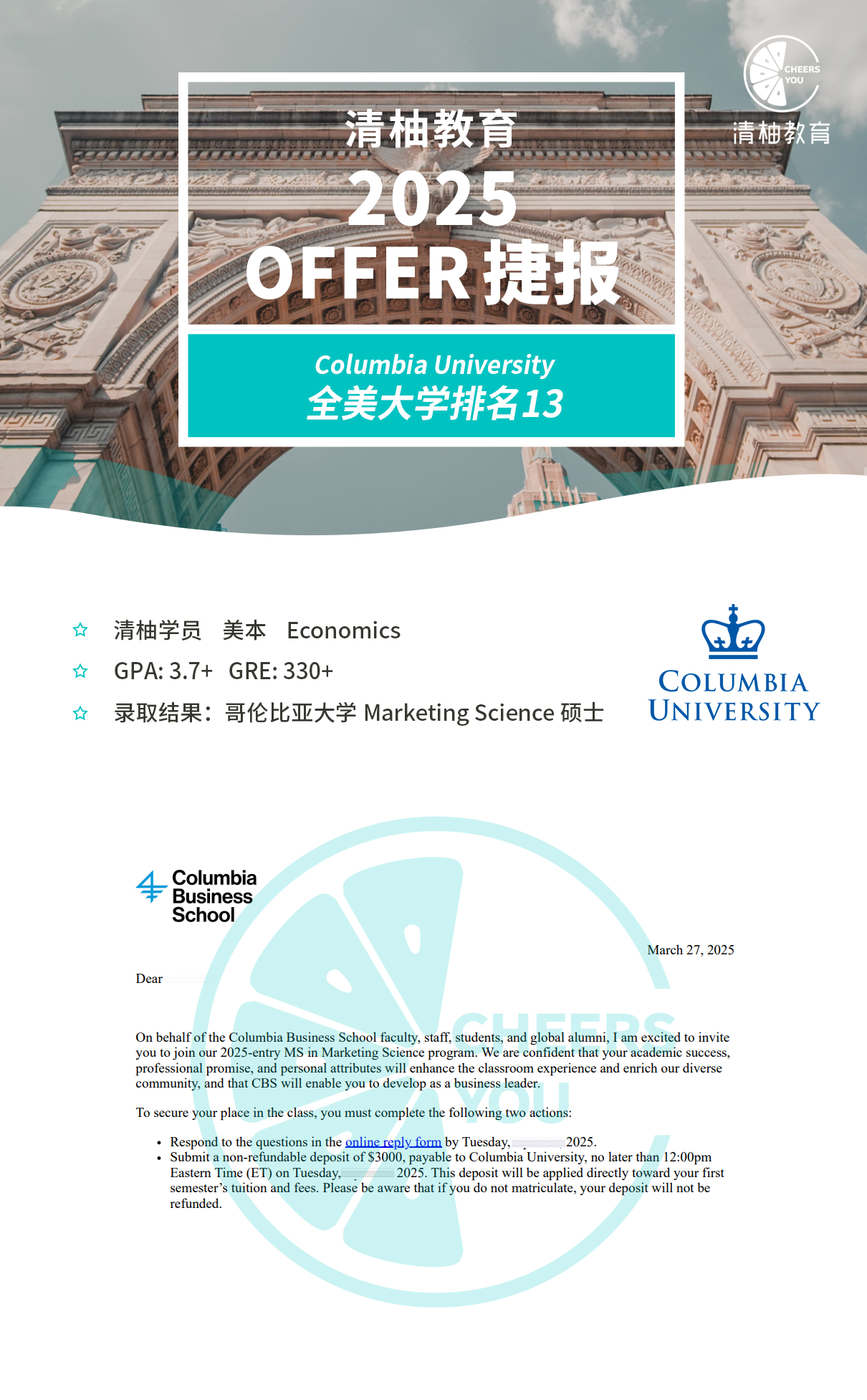
| CheersYou x Columbia University Marketing Science Admission Case | |
| Undergraduate Institution | US Undergraduate |
| Undergraduate Major | Economics |
| GPA | 3.7+ |
| GRE/GMAT | GRE 330+ |
| Admitted Program | Columbia University - Master of Science in Marketing Science |
| Admission Term | Fall 2025 |
Introduction to Columbia University's Master of Science in Marketing Science Program
| Program Name | Master of Science in Marketing Science (MSM) |
| School | Columbia Business School |
| Degree Type | Master of Science |
| Program Duration | Two semesters of coursework + Third semester Capstone (approximately 12 months) |
| Credit Requirements | At least 30 credits |
| Program Attribute | STEM Program |
| Campus | New York City |
Columbia's Marketing Science is a STEM master's program centered on Marketing Analytics.
The program aims to cultivate data-driven marketing professionals (Analytical Marketers) who can combine quantitative analysis skills, market insights, and creative thinking, helping students use data to solve real-world business problems and make more scientific marketing decisions for enterprises.
Columbia University believes that as companies increasingly rely on data for marketing decisions, the demand for talents who understand both marketing and possess statistical analysis and data modeling capabilities is growing, which serves as the important background for establishing this program.

Program Feature Analysis: Why Choose Columbia's Marketing Science?
As one of the world's top business schools, Columbia Business School (CBS) leverages Columbia University's robust academic resources and New York City's status as a global hub for commerce, finance, and technology to provide students with abundant learning and career development opportunities.

In addition to its comprehensive MBA, EMBA, and PhD programs, Columbia Business School offers several specialized master's degrees. Among these, the Marketing Science program is a key STEM-designated initiative developed in recent years, aiming to address the growing corporate demand for talent skilled in data-driven marketing.
1. STEM-Designated Program with a Focus on Data-Driven Marketing
Unlike many Marketing master's programs that lean towards brand management or advertising communications, Columbia's MSM program is more oriented toward Marketing Analytics.
The school expects students not only to understand consumers but also to be able to:
- Build predictive models
- Analyze consumer data
- Leverage AI and machine learning to optimize marketing strategies
- Translate business problems into quantifiable analytical questions
Therefore, the program has a stronger quantitative focus, making it more suitable for applicants with backgrounds in mathematics, statistics, economics, computer science, or business.
2. Highly Flexible Curriculum with Cross-School Course Selection
Beyond the core Marketing Science courses, students can also elect to take courses from:
-
Columbia Business School MBA courses
- PhD courses
- School of Engineering courses
- Department of Statistics courses
- Computer Science courses
- Economics courses
- Psychology courses
This cross-school educational model allows students to freely combine courses based on their career plans, creating a more personalized development path.
3. Small Cohort Size for More Precise Career Support
The cohort size for Columbia's Marketing Science program is relatively small.
The Career Management Center (CMC) provides customized career coaching for Marketing Science students, including:
- Resume revision
- Mock Interviews
- Networking opportunities
- Career Coaching
- Corporate recruitment resources
Compared to larger programs, the small cohort size means students receive more guidance from professors and support for their career development.
4. Significant Location Advantage in New York City
As one of the global centers of commerce, New York City hosts a large concentration of:
- Tech companies
- Consulting firms
- Consumer brands
- Advertising agencies
- Financial institutions
- Media enterprises
Columbia students not only have access to rich industry resources but can also participate in company presentations, industry events, and alumni networking, creating more opportunities for future internships and employment.
Core Course Breakdown: What Do You Actually Study in Columbia's Marketing Science?
When many students see "Marketing Science," their first reaction is often:
Is this just Marketing under a different name?
In fact, it is not.
From the perspective of curriculum design, Columbia University's Marketing Science program is more like a combination of Marketing Analytics + Data Science + Consumer Research.
The entire program requires students to complete 30 credits, including Core Courses, FlexCore Courses, **Electives**, and a Capstone Project. The program adopts a three-semester training model, where students typically complete coursework in the first two semesters and finish the Capstone in the third semester.

Five Core Courses
The official website lists five courses as core courses that all students must complete.
1. Statistical Modeling and Decision Making
This is one of the most important foundational courses in the entire program.
The course mainly revolves around:
- Statistical Modeling
- Prediction
- Data Analysis
- Decision Making
It helps students build the ability to use statistical models to solve business problems.
For those planning to work in Marketing Analytics, Business Analytics, or Consumer Insights in the future, this course is almost considered "basic skills."
2. Python Programming for Data Science
Compared to traditional Marketing programs, one of the biggest features of Columbia University is that it directly requires students to learn Python.
The course mainly includes:
- Python data processing
- Data visualization
- Data analysis
- Automated analysis processes
The university hopes that students can truly use code to process marketing data, rather than just staying at the level of Excel or BI tools.
3. Market Intelligence: The Art and the Science
This course can be understood as:
How to truly transform data into business insights.
In addition to analyzing consumer data, it is more important to answer:
How should companies utilize this data?
The course will cover:
- Market research
- Consumer behavior analysis
- Business insights
- Market strategy
It helps students build a complete framework for Marketing Decision Making.
4. Marketing Consulting Skills
This course is also a distinctive feature of Columbia University.
Unlike many schools that emphasize Marketing Theory,
Columbia University places more emphasis on:
How to truly solve problems for enterprises.
The course will train students in:
- Client Communication
- Presentation
- Consulting Framework
- Problem Solving
Many classroom cases are directly derived from real-world business scenarios.
Therefore, this course is very helpful for future applications to consulting firms, tech companies, or FMCG (Fast-Moving Consumer Goods) enterprises.
5. Capstone Project
The Capstone is the most important practical course in the entire program.
Students will complete a real-world business project under the guidance of a mentor.
The university hopes that students can:
- Comprehensively apply statistical analysis
- Python
- Marketing Analytics
- Consumer Research
- Business strategy
To ultimately form a complete solution.
The official website emphasizes that the purpose of the Capstone is to help students truly apply classroom knowledge to real-world business problems, rather than just staying at the theoretical level.
FlexCore: Freely Choose Based on Career Direction
In addition to the fixed core courses,
the university has also set up two groups of FlexCore courses.
Students need to complete one direction from each group.
The first group of options includes:
Option A
- Advanced Marketing Analytics
or
Option B
- Digital Marketing
- Social Networks
If you hope to enter:
- Meta
- TikTok
- Amazon
and other internet companies in the future,
the Digital Marketing path is usually more suitable.
If you hope to work in:
- Marketing Analytics
- Consumer Insights
- Pricing
- Consulting
then Advanced Marketing Analytics is more quantitative-focused.
The second set of options includes:
Option A
- Behavioral Economics & Decision Making
or
Option B
- Strategic Consumer Insights
This set of electives reflects another characteristic of Columbia's Marketing program:
Consumer Psychology.
Marketing is not just about analyzing data.
More importantly, it is about understanding:
- Why do consumers make purchases?
- How to influence consumer decisions?
- How to design products and marketing strategies?
Therefore, Behavioral Economics and Consumer Insights are also important components of the entire program.
Elective Courses
Another advantage of Columbia's Marketing Science program is the high degree of flexibility in course selection.
In addition to Marketing courses, students can also explore areas such as Business Analytics, AI, and Machine Learning.
Popular electives include:
Marketing Track
- Product Management
- Pricing Strategies
- Media Planning & Growth Marketing
- User Experience
- Media Platforms and Content
For students who hope to enter Product Marketing or Growth Marketing, these courses are highly practical.
Analytics & AI Track
In recent years, the curriculum has continuously incorporated AI content.
For example:
- Foundations of AI for Business
- Machine Learning
- Artificial Intelligence
- Generative AI for Business
- Intro to Databases for Business Analytics
As we can see,
Columbia does not treat AI as a separate major,
but rather emphasizes:
How to leverage AI to enhance marketing analytics and business decision-making capabilities.
This is also a capability that employers are increasingly focusing on when recruiting Marketing Analytics talent.
Why is the Curriculum Highly Competitive?
Compared to many other Marketing programs, Columbia's Marketing Science program has three distinct advantages.
First, it emphasizes data skills.
The curriculum not only covers Marketing,
but also requires students to master:
- Statistics
- Python
- Machine Learning
- AI
to truly possess data analysis capabilities.
Second, it combines business with technology.
Marketing is no longer just about advertising.
The curriculum focuses more on:
- Data-driven decision making
- Business analytics
- Consumer insights
- Product growth
aiming to cultivate interdisciplinary talents who can bridge business and technology.
Third, it offers abundant course resources.
In addition to MS courses, students can also take MBA and PhD courses from Columbia Business School, as well as relevant courses from other schools at Columbia University (such as the School of Engineering, the Department of Statistics, the Department of Computer Science, Economics, Psychology, etc.), further expanding their professional expertise.

Application Requirements Analysis: What Background Does Columbia's Marketing Science Program Require?
Compared to many other business school programs, Columbia's Marketing Science program places greater emphasis on applicants' quantitative analysis ability.
Columbia's Marketing Science is a STEM-designated program centered on Marketing Analytics, so it expects applicants to have a certain foundation in mathematics, statistics, and data analysis.
Application Materials (Application Checklist)
To apply for Columbia's Marketing Science program, you need to submit the following materials:
- Online Application
- Undergraduate Transcripts
- Resume / CV
- Two Letters of Recommendation
- GMAT or GRE scores
- English language proficiency test scores (for international students)
- Two Essays
- One Short Answer question
- Application Fee
Compared to many other programs, Columbia's application materials are not overly complex, but they place greater emphasis on storytelling and career goals.
GMAT / GRE Requirements
The GMAT or GRE is required.
The school accepts:
- GMAT (including the new GMAT Focus Edition)
- GRE
The admissions committee does not prefer one test over the other, nor will it combine scores from multiple test attempts. Instead, it evaluates applicants based on their highest single score.
English Language Proficiency Requirements
If your undergraduate coursework was not taught in English, you are required to submit English proficiency test scores.
The school accepts:
- TOEFL iBT
- IELTS
- PTE Academic
If you have already obtained a bachelor's, master's, or doctoral degree taught in English, you typically meet the English language requirement and do not need to submit additional language test scores.
Letter of Recommendation Requirements
Applicants need to submit:
Two Letters of Recommendation
The official website does not strictly require that these letters come from professors or direct supervisors.
For current students:
It is recommended to choose:
- Professors
- Research supervisors
For working professionals:
It is recommended to choose:
- Manager
- Supervisor
Recommendation letters must be completed independently by the recommenders; applicants are not allowed to participate in writing the content of the letters.
What Should You Write in the Application Essays?
The Marketing Science application includes:
Short Answer
What is your immediate post-MS professional goal?
Limit:
50 characters
This is very short.
It primarily assesses:
What do you want to do for your first job after graduation?
For example:
- Marketing Analytics
- Product Marketing
- Consumer Insights
These are all typical answers.
Essay 1
This essay mainly focuses on:
- Academic Goals
- Personal Growth
- Achievement
The school wants to understand:
Why are you a good fit for the Marketing Science program?
And:
Which experiences have shaped who you are today?
Essay 2
The second essay is more focused on career goals.
You need to answer:
Why did you choose Columbia's Marketing Science program?
And:
Why can this program help you achieve your career goals?
Compared to many other schools,
Columbia University prefers to see:
The alignment between Career Goals and the curriculum.
Rather than vague statements such as:
Columbia is great.
Columbia has always emphasized:
Why this Program
Rather than:
Why this School.
Prerequisites
Columbia's Marketing Science program does not require applicants to come from a specific major.
On the contrary, Columbia welcomes students from diverse academic backgrounds to apply.
All majors are encouraged to apply.
In other words:
Regardless of whether your background is in:
- Business
- Engineering
- Mathematics
- Psychology
- Communications
You are eligible to apply.
However, Columbia also notes that:
Typical admitted students usually have coursework in:
- Probability
- Statistics
- Linear Algebra
Additionally, Columbia states that:
Having programming experience in Python, R, or similar languages will make your application more competitive.
Work Experience Requirements
Columbia explicitly states:
Work experience is not a requirement for application.
Both:
- Recent graduates
- Working professionals
Are welcome to apply.
However, Columbia also mentions that:
Having:
- Internship experience
- Full-time work experience
Will be beneficial for your future studies and career development.
Who is the best fit for this program?
Although Columbia explicitly states All majors are encouraged to apply, based on the curriculum content, the following types of applicants have a higher fit with the program:
Business Background
Students majoring in Marketing, Management, Business, etc., who also possess data analysis skills, will align better with the program's training objectives.
Economics Background
Economics students typically have a foundation in statistics and econometrics, which matches well with the quantitative requirements of Marketing Science.
Mathematics / Statistics Background
If you aspire to work in roles such as Marketing Analytics, Consumer Analytics, or Pricing in the future, a background in mathematics and statistics offers a natural advantage.
Computer Science / Data Science Background
As AI and marketing continue to converge, more technology companies are seeking talent with both technical and business capabilities. Applicants with skills in Python, SQL, machine learning, etc., are highly competitive for roles in Product Marketing, Growth Analytics, and similar fields.
Psychology Background
One of the core aspects of marketing is understanding consumer behavior. Applicants with backgrounds in consumer psychology and behavioral sciences also have certain advantages in directions such as Consumer Insights and User Research.
Career Paths: What can you do after graduating from Columbia's Marketing Science program?
Many students have a question when they first encounter Marketing Science:
After graduation, is it considered Marketing or Data?
The answer is actually:
Both.
Columbia officially states that Marketing Science is not designed to train traditional Marketing Managers, but rather to cultivate Analytical Marketers (data-driven marketing professionals) who can leverage data to drive business decisions. Graduates can enter various industries such as consumer goods, technology, media, advertising, retail, and financial services, working in roles related to data analysis and marketing.
Therefore, compared to traditional Marketing programs, its career paths lean more towards:
- Marketing Analytics
- Consumer Insights
- Product Marketing
- Growth Marketing
- Business Analytics
- Pricing Analytics
- CRM Analytics
- Marketing Consulting
If you hope to enter the internet, technology, or consulting industries in the future, these roles align well with the program's training objectives.
What Career Resources Does Columbia University Offer?
As an official master's program under Columbia Business School, Marketing Science students have access to career development resources provided by the school's Career Management Center (CMC).
The CMC offers a range of career support services specifically for MSM students, including:
- Pre-MS Career Curriculum
- One-on-one Career Coaching
- Resume and cover letter review
- Mock Interviews
- Networking guidance
- Alumni resources
- Columbia Business School Career Portal (COIN) job platform
Due to the small cohort size, the career services team is able to provide more customized support tailored to the job search goals of Marketing Science students.
Where Do Graduates Work?
According to the Columbia Business School website, Marketing Science graduates have joined both traditional enterprises and tech companies, including:
- ByteDance
- Tencent
- Uber Eats
- Citibank
- Nordstrom
- Shiseido
Additionally, the program's introduction page lists partner companies and representative employers where students have secured jobs, such as:
- Spotify
- DoorDash
- Deloitte
- Dior
- JP Morgan
- Yahoo
- Wayfair
- Roku
- Atlassian
- Xiaohongshu (Little Red Book), among others.
In terms of industry, graduates primarily enter the following sectors:
- Tech and Internet
- Consumer Brands (FMCG)
- Luxury Goods
- Retail
- Advertising and Media
- Consulting
- Financial Services
Which Career Goals Is Columbia's Marketing Science Program Suitable For?
If your goals align with the following directions, Marketing Science is a program worth considering:
✅ Marketing Analytics
✅ Consumer Insights
✅ Product Marketing
✅ Growth Marketing
✅ Business Analytics
✅ Marketing Consulting
However, if your goals are:
- Brand Management
- Creative Advertising
- Public Relations (PR)
- Integrated Marketing Communications
Then you may want to further compare other master's programs with a more traditional marketing focus and make your choice based on your career planning.

Frequently Asked Questions (FAQ)
Q1: Is Columbia's Marketing Science program a STEM program?
Yes. Columbia Business School officially lists Marketing Science as a STEM-eligible program, complying with relevant STEM policies.
Q2: Does Columbia's Marketing Science program require work experience?
No.
The school explicitly states that work experience and internships are not mandatory requirements for application or admission. However, relevant experience can enhance your application competitiveness and benefit your subsequent studies and job search.
Q3: Is Columbia's Marketing Science program more focused on Marketing or Data?
Overall, it leans more towards Marketing Analytics.
The curriculum emphasizes statistical analysis, Python, market data analysis, and consumer insights. It is better suited for students who wish to use data to solve business problems, rather than those interested in traditional advertising or brand communication.
Q4: What are the biggest advantages of the program?
From the program's positioning perspective, there are four main advantages:
- The Columbia Business School brand
- STEM program designation
- Integration of data analytics and marketing
- New York City location and abundant industry resources
Additionally, small class sizes, flexible course selection, and career support provided by the Career Management Center are also key features of the program.
Is Columbia University's Marketing Science Program Worth Applying To?
If you are looking for a program that balances business acumen, data analytics, and marketing strategy, then Columbia University's Marketing Science program is undoubtedly worth your close attention.
Compared to traditional Master's in Marketing programs, it places greater emphasis on the application of Quantitative methods, Analytics, and AI in business, cultivating hybrid talents who can combine data analysis capabilities with market insights.
Leveraging the curriculum resources of Columbia Business School, the industrial environment of New York City, and comprehensive career development support, students gain access to abundant industry opportunities and can choose more diverse career paths based on their personal interests.
Interested in Applying to Columbia's Marketing Science? Contact CheersYou (清柚教育)
The Marketing Science program at Columbia University places significant emphasis on applicants' quantitative abilities, career planning, and alignment with the program's educational objectives. In addition to academic background, internship experience, data analysis skills, the quality of your personal statements, and your overall application strategy will all influence the final admission decision.
If you are planning to apply to Columbia's Marketing Science program, or are currently preparing for related Master's programs in the US such as Marketing or Business Analytics, feel free to contact CheersYou (清柚教育) for a one-on-one consultation.
We will provide personalized school selection guidance, background enhancement recommendations, and application planning based on your undergraduate institution, major, GPA, language test scores, GRE/GMAT scores, internship and research experience, and career goals, helping you develop a more competitive application strategy.
👇 Click the card below to get a one-on-one application assessment for Columbia's Marketing Science program