Financial Engineering — a dream major for countless people. It is the brightest major, and also the darkest.
To some extent, it is directly equated with dollars. Buffett and Soros are its spokespeople.
This deified major is a cradle for elites. But high risk and high reward coexist; its admission rate is said to be below 8%. In this industry, you might rise to fame overnight, or lose everything in an instant.
I've been inundated with questions about Financial Engineering lately, so in this 4W1H edition, I, with my vast connections, am introducing Pop, a current NYU MFE student, to give you an in-depth breakdown of this major that everyone loves and hates.

Pop, a current NYU Financial Engineering master's student, graduated from Peking University. He enjoys Dota, Texas hold'em, writing, and dancing. Though studying Financial Engineering, he has the soul of an artsy intellectual and also dreams of working in IT.
Why MFE?
Q: Based on your own experience and background, why is Financial Engineering so popular?
A: The popularity of Financial Engineering is definitely a result of historical trends; it's not something that can be altered by individual effort.
I think the biggest reason is the overall popularity of the financial industry. With economic development and mass media promotion, the idea of "high salaries in finance" has become deeply ingrained. This attracts many talented people who want to enter this field—just look at the popularity of finance and economics majors at the undergraduate level. Then at the graduate application stage, in addition to those who studied finance as undergraduates, many students from other majors want to switch to finance. This huge pool of applicants makes finance programs very "hot."
Within finance, Financial Engineering, as a program closely integrated with science and engineering and focused on practical applications, has high requirements for mathematical and programming skills. This perfectly matches the skills and needs of many students from science and engineering backgrounds, and they can also earn relatively higher salaries upon employment, leading to the popularity of Financial Engineering.
I studied economics as an undergraduate, which is more theoretical and not closely related to Financial Engineering, but it gave me a certain mathematical foundation. Combined with my self-study of many computer courses, my background was somewhat relevant. Plus, I plan to work in the financial sector and do tech-related work, so I ultimately decided to come to NYU for Financial Engineering.
There are many students at universities both at home and abroad who want to work in finance. Many of them are from science and engineering backgrounds or even finance itself, and a large number plan to apply for Financial Engineering. As you can imagine, there will be a flood of applicants for MFE programs.
However, there are many students in MFE now, and not all of them genuinely like finance, nor can everyone adapt to the curriculum requirements and future work pressures. So I advise everyone not to blindly follow the crowd. What others say is great may not be suitable for you. When choosing a major, you should make a comprehensive consideration based on your own interests and career plans.
Q: MFE is hyped up so much. Is it really that hard to learn?
A: I think whether a major is "hard" or "not hard" varies from person to person. Financial Engineering requires certain levels of finance knowledge, math, and computer skills. If you have little exposure to these areas, you will naturally find the learning process challenging. If you come from a related background like applied math, finance, or computer science, it will be much easier. Of course, no one is all-encompassing, so you still need to work hard here.
In the NYU MFE program, there are quite a few Chinese staff. Communication and consultation are relatively easy, both in and out of class, making it a generally friendly environment for Chinese students. But this also means intense competition. Surrounded by top STEM students from various universities at home and abroad, it's natural to feel a bit nervous. But don't be afraid—the courses are not as hard as you might think. As long as you ask questions, think deeply, and practice a lot, you'll solve the academic challenges.
Q: How difficult is it to apply for MFE? How fierce is the competition?
A: Applying for MFE programs is quite difficult. For top programs like Columbia, CMU, and NYU, every applicant is among the best from their respective schools, and the overall acceptance rate is less than 10%. Even MFE programs at less prestigious schools are the flagship programs of their engineering schools. No matter which school you apply to, you'll face competition from a large pool of students from finance and STEM backgrounds, both domestic and international (especially domestic). So be mentally prepared.
MFE applications require high standards in every aspect: GPA, GRE, TOEFL, internship experience, and project experience all need to be impressive. For example, having a relevant undergraduate major, having taken multiple relevant courses, a GPA above 3.8, internships in asset management or risk control at securities firms or investment banks, and outstanding standardized test scores are all pluses on your MFE application. Achieving these requirements is not easy, especially for those whose undergraduate school or major isn't a perfect fit. You need to start preparing early so you're not completely lost when application season arrives in your junior or senior year.
Q: Can you share your study life at NYU? Tell us about the MFE courses and program.
A: NYU's Financial Engineering program has four tracks, each with a different focus. The curriculum primarily revolves around three areas: finance, mathematics, and computing, with an emphasis on math and finance.
The program requires a total of 36 credits, including a 3-credit capstone project. Most students choose to complete the program in four semesters over two years, taking 9 credits per semester (as required for full-time F-1 students at NYU), which helps maintain balance. Typically, each course has weekly assignments, and most have midterms and finals; some also include group or individual projects. So, overall, you need to ensure sufficient study time each week. Some courses last only half a semester, or seven weeks, and are more intensive, generally requiring more effort.
After arriving in the U.S., you cannot apply for CPT until you've been studying for nine months, so most people start internships or part-time work in the summer after the first year, allowing you to focus on studying (or fun) in the first year. By the second year, once you're more familiar with the coursework, you can take on part-time jobs alongside classes, and these can count as credits, so no need to worry too much about time.
For those who took relevant courses as undergraduates, you can waive some introductory courses. If you're interested, check the program's website for specific requirements; you'll need to provide transcripts or take exams to demonstrate mastery. Note: Waiving credits does not change the requirement to complete 36 credits for graduation; you'll need to replace waived courses with more advanced ones. As for detailed course reviews, given limited space and my own limited course experience, I recommend you reach out to your own senior peers for insights.
Q: What are your plans after graduation? How is the job market in the U.S.?
A: According to data from the school's website, the vast majority of MFE graduates find satisfactory jobs in a timely manner. As for where and in what industry, that varies from person to person. Many graduates work in financial institutions large and small, such as investment banks and funds, in roles like financial analysts, financial engineers, data analysts, and other careers closely related to Financial Engineering.
As a STEM-designated major, Financial Engineering offers certain advantages over non-STEM fields for employment. However, due to massive enrollment in recent years, the number of graduates in related fields is approaching saturation, and with the overall U.S. economic downturn, the creation of new jobs has slowed. So, graduates definitely won't have a completely smooth ride. Fortunately, NYU is located in the heart of New York City, giving it a unique geographical advantage. Companies of all sizes participate in NYU's campus recruitment; many conduct interviews at the Wasserman Center for Career Development, and some hold info sessions at the main campus and Tandon campus. Whether you want to join a large corporation or a small startup, there are ample resources and channels to connect you with your dream job.
As for landing an offer, that depends on individual effort. Generally, the most reliable way to get an interview is through a referral. If you know someone working at the company, like a relative or a senior alumnus, they can be your biggest help. Large companies, in particular, receive many impressive resumes that look similar every day; if you have an internal referral, you can skip the luck-dependent resume screening stage. Also, NYU Tandon has finance clubs that connect upper- and underclassmen to bridge these gaps. Once you secure an interview, you need to prepare specifically for it—for example, by reading online experiences, asking seniors for advice, and practicing with lots of problems. I especially want to remind interviewees that practicing problems is the best way to pass technical interviews, especially for roles in investment banks or funds, so do as many as you can. If you don't plan to work in the U.S., you can start preparing applications for companies back home early. With a U.S. MFE degree, your job search in your home country will likely be much easier.
Q: Any advice for younger students applying to MFE programs?
A: Having said so much, let me offer some concrete advice.
1. Make a solid personal plan.
Having a long-term plan is essential—this includes your ideal career, required skills, etc. For Financial Engineering, if you plan to apply, you need to arrange for GRE preparation, internships, and projects early on. The same goes for other majors.
2. Work hard and enhance your personal capabilities.
This doesn't just mean grinding for GPA, research, or building your resume; more importantly, it means deepening your understanding of the field and broadening your perspective of the world.
3. Broaden your horizons and gather information.
No matter what major you apply for or where you plan to work in the future, you need a certain level of understanding. This process can be lengthy. Starting now, students can intentionally ask senior peers for advice, regularly visit relevant websites, and try to stay informed.
What is MFE?
Financial Engineering (also known as Financial Mathematics, Mathematical Finance, Quantitative Finance, or Computational Finance) is an interdisciplinary field combining finance, mathematics, and computer science. Its courses are typically offered jointly by a university's business school, mathematics department, and engineering school. Because of its focus on finance, MFE curricula in the U.S. typically include courses like stock market analysis, portfolio analysis, futures and options, asset pricing, capital budgeting, fixed income analysis, interest rate models, and financial risk management.
Financial Engineering is one of the fastest-growing disciplines in recent years, covering computer science, finance, mathematics, and statistics. With the rapidly changing financial environment, technological advances, and market globalization, the types of enterprises are becoming increasingly diverse. In this context, the market demands more varieties of financial products as investment tools. To meet such complex needs, designing a financial product requires concepts from finance, support from math and statistics, and knowledge of finance itself. Thus, the prospects for Financial Engineering are undoubtedly vast.
In summary, as an interdisciplinary field, Financial Engineering applies mathematical principles and computer tools to analyze financial problems.
At Cornell University, the first semester of the Financial Engineering track focuses on foundational courses, such as Derivatives and Bonds, Stochastic Calculus for Financial Engineering, Fixed Income Securities and Interest Rate Derivatives, and Corporate Engineering Seminar. The second semester delves deeper but still emphasizes applications, with courses like Quantitative Methods for Financial Risk Management, Topics in Linear Optimization, Financial Optimization Modeling, and Monte Carlo Methods for Financial Engineering. Between the second and third semesters, a summer mini-semester allows for internships. The third semester integrates theory and practice, featuring courses like Applied Financial Engineering – Project Course, Computational Methods in Finance, and Financial Engineering Seminar.
To sum up, as a qualified MFE student, the skills you should master and learn include the following:
Focus on secondary market
Math-Statistics
Maths-Stochastic Calculus
Programming
Market Sense
Interpersonal Skill
Probability and mental mathematics
Statistical concepts (time series, machine learning, etc.): process and study historical data
Stochastic calculus: pricing
Coding: C++
Applications:
Pricing of financial derivatives (more in a research sense)
Portfolio management: quantitative tools, mathematical statistical analysis, time series analysis, machine learning for investment
Analysis (buy-side hedge funds), automated trading execution/market making: using code
In MFE, you not only need to study finance, markets, statistics, and other areas but also integrate them seamlessly. Studying MFE means learning three or more disciplines at once; the intensity and difficulty are self-evident—it's no exaggeration to call it one of the hardest majors. To pursue MFE, you must have a heart that can withstand immense pressure and the perseverance to study hard.
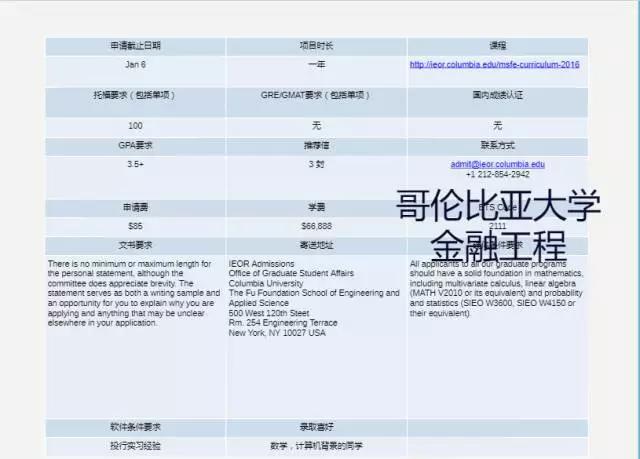
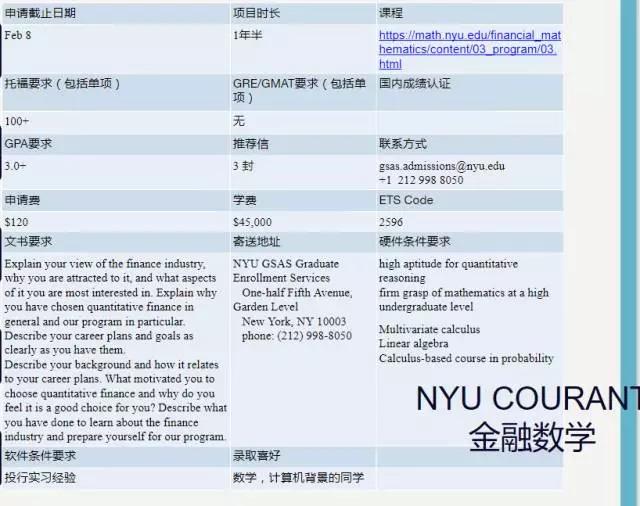
Which School to Choose?
Where to go after graduate?
Regarding the payoff: after all this hard work—squeezing through the narrow admission bridge, pulling all-nighters for finals, and finally graduating—can everyone who studies MFE become a financial engineer?
A financial engineer—a profession born with the creation of financial engineering—refers to professionals who use financial instruments creatively to solve financial problems. Financial engineers utilize basic financial tools such as stocks, bonds, and futures to design and tailor products according to client requirements, forming reasonable combinations of returns, currencies, risks, and maturities to create more complex financial innovations that enhance returns and reduce risk.
Financial engineers possess a set of specialized skills that cannot be achieved by technical expertise alone. Moreover, because the pace of financial innovation outstrips the market's ability to produce competent financial engineers, they are generally in high demand. Their job prospects are exceptionally bright, and without a doubt, their work offers substantial rewards.
The overall salary level of financial engineers is quite high, standing out among finance-related fields. In China, returnees with Financial Engineering degrees also enjoy excellent compensation, significantly higher than that of their counterparts.
It is reported that on Wall Street, financial engineers with some reputation can earn over $500,000 annually, and those at other banks, insurance companies, and wealth management firms can earn over $400,000.
Meanwhile, in China, the salary of "fintech" talent in state-owned commercial banks can be 3 to 5 times that of peers at the same level. Insiders reveal that annual salaries at joint-stock banks are 10 times those at state-owned banks for similar positions, and "hot talent" in commercial banks is often poached by foreign banks with even higher pay. Thus, interdisciplinary talent with expertise in both finance and IT has become the focus of the high-end talent market.
Besides that, graduating in Financial Engineering doesn't limit you to being a financial engineer; many finance-related industries are suitable for MFE graduates, so the employment scope is quite broad.
Looking at employment data, the outlook is quite optimistic. The industries and positions to choose from are diverse; landing an offer right after graduation is not a dream. In summary, there's no shortage of opportunities. Based on our analysis of graduate employment, they typically go into these industries:
Investment banking (securities firms):
Renowned international investment banks: Goldman Sachs, Citi, Morgan Stanley, JPMorgan, etc.; domestic investment banks: CICC, Industrial Securities, Guotai Junan, CITIC Securities, etc. Mainly engaged in IBD, Sales & Trading, Research, etc.
Big Four accounting firms and consulting:
MFE graduates can join the Big Four accounting firms—PwC, Deloitte, KPMG, EY—and strategy consulting firms like McKinsey, BCG, Bain, Roland Berger, etc., working as corporate strategy consultants. It's relatively easier to enter compared to investment banks.
Funds, trusts, private equity, and venture capital:
Primarily serving as analysts; the industry barriers are high, and analysts become highly valuable after a few years of experience.
Insurance companies:
Mainly engaged in actuarial and risk control roles, which are high-salary positions within the company.
Fortune 500 corporations:
Responsible for corporate finance functions such as accounting, capital management, cost control, and internal control.
How to apply?
There are only so many top schools, yet the number of applicants grows each year. Do you really understand the true difficulty of applying?
Based on application cases and data in recent years, competition has intensified, and requirements for applicants have risen. Among top-100 comprehensive universities, only about 20 offer MFE programs, making it even more challenging. How can you stand out and secure your ideal offer?
Drawing from my experience helping applicants, I've summarized the following advice:
Prerequisite courses: Financial Engineering favors students with strong quantitative backgrounds and generally requires applicants to have taken the following prerequisites (preferences vary by school, but this list is comprehensive): calculus, linear algebra, probability theory, mathematical statistics, partial differential equations, real analysis, stochastic processes, numerical methods, C++ programming, algorithms, and data structures.
Standardized test scores: MFE applicants should ideally have very high GPAs and GRE/TOEFL scores, along with research-oriented internships in finance—for example, through modeling to analyze and develop related financial derivatives or research and develop new products, ideally at securities firms, forex, funds, insurance companies, etc. If targeting top-30 schools, the baseline is typically a GPA of 3.5+, TOEFL 105+, and GRE 327+.
Work Experience: Some schools prefer or recommend having certain work experience, which can be helpful. For example: University of California--Berkeley, average 3.5 years; Carnegie Mellon University, average 1.3 years.
Application background: Mathematics >= CS >= Finance and Economics on your transcript. You need to invest significant effort in improving in all three areas—math, coding, and finance. For those unsure where to start, here are some tips I've compiled:
Math:
Stochastic Process, Real Analysis, ODE, PDE, Probability, Statistics, Numerical
Method, etc
Coding:
Language, Data Structure, Algorithm,JAVA C++(most important, will be asked in interviews) Python; R Matlab SQL
Can be supplemented through self-study
Finance:
Macro Econ, Econometrics, Investment, Fixed Income Securities Analysis:
Every break, do internships in finance; they don't have to be big names or highly specialized, but having experience in the field is best, especially in secondary markets, and understanding what the team is doing.
Other application materials:
Recommendation letters: internships + academic (math/programming). For fresh graduates, a mix of 2 academic + 1 internship is recommended; for working professionals, 1 academic + 2 internship.
Research:
Relevant topics: code/models/strategies
GRE math should ideally be a perfect score. The personal statement needs to highlight the technical aspects, providing examples that demonstrate quantitative abilities, based on the skill set of practitioners.
Interviews:
Understanding of the macro market: political economy, Hang Seng Index, S&P Index, government bonds, etc.