What Is Pass/No Pass (Pass/Fail)?
Pass/No Pass, also known as Pass/Fail, is a grading option at U.S. universities.
There are two grading methods at U.S. universities. The first is the common Letter Grade system, with grades A, B, C, D, and F. The second, which this article focuses on, is P/NP.
With P/NP, a course appears on the transcript as either Pass (pass) or No Pass (fail). A Pass earns credits but does not affect the GPA, while a No Pass yields no credits and also does not affect the GPA.
Generally, a course grade of C or above is considered a Pass, while below a C is a No Pass. Most schools allow students to switch certain non-major courses (mainly general education requirements) to P/NP, but major courses cannot be switched to P/NP.
Additionally, the number of credits that can be taken P/NP is limited. For example, at UCI, most majors allow an average of 4 P/NP credits per semester (specific limits vary by university).
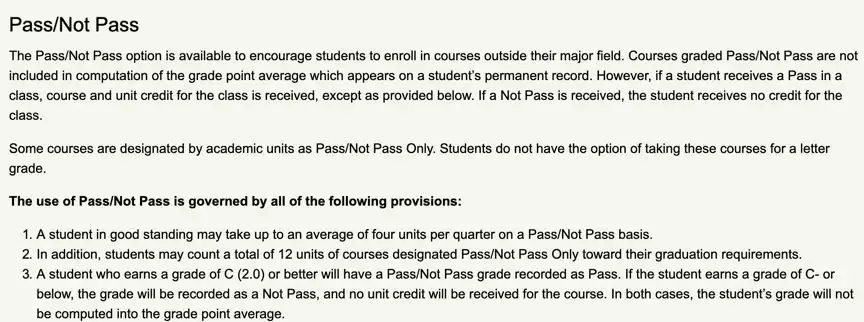
UCI official website
Does P/NP Affect Graduate School Applications?
This is a common concern. CheersYou(清柚教育) would like to clarify that most graduate admissions offices, upon receiving transcripts from U.S. undergraduate students, do not recalculate the GPA.
Admissions offices are already overwhelmed—a popular program may receive thousands of applications, including many from international students.
Transcripts from Chinese students often need to be recalculated because the grading system in Chinese universities differs from that in the U.S.
For U.S. undergraduates, admissions officers are too busy to meticulously replace every P/NP with a C and recalculate the GPA. So the notion that they would convert P/NP to a C is unfounded.
However, P/NP can affect your graduate application in certain cases—specifically when the program values that particular course.
For instance, if you're applying to a graduate program in STEM, you absolutely must not switch courses like math, economics, statistics, or programming to P/NP. But for courses like writing, history, or political science, switching to P/NP is generally fine.
Conversely, if you're applying to a graduate program in the humanities, such as journalism, then don't switch your writing courses to P/NP, while courses like physics or chemistry can be switched.
U.S. undergraduate students online share similar views:
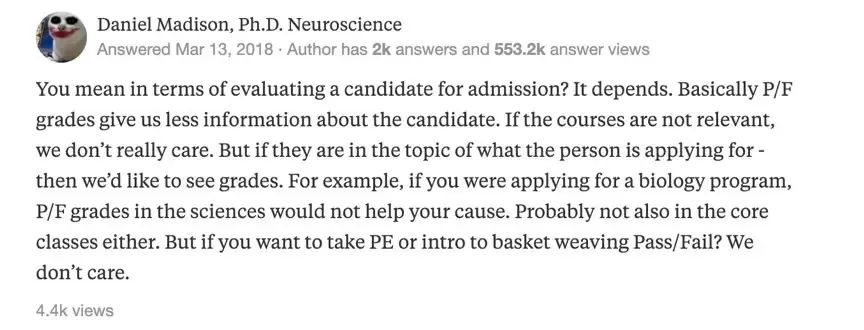
P/NP: A GPA Lifesaver for U.S. Undergraduates
Chinese universities do not have a P/NP system, so Chinese students must still achieve decent grades in non-major courses (such as the beloved "Mao Zedong Thought" and "Marxist Principles") compared to their U.S. counterparts.
For U.S. undergraduates, when faced with courses they are not good at and irrelevant to their future graduate studies, P/NP comes to the rescue: just pass the course without spending too much effort, and it won't affect the GPA—so convenient!
But a few points to keep in mind:
1. Don't switch too many courses to Pass/No Pass in a single semester.
2. Don't get too relaxed; even for non-major courses, if you end up with a No Pass, you'll have to retake the course.
3. This article covers general cases; individual situations may require specific analysis.
What About Withdraw, P/NP's Sibling?
Withdraw, or "W", is when you drop a course after the normal drop deadline. Your transcript will show a W, indicating a withdrawal.
A withdrawal earns no credits and does not affect the GPA, but it can have some impact on your graduate school applications.
If you withdraw from just one course and it's not a required course, it's usually not a big issue. If it's a required course, you'll have to make it up later. Withdrawing from many courses, however, can have a significant negative impact. So only choose to withdraw as a last resort.