Recently, many GRE test-takers online have reported that at-home test scores are being released slowly; contacting ETS customer service hasn't sped things up, and some haven't even received a response, leaving the issue unresolved.
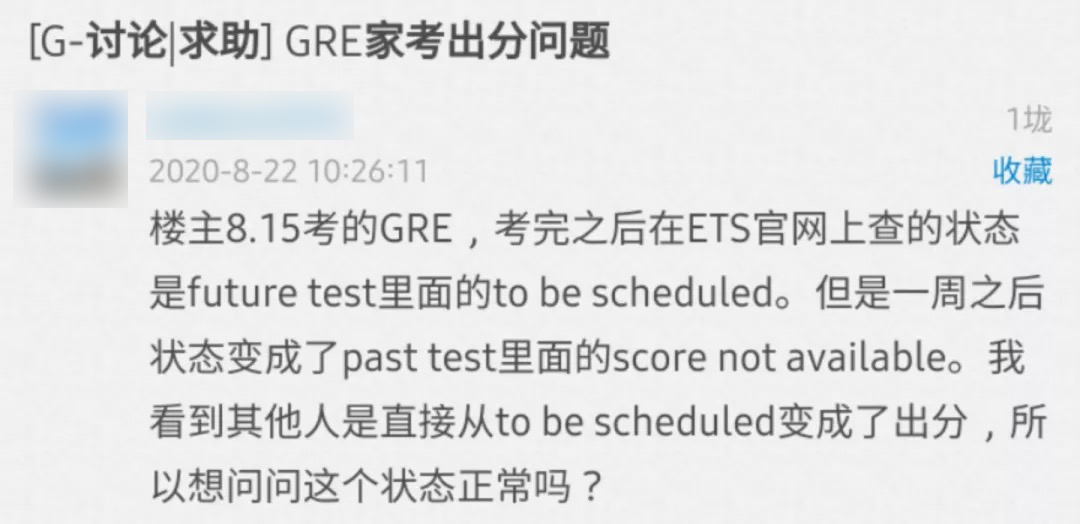

If you encounter such a long delay in score release, beware! A prolonged delay There is a very high chance that the legitimacy of your GRE score is being doubted! Your score is very likely to be canceled!
Some students have already reported that after waiting for weeks, their scores remained “unavailable,” only to receive an email stating that “background software was running” and that their scores had been canceled!
Why Are GRE Scores Canceled?
So, what exactly leads to ETS canceling a score?
1. Significant Score Difference Between Two GRE Attempts
Recently, many students have opted for at-home testing. In a familiar environment, test pressure decreases, and they perform well. Many have seen significant improvement compared to previous scores.
However, if the difference between two GRE scores is too large, your new score is likely already on ETS's radar. If individual section scores (Verbal, Quantitative) or the total score differ by more than 18 points, the chance of being suspected by ETS increases greatly.
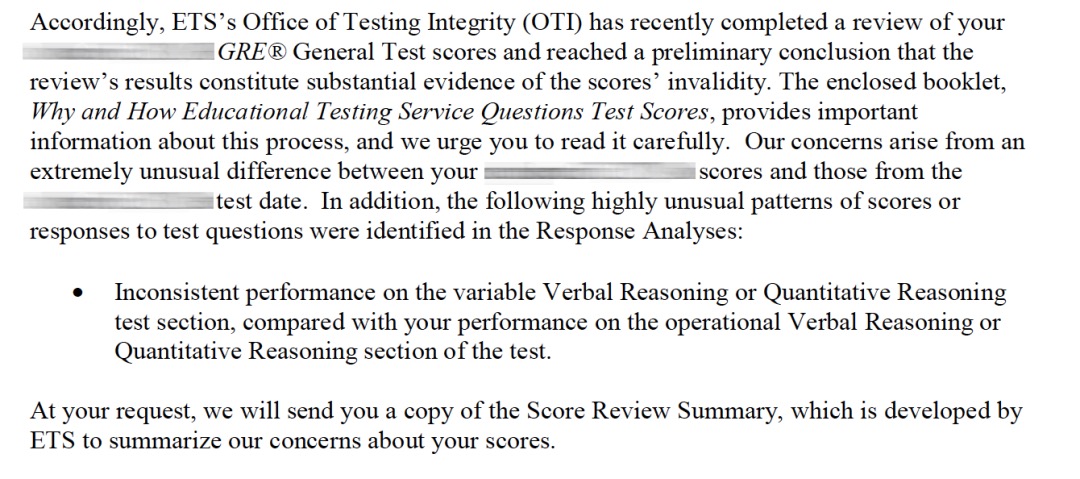
2. Abnormal Proctoring Data
Of course, some students with large score differences still retained their scores. This is because ETS's final decision to cancel a score is also based on proctoring data, including the time spent on each question, accuracy, combined with the difficulty of each question to make a comprehensive judgment.
This serves as a warning to students who have studied from jj (practice questions) before the test: you must control your answering speed reasonably! If you happen to encounter the exact same question on the test, it's very likely that a question of high difficulty will be answered too quickly because you've seen it before.
This can make proctoring data stand out abnormally, so students must remember not to “instantly select” answers and to allocate your time evenly across the test.
Why Are GRE Scores Delayed?
So, what's going on when scores haven't been canceled yet but are still delayed?
1. Exam Proctoring Data Is Abnormal, Under Review
Even for at-home tests, ETS has a dedicated proctoring system that can detect test-taking behavior; any abnormal performance will be recorded.
When proctoring data appears abnormal, ETS typically reviews all exam data again, leading to delayed score release.
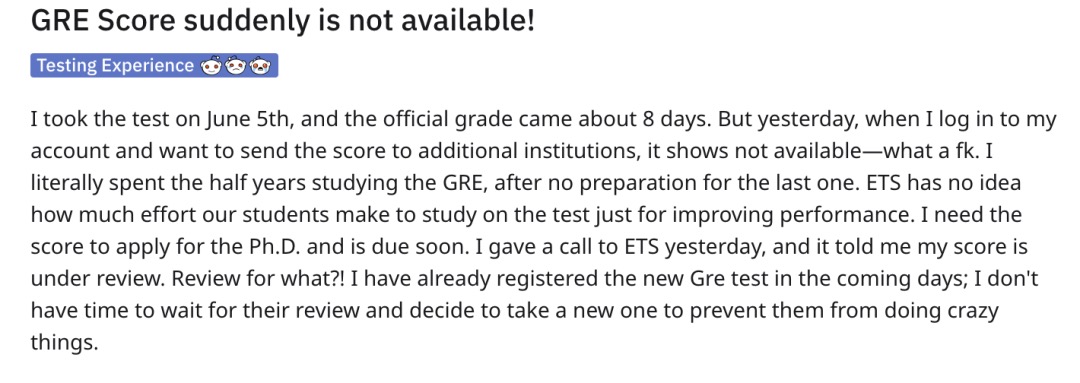
2. ETS Random Audits
Due to this year's special at-home testing format, GRE scores have been generally higher. Apart from genuine high performance, it cannot be ruled out that some students used proxy testing services.
ETS is well aware of this, and since the launch of the at-home testing service, they have been strictly investigating proxy testing. Recently, ETS has been randomly auditing some test-takers' data, which is likely why many are experiencing delays.
With rampant proxy testing ads on social media platforms, we advise everyone not to take the risk. Once ETS detects abnormal behavior such as background software running, not only will your score be canceled, but it will also negatively impact your academic integrity.

Of course, with more people taking at-home tests, reviews take longer. If a normal test-taker's score release is delayed, don't panic excessively; wait patiently or contact ETS, and in most cases, you will eventually receive your score.
For those whose scores have been canceled, you can choose to appeal, but unfortunately, the chance of a successful appeal is very small. This is because ETS officially states that their data detection involves two rounds of review, making it very rigorous. If they have reason to suspect foul play, it means they have already gathered substantial evidence.
Therefore, even for at-home tests, students should not take the exam casually with a lucky mindset. The new testing format does not mean lax supervision or that you can just try your luck. Also, while jj can be helpful, you must still approach them cautiously.
What If Your GRE Score Is Low?
So, for those who have received their scores but didn't get an ideal one, with generally high scores this year, does it mean there's no chance for top universities?
Although GRE scores are positively correlated with admission rates, it does not mean that without a high GRE score you're automatically out of the running for top schools.
Admissions officers mostly value your comprehensive abilities: GPA, school selection strategy, internship experience, application essays, etc. These are all indispensable decisive factors.
1. GPA
A solid GPA is crucial for applying to top universities; this hard metric is an iron threshold. Don't think that with a 2.0 GPA and a 330 GRE, schools will look at you with new eyes.
In fact, many top programs set a minimum GPA of 3.0 as an initial screening criterion. If a student has a very high GRE score but a very low GPA, it may instead raise reasonable doubts about your academic ability.
GPA directly reflects your accumulated learning outcomes and attitude over time. Maintaining a satisfactory GPA during your undergraduate studies is the foundation for gaining admissions officers' approval.
2. School Selection Strategy
School selection strategy is crucial. Choosing schools is like deploying troops in battle: you must know yourself and your enemy. Based on your situation, pick the programs that are your favorites, the best fits, and the most likely to admit you, deploying your efforts wisely to maximize your admission chances.
3. Internship Background
Students who have managed a "turnaround from low GRE/GMAT" often share a common trait:
A rich and strong practical background
High-value internships are a brilliant addition to your resume, especially crucial for programs that emphasize practical experience. They can also help you secure recommendation letters and provide important material for your essays.
4. Recommendation Letters
Universities are increasingly demanding with recommendation letters. With applicants often applying to 8-10 schools, professor recommendations have undoubtedly become a more challenging and competitive component.
Admissions officers want to see direct evaluations from your instructors—something transcripts, resumes, or even essays cannot fully convey.
5. Essays
If GPA is your appearance, standardized test scores your wealth, and recommendation letters whispers from friends and family, then essays are your first date with the top school—the only systematic way to present your personal experiences, and one of the most critical aspects of the application.
A great essay can make an admissions officer's eyes light up and sometimes directly determine whether an applicant is admitted or rejected.
The GRE at-home testing has been extended to October 31. We hope everyone takes every GRE exam seriously. We also wish all those preparing for the test achieve their ideal scores and get admitted to their dream schools!
Precise positioning, conquer top schools!
Scan the QR code below now to start a one-on-one study abroad consultation~
.jpg?x-oss-process=style/opt-webp)