Recently, a consulting student came to us in a panic, saying that their 330+ GRE score had been canceled on suspicion of cheating!! But the student kept recalling the test process and felt nothing was unusual.
.jpg?x-oss-process=style/opt-webp)
We carefully read ETS's letter with the student, but the content didn't explicitly point out the student's problem. Just when we were puzzled, the student suddenly mentioned, "Could it be because I took the test in XXX company's computer lab?!"
.jpg?x-oss-process=style/opt-webp)
At that time, the student was in China. Worried about poor internet speed at home, and with the invitation of the training institution's teacher who said many students took the test in their computer lab, the student went to the institution's computer lab to take the test.
With this suspicion, the student went back to investigate and found that another student who studied GRE with them and also took the test in the computer lab also had their score canceled!
We also helped review and analyze the reasons:
1. The computer lab of the offline GRE institution might have installed some background-running software, which was detected by ProtectU, leading the system to judge as cheating;
2. The computer lab may have had a large number of test-takers taking the test, producing abnormal scores under the same IP address;
3. The computer lab may have had serious cheating or proxy testing incidents before, making it a key target of ETS test center monitoring.
Currently, the student has emailed the test center to appeal, and ETS says the matter is still being processed. We hereby solemnly remind all test-takers to strictly follow the test procedures. Preparing for the test is not easy, so don't let your hard work go to waste.
What Can Lead to GRE Score Cancellation
Since the GRE opened online testing, due to the new test format and rampant proxy testing, score cancellations have occurred frequently.
In principle, the main reason ETS cancels scores is the detection of academic dishonesty. However, it is worth noting that sometimes students do not actually cheat, but some improper operations can also lead to score cancellation.
.jpg?x-oss-process=style/opt-webp)
After reading the official ETS introduction above, many students may still not understand the logic behind score cancellations. CheersYou(清柚教育) has long maintained communication and cooperation with ETS China, and we have learned some information from various aspects:
It is understood: ETS absolutely maintains the fairness and impartiality of the test, cracking down on all cheating, proxy testing, and other behaviors harmful to academic integrity. The test system also has a series of anti-cheating algorithms, but these algorithms cannot be disclosed to the outside world at present. Once these methods are made public, it is equivalent to revealing them to unscrupulous institutions.
So from the existing information, CheersYou(清柚教育) has summarized the following reasons and solutions for score cancellations:
1. Excessive Score Difference Between Two Tests
It is not uncommon for GRE scores to be canceled due to excessive score differences, and test-takers encounter this every year.
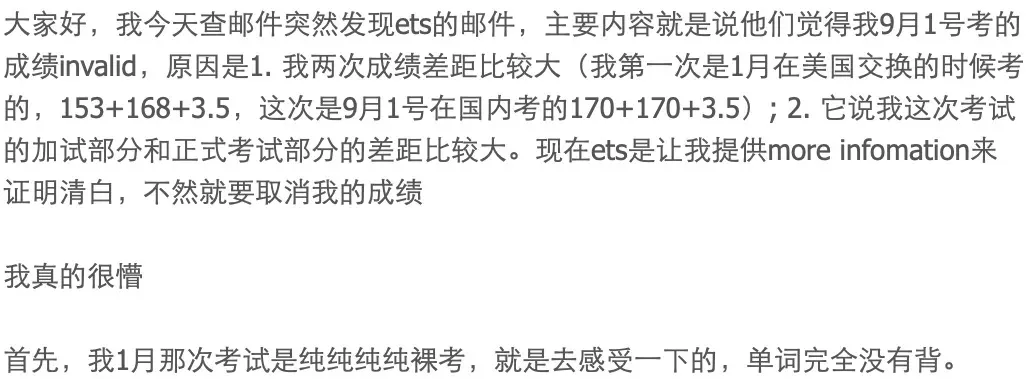
If the score difference between two consecutive GRE tests is over 18 points, there is a high probability of being flagged by ETS, and in serious cases, the score may be canceled. Some students were unlucky and had their scores canceled with a difference of over 15 points.
Although a large score difference between two GRE tests does not 100% lead to score cancellation, ETS will analyze test data to see if there are abnormal behaviors; however, a large score difference certainly gives ETS sufficient reason to raise reasonable doubts about the test-taker's score.
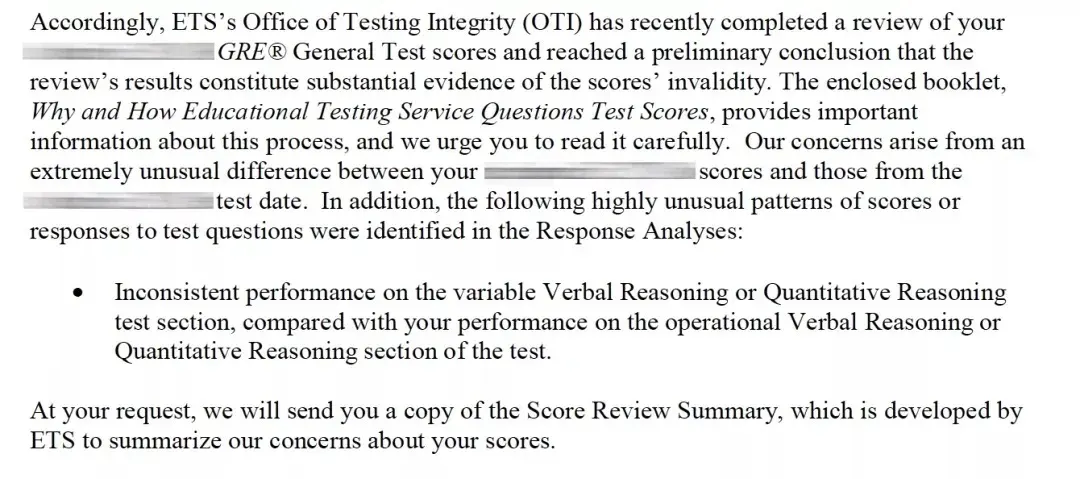
If flagged by ETS, your official score report is likely to be reviewed and delayed; once ETS discovers irregularities, the score will be canceled.
Therefore, students must prepare seriously, do not take the test without preparation. Some students take the first test with a trial mindset; this casual attitude toward the test is absolutely unacceptable.
2. Answering Questions Instantly
As an educational institution deeply engaged in the GRE field for many years, we also know that with correct methods and plenty of practice, it is possible to answer questions instantly, not to mention that many students encounter original test bank questions.
However, we have repeatedly emphasized to test-takers: Do not answer questions instantly in the test!
ETS generally has technology to closely monitor test-takers' exam data, including time spent on each question, accuracy rate, etc., and combines the difficulty of each question to comprehensively judge whether the student's responses are normal. Online test monitoring is the same, or even stricter.
At this time, even if you encounter original test bank questions, please answer normally to avoid being judged as having abnormal test behavior by the system.
3. Presence of Abnormal Devices or Software
In addition to cracking down on cheating, ETS also combats recording theft and similar behaviors, and will require a check of the test-taker's room facilities before the test. Students must not have any peripheral devices unrelated to the test in their homes, such as cameras. Even if not discovered at the time and you take the test normally, your score may still be canceled later.
During the test, other software is strictly prohibited, such as Zoom, Skype, Tencent Meeting, WeChat video, Apple virtual desktop, etc. Students must remember to close relevant software and set them in advance to prevent them from automatically popping up or running in the background!
Recently, some test-takers have been denied and had their test canceled as soon as they entered the exam, and the computer lab test mentioned at the beginning may also be due to this reason.
What to Do if Your GRE Score Is Canceled
If your GRE score is canceled, you can email ETS test center to appeal, explaining that you did not cheat and providing relevant evidence. However, the current probability of a successful appeal is extremely low, and it is recommended not to place too much hope on the appeal.
If the appeal fails, there may be the following two situations:
1. The test center refuses to reinstate the score and offers no alternatives.
2. The test center refuses to reinstate the score but offers some alternative solutions:
(1) The test-taker can retake the test for free.
(2) Cancel the test score for this attempt and receive a full refund.
(3) Have the score report for this test marked as canceled and sent to schools for their own decision.
(4) Continue with arbitration (U.S. only).
It can be said that almost all students who encounter score cancellations choose to retake the GRE test.
Is GRE Proxy Testing a Poison You Dare Drink?
Since the GRE implemented the at-home test policy last year, proxy testing agencies have fully targeted this "business opportunity" and carried out overwhelming sweeping promotions.
The development of the proxy testing service industry seems to bring "convenience" to many students, but those who use these services never think about the consequences they will face once caught.
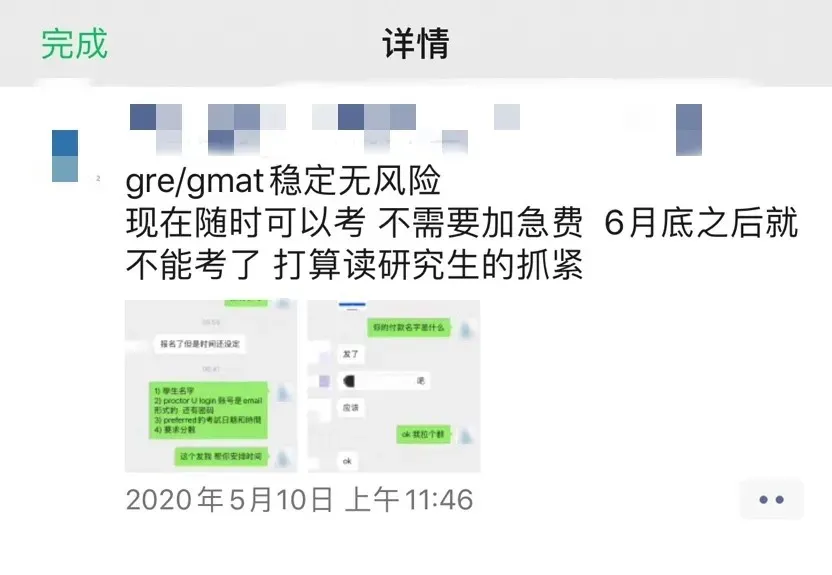
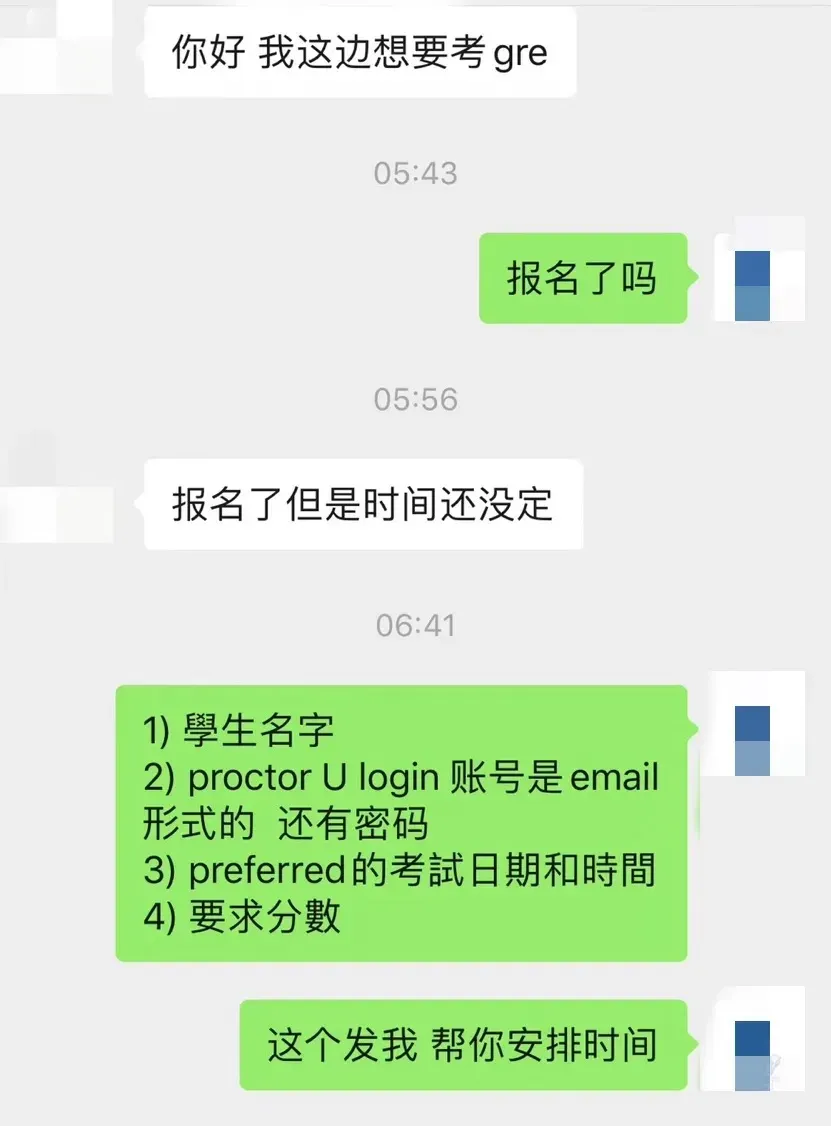
Many students see the 330+ scores achieved through proxy testing and are "envious," thinking that with a proxy-tested 330 they can get into Harvard. Here we must tell you a cruel truth: Proxy-testing scores, even a perfect score, are useless!
Admissions officers at every graduate school are experienced teachers who know the application landscape well. While a high GRE score of 330+ attracts the attention of admissions officers, it may also bring stricter scrutiny to the application materials.
If a student has a GRE of 338 but a GPA of only 2.8, and their personal statement, resume, recommendation letters, etc. are mediocre, it easily raises doubts about the student's background and even personal integrity. Some students may receive additional interviews, while others may receive rejections directly.
Additionally, ETS has always maintained a zero-tolerance and severe punishment attitude toward cheating. Once proxy testing fraud is investigated, not only will the single test score be canceled, but also includes one-year test ban, lifetime test ban, etc.
The GRE test is not a one-time opportunity; you can allocate sufficient time to plan and prepare.
Your one risky move may also cause countless other test-takers to suffer. What is delayed is not only everyone's scores and applications, but also the image of international students that has been maintained.
The GRE at-home test is still ongoing, and it is what every test-taker should do: prepare diligently and honestly, and be a person of integrity.