
The United States remains a key destination for international students worldwide.
According to the latest Open Doors Report 2026 released by the Institute of International Education (IIE), in the 2025/26 academic year, the number of international students in the U.S. reached 1.146 million, with 57% choosing STEM fields.
Meanwhile, the number of international students gaining work experience in the U.S. through OPT reached 336,000, a year-over-year increase of 14%.
Source: opendoors
For families planning to study in the U.S., beyond university rankings and program strength, internship, employment, and career development opportunities after graduation are increasingly worth attention.
So, when studying in the U.S., which city should you choose to access more career resources?
Recently, Hiring Lab, the research arm of global recruitment platform Indeed, released its first "2026 Best U.S. Cities for Jobs" ranking, offering a new reference for international students' future development.
2026 Best U.S. Cities for Jobs
What Makes a City Job-Friendly
Many city rankings focus on where is suitable for business development, but Indeed's ranking takes a different angle:
From the perspective of workers, where is more suitable for work and life?
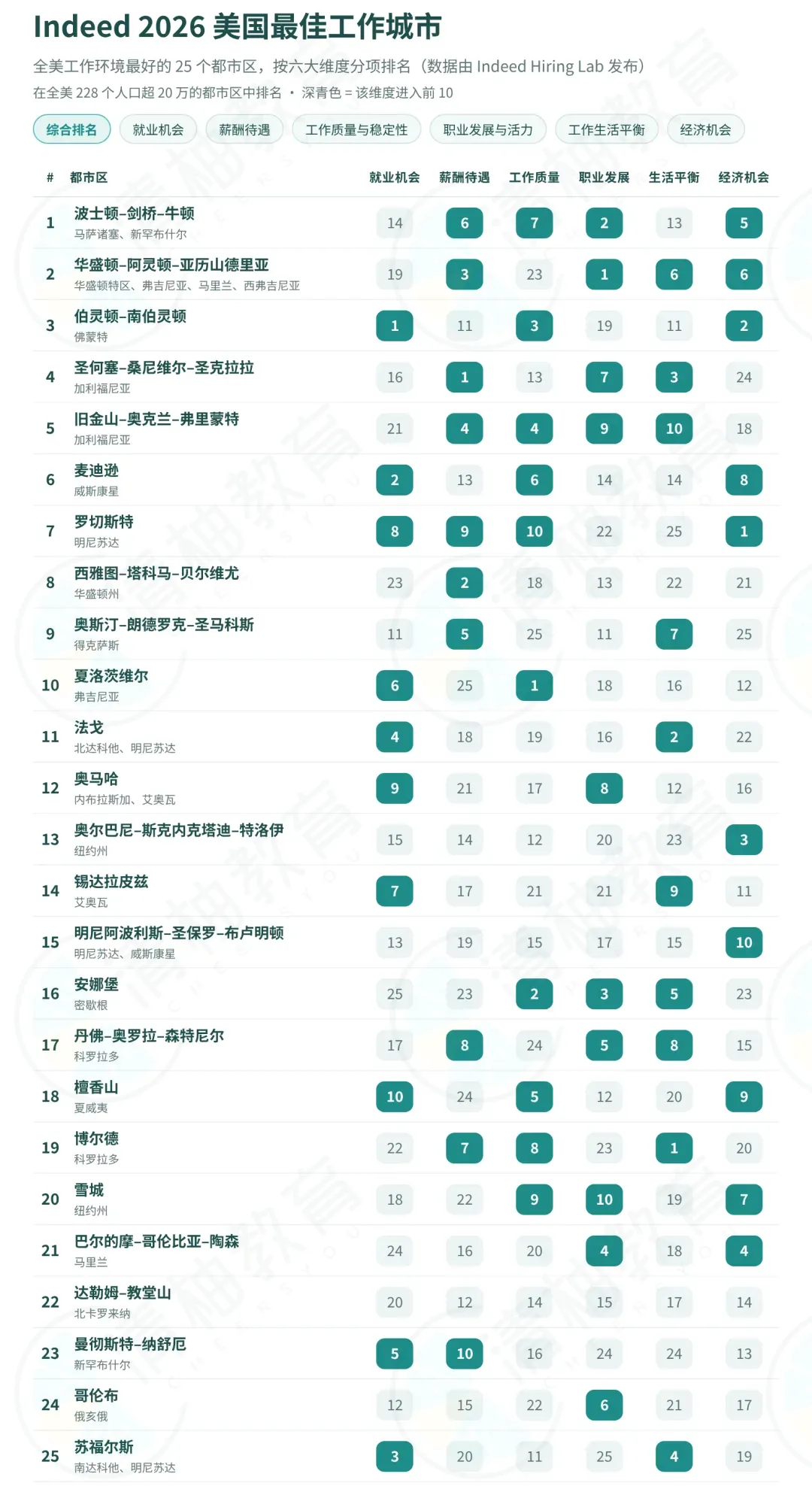
This evaluation covers 228 metropolitan areas in the U.S. with populations over 200,000, combining 40 indicators across six dimensions: job opportunities and compensation each account for 20%; job quality and stability, career development and dynamism, work-life balance, and economic opportunity each account for 15%.
Among these, the compensation indicator not only looks at salary levels but also deducts relevant taxes and adjusts for local cost of living, avoiding overestimation of cities with high salaries but high expenses.
Below is the Top 25 Best U.S. Cities for Jobs ranking:
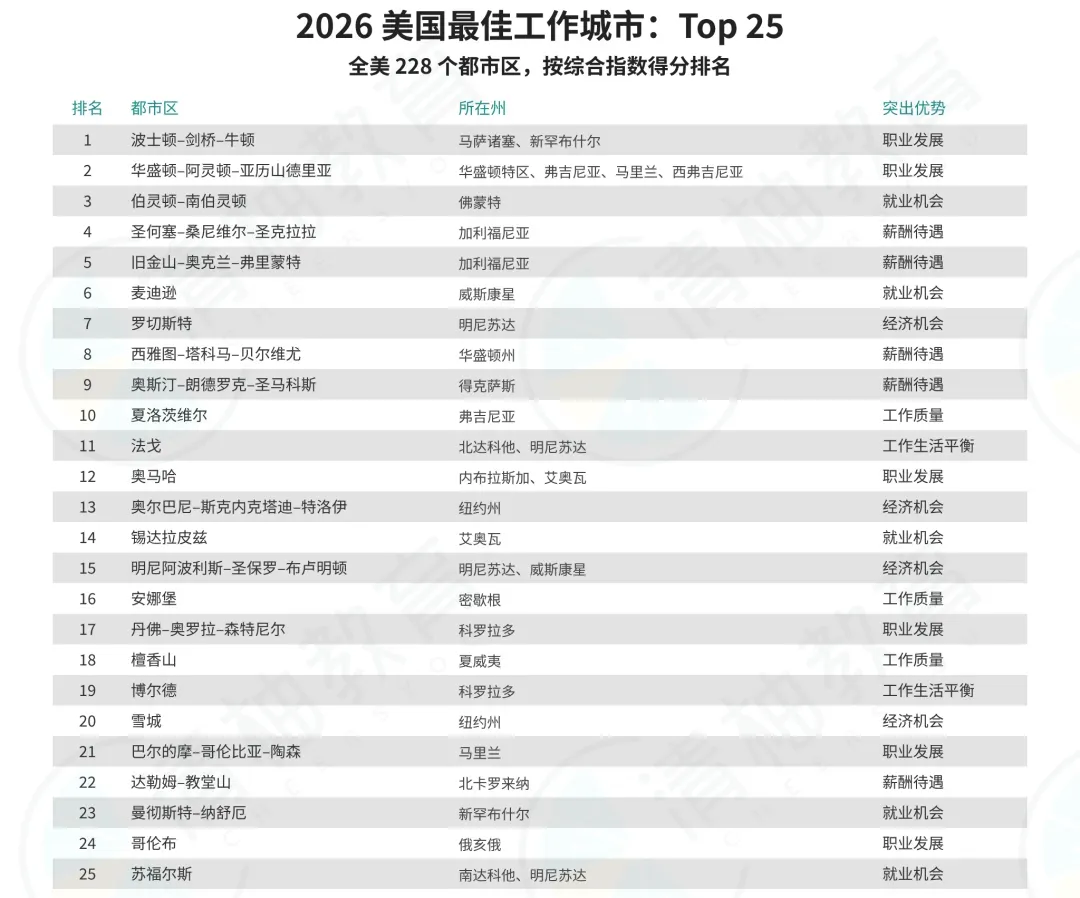
From the ranking, big cities are not the only winners. Besides traditional employment centers, some small and medium-sized metropolitan areas with concentrations of universities, hospitals, and research institutions also made the top 25.
Boston Tops the List: Standout Overall Strength
As the champion of this ranking, Boston did not take first place in any single category, but it performed outstandingly across multiple dimensions. It ranked 2nd in career development, 5th in economic opportunity, 6th in compensation, and 7th in job quality.

Boston is not only home to world-renowned universities such as Harvard University and MIT, but also has a deep industrial foundation in fields such as healthcare, biotechnology, finance, and technology.
For international students, this city offers not only high-quality educational resources but also abundant internship and career development opportunities.
College Towns Stand Out
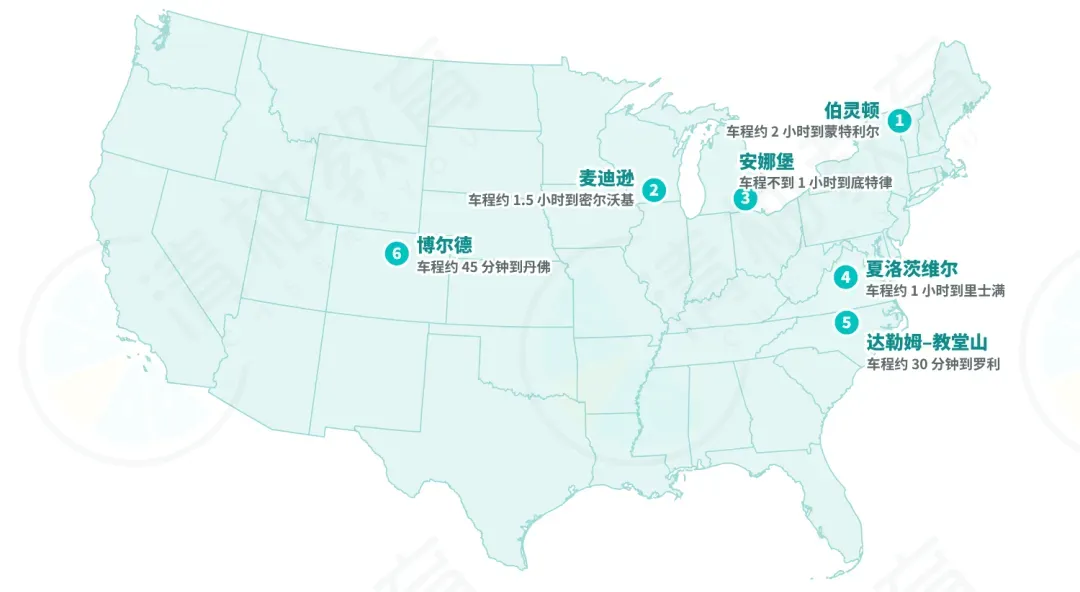
A closer look at the rankings reveals an interesting phenomenon: among the top 25, at least 7 metropolitan areas have distinct college-town characteristics.
|
Ranking |
City |
Representative University |
Notable Strength |
|---|---|---|---|
|
3 |
Burlington |
University of Vermont |
No. 1 in Job Opportunities |
|
6 |
Madison |
University of Wisconsin–Madison |
No. 2 in Job Opportunities |
|
10 |
Charlottesville |
University of Virginia |
No. 1 in Job Quality |
|
16 |
Ann Arbor |
University of Michigan |
No. 2 in Job Quality, No. 3 in Career Development |
|
19 |
Boulder |
University of Colorado Boulder |
No. 1 in Work-Life Balance |
|
20 |
Syracuse |
Syracuse University |
Top 10 in both Job Quality and Economic Opportunity |
|
22 |
Durham–Chapel Hill |
Duke University, UNC Chapel Hill |
All six metrics rank between 12th and 20th |
In addition, other metropolitan areas on the list, such as Boston (Harvard, MIT), Austin (UT-Austin), Columbus (OSU), and Baltimore (JHU), are also home to strong universities and research institutions.
Why College Towns Perform So Well
Indeed specifically highlights a phenomenon in the U.S. urban economy: the clustering effect of the education and healthcare industries.
Universities and hospitals not only directly create jobs, but also attract talent, research investment, and related businesses, driving the development of surrounding industries. For example:
-
Madison: Home to the University of Wisconsin–Madison and also the headquarters of healthcare software company Epic
-
Rochester (MN): Home to the globally renowned Mayo Clinic and the University of Minnesota Rochester, with a highly developed healthcare industry
-
Ann Arbor: The University of Michigan and its medical and research systems bring education, healthcare, and technology-related resources to the area
Compared with cities that depend on a single company or industry, these metropolitan areas tend to have a more diversified employment base. In addition, industries that require a large amount of in-person services, such as healthcare, have some roles that are at relatively lower risk of being directly replaced by AI, which also helps strengthen the resilience of the local job market.
City Rankings by Different Career Goals
There is no single optimal answer when it comes to a city's employment environment. Everyone has different priorities. Some students value salary more, some hope for more career development opportunities, and others care more about job stability and work-life balance.
The Indeed rankings also provide rankings across different dimensions, which can serve as supplementary references.
Top 5 cities under selected employment dimensions and representative institutions:
|
Focus Area |
Top 5 Cities by Dimension |
Examples of Related Institutions |
|---|---|---|
| Seeking High Salary |
San Jose, Seattle, Washington, D.C., San Francisco, Austin |
Stanford University, University of Washington, Georgetown University, University of California, Berkeley, University of Texas at Austin, etc. |
| Early Employment |
Burlington, Madison, Sioux Falls, Fargo, Manchester |
University of Vermont, University of Wisconsin-Madison, etc. |
| Job Stability |
Charlottesville, Ann Arbor, Burlington, San Francisco, Honolulu |
University of Virginia, University of Michigan, etc. |
| Rapid Growth |
Washington, D.C., Boston, Ann Arbor, Baltimore, Denver |
George Washington University, Harvard University, Massachusetts Institute of Technology, Johns Hopkins University, etc. |
| Work-Life Balance |
Boulder, Fargo, San Jose, Sioux Falls, Ann Arbor |
University of Colorado Boulder, University of Michigan, etc. |
It is worth noting that Ann Arbor ranks in the top five across all three dimensions of job quality, career development, and work-life balance; Burlington, San Jose, and Washington, D.C. also perform prominently across multiple dimensions.
As can be seen, a city's employment advantages are not reflected only in salary levels, but also include job quality, career growth space, and living conditions.
How International Students Can Leverage City Employment Resources
A City's Industry Advantages Are Also an Important Reference for Choosing a School
Many students, upon hearing "college town," worry that the place is too small and offers too few job opportunities. But the Indeed rankings show that some small and medium-sized metropolitan areas perform just as well as large cities in terms of job opportunities, job quality, and career development.
Many college towns have research centers, affiliated hospitals, science and technology parks, and alumni-run companies, providing students with abundant industry resources. In addition, some college towns are closely connected to larger metropolitan economic circles. Choosing a college town does not mean giving up the career resources of a big city.
For students, local industry clusters not only mean more potential internship and employment opportunities, but also help them learn about industry trends in advance and build professional networks during their studies.
Understand CPT and OPT Policies in Advance
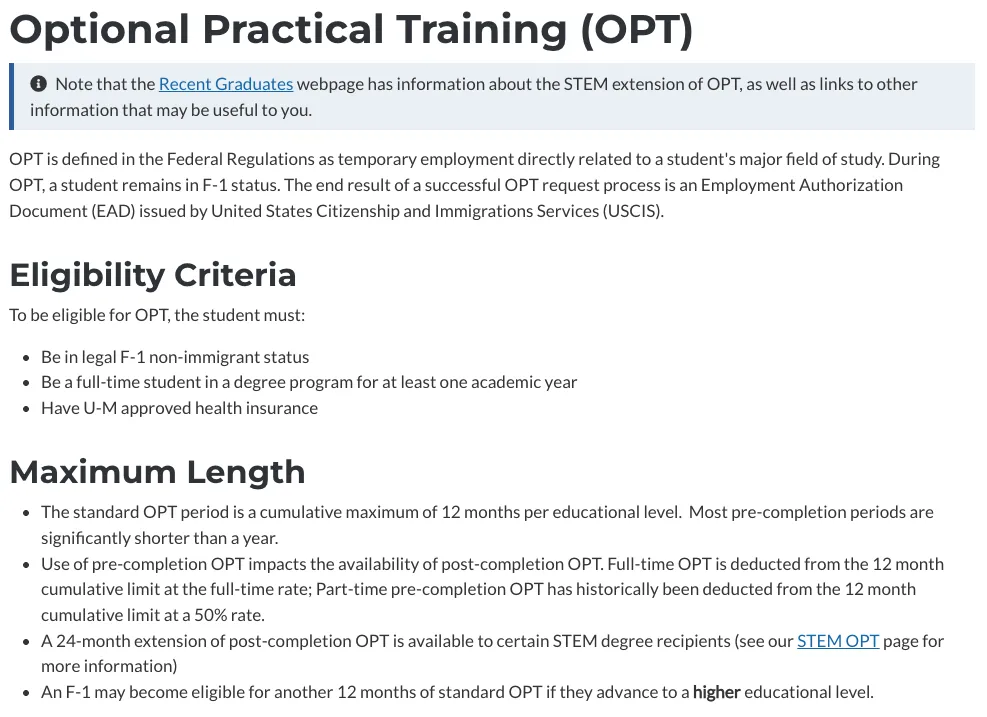
F-1 students in the United States can participate in internships related to their field of study through CPT during their studies; after graduation, they can apply for OPT to obtain a work permit of up to 12 months; eligible STEM graduates may also apply for an additional 24-month OPT extension.
When choosing a school, in addition to looking at city employment rankings, it is also recommended to understand in advance:
- The school's CPT and OPT application requirements and related regulations
- Whether the target program meets the STEM OPT extension requirements
- Whether the curriculum offers internships, practical projects, or co-op opportunities
- What industry resources the school's career development center offers
- Local employers' hiring and work authorization requirements for international students
Source: UMich
Pay Attention to Employment Opportunities at Educational, Medical, and Research Institutions
The Indeed rankings reflect that universities, hospitals, and research institutions play an important role in the employment ecosystem of certain cities.
For students majoring in public health, biostatistics, health informatics, education, computer science, and other fields, these institutions and their surrounding industries are worth focusing on.
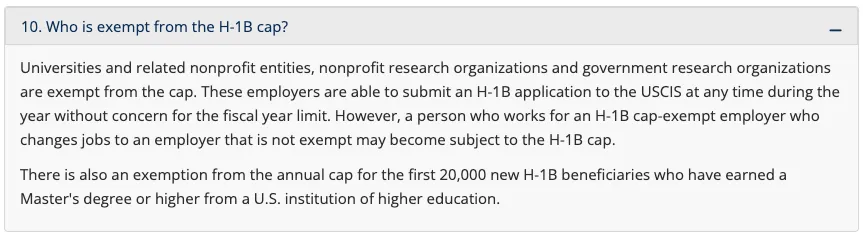
In addition, eligible higher education institutions, nonprofit organizations affiliated with universities, nonprofit research institutions, and government research institutions are not subject to the annual H-1B cap when filing H-1B petitions.
Source: UCBerkeley
For international students who hope to continue developing their careers in the United States after graduation, this is one of the employment paths worth understanding in advance.
Looking at the 2026 Best Cities for Jobs in the U.S. ranking, in addition to traditional employment centers like Boston, many college towns also demonstrate unique advantages in employment opportunities, job quality, and career development thanks to their distinctive industry characteristics and research resources.
Of course, a city's overall employment ranking does not equate to actual employment opportunities for international students. This ranking provides everyone with a new perspective on understanding the U.S. job market, but specific study and career planning still requires comprehensive consideration of factors such as field of study, school resources, personal background, and work visa policies.
Whether choosing a bustling metropolis or a college town with distinctive industry resources, we hope every international student can find a development direction that suits them, make full use of the resources and opportunities available during their studies, and find more possibilities on their future academic and career paths.