
This year, the world's largest salary data website, PayScale, surveyed nearly 250,000 U.S. graduates with bachelor's degrees or higher and found that 66% regret their university education.
.png?x-oss-process=style/opt-webp)
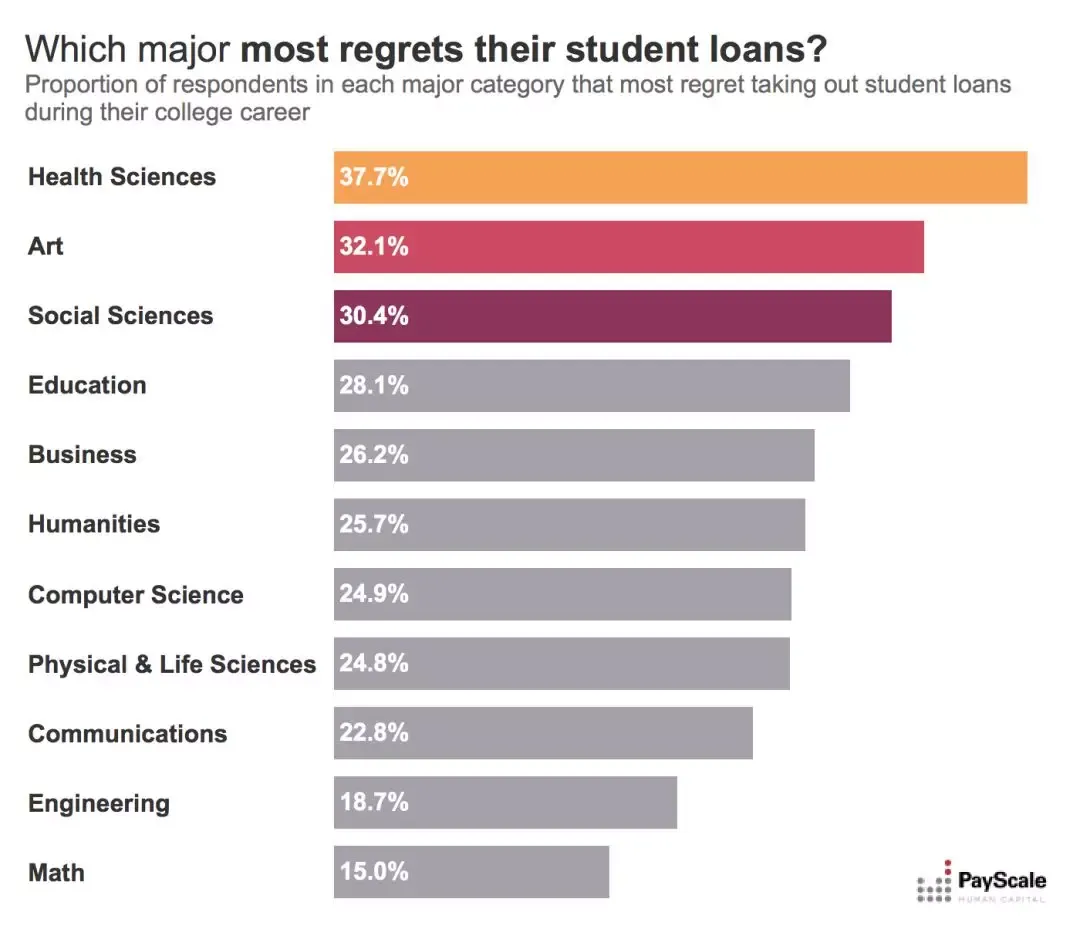
According to the survey, student loans have consistently topped Americans' "number one regret." Among them, Millennials show the strongest remorse over student loans. The total U.S. student loan debt approached $1.6 trillion in 2019, even surpassing credit card debt.
.png?x-oss-process=style/opt-webp)
Two other common university education regrets are the field of study chosen and poor social skills.
Overall, those who majored in engineering, education, computer science, and business have lower levels of regret about university. STEM graduates tend to enter high-income professions, and thus the proportion with no regrets about their university education is naturally the highest.
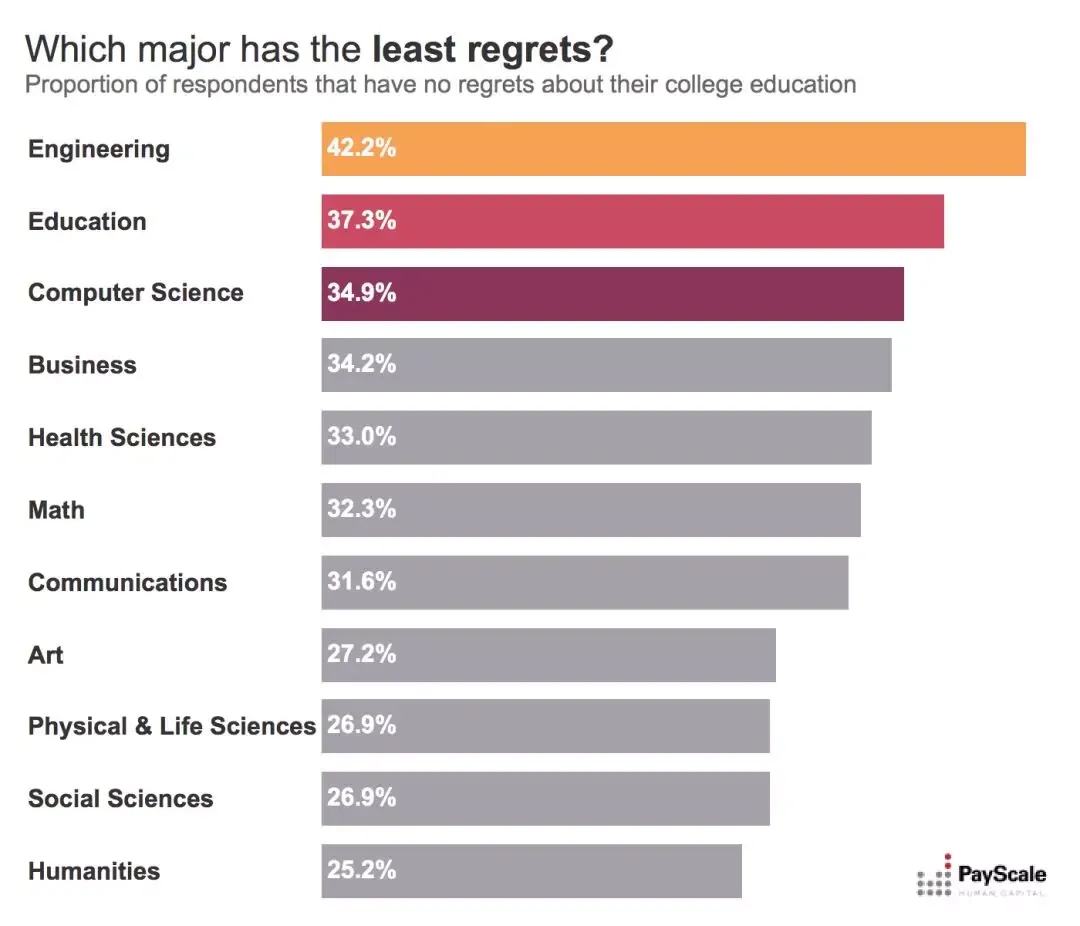
Education has long been considered one of the most meaningful majors, with over 37% of education professionals expressing no regrets. However, regarding student loans, a higher proportion of education majors regret taking them out, reflecting the relatively low return of the field.
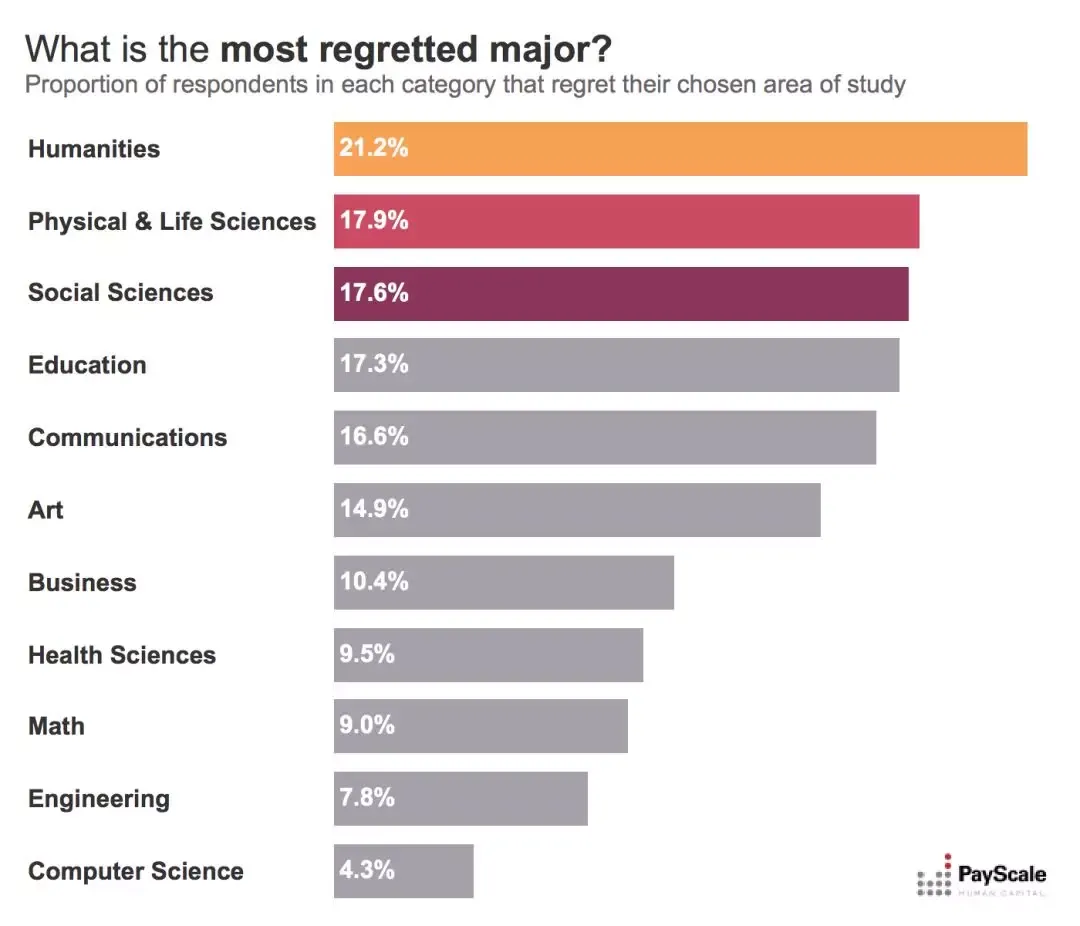
In terms of field of study, over one-tenth of university graduates regret having chosen the wrong major.
Humanities lead the pack, with over 20% of majors including English and history indicating they should not have chosen their field. Other fields such as physical and life sciences, social sciences, education, communications, and art are also listed by many graduates as regretted majors.
Graduates in computer and engineering fields have the lowest level of complaints about their area of study.
(Click to view original article)
It is easy to see that while salary does not determine all university regrets, it indeed has the most profound impact on the overall regret level of university education.
However, are these statistically identified most-regretted majors truly not worth studying just because their economic returns are less than ideal?
Employment prospects and debt issues are now two key factors influencing American students' major choices, with Chinese international students tending to focus more on the former. This can even lead to situations where those who love humanities end up compromising and choosing a STEM major.
Yet, as one American netizen put it: "Education is the cultivation of moral spirit, far above the pursuit of money. If someone chooses a major solely based on salary, they are merely attending a trade school."
Fields such as humanities, social sciences, and the arts have always had their reason for being, and it is precisely these disciplines that have created human civilization.
These so-called "regret disciplines" are largely considered from a monetary perspective, but from the angles of life philosophy, values, and worldview, the insights gained from these fields may be far more valuable than money.
Moreover, those who studied humanities at the undergraduate level also have the opportunity to pursue advanced degrees in high-paying fields such as engineering, healthcare, and law. The diverse learning background can help them develop unique insights and thinking in new fields.
Of course, real-world education cannot be so perfect. Debt and income are indeed issues that today's students need to consider before entering university.
After all, attending university is now a very costly and energy-consuming endeavor. It is entirely reasonable to seek higher income to improve the return on investment of a university education, especially since many students are also genuinely passionate about their high-earning majors.
Everyone's purpose in learning may differ. You might pursue artistic accomplishment without caring about future career paths; you might emphasize pragmatism and seek higher-value returns.
Everyone's learning outcomes will also differ. You might enter a top law school and become a highly-paid lawyer envied by all; you might also graduate in computer science but end up unable to find a suitable company.
Choosing a major can seem easy, something settled in half a day, or it can be complicated, something you continue to ponder even after graduation.
CheersYou(清柚教育) here sincerely hopes that every student can find the best balance between interest and pragmatism. At the same time, remember that there is no shortcut to success; those who work diligently and think deeply are the most promising.