

Artificial intelligence is gradually transforming the way economic research, financial analysis, and public policy-making are conducted.
As technologies such as machine learning and big data analytics become increasingly integrated into the field of economics, there is growing attention on interdisciplinary talent who possess both AI technical skills and an economics analytical background.
In this context, Emory University recently announced a new Master of Science in Artificial Intelligence and Economics. The program will welcome its inaugural cohort in Fall 2027, and applications are currently open.
Source: Emory
Emory University’s New AI + Economics Master’s Program
Program Overview
The MS in AI and Economics is a STEM-designated program jointly taught by Emory University’s Department of Computer Science and Department of Economics.
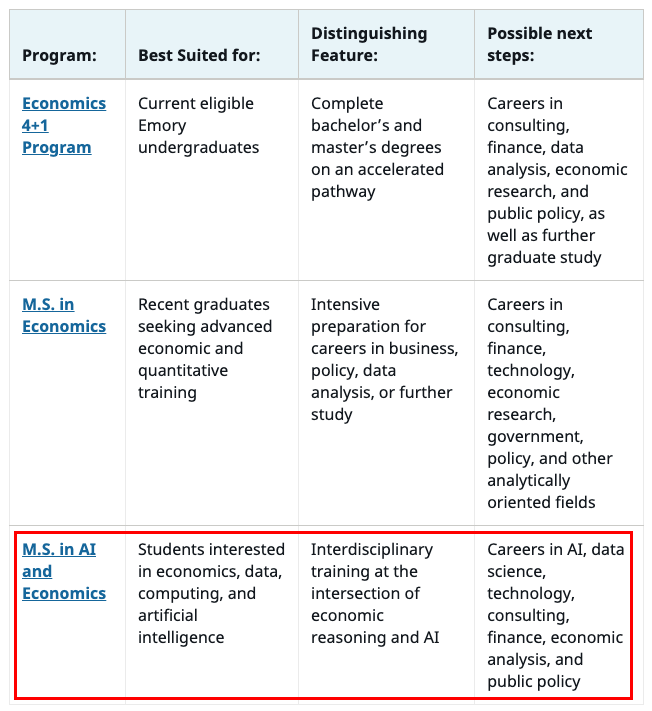
The program emphasizes the integration of artificial intelligence technology with economic theory. Students will study topics such as machine learning, econometrics, computational methods, and economic policy analysis, exploring the application of AI techniques in economic research and real-world decision-making.
The program has also established partnerships with the Federal Reserve Bank of Atlanta and Emory’s Goizueta Business School, providing students with opportunities to engage with real-world economic and financial data challenges.
Curriculum Structure
The program follows a one-year, three-semester training model. The curriculum consists of core courses, specialized elective courses, Capstone practical projects, and career development components.
Core Courses
Students must complete four core courses to build a foundational knowledge base in artificial intelligence and economic data analysis:
- Machine Learning
- Artificial Intelligence
- Big Data Econometrics
- Computer Programming & Data Management in Economics
Source: Emory
Specialized Elective Courses
Students must select two computer science electives and one economics elective.
Computer science course options include:
- Natural Language Processing
- Neural Networks & Deep Learning
- Human-AI Interaction
- Social & Ethical Issues in Computing
Economics course options include:
- Digital Assets & Blockchain
- Internet Economics
- Algorithmic Game Theory
- Computational Macroeconomics
Capstone Practical Projects
The program requires students to complete two Capstone courses. Options include:
- Advanced Computing Methods in Economics
- AI and Economic Policy
- Emerging Technologies & Innovation Policy
Additionally, the program includes career development and professional training components to help students apply their knowledge to real-world problems.
Application Requirements
Academic Requirements
- A bachelor's degree from a recognized higher education institution, or completion of a bachelor's degree before program entry
- A minimum cumulative undergraduate GPA of 3.0/4.0; the school prefers applicants with a GPA of 3.5 or above
- An undergraduate major in economics is not required, but applicants must have a foundational understanding of relevant economics and mathematics
- Practical proficiency in at least one advanced programming language
Regarding economics, applicants are required to complete the following foundational courses:
- Calculus
- Probability and Statistics or Mathematical Statistics
- Principles of Microeconomics and Intermediate Microeconomics
- Principles of Macroeconomics and related intermediate-level courses
- Econometrics
Source: Emory
In terms of computer science, the school does not prescribe a mandatory list of prerequisite courses, but strongly recommends that applicants possess a foundation in linear algebra, discrete mathematics, algorithms, data structures, and programming.
Knowledge of databases, computer systems, and computer architecture is also included in the academic preparation guidelines provided by the school.
Application Materials
- Transcripts for undergraduate and any other higher education stages
- Curriculum Vitae (CV)/Resume
- Statement of Purpose: One page explaining the reasons for applying to this program and areas of interest
- Two letters of recommendation
- Proof of English language proficiency
- GRE scores are not mandatory, but self-submission is encouraged to demonstrate quantitative analysis and analytical writing abilities
Application Timeline
January 15, 2027: Priority application deadline
April 15, 2027: Final application deadline
May 15, 2027: Enrollment deposit deadline
The school advises international students to submit their materials before the priority application deadline whenever possible, to allow sufficient time for subsequent visa processing.
Additionally, admitted students are automatically considered for partial tuition scholarships without needing to submit a separate scholarship application.
Emory University’s newly launched Master’s program in AI + Economics integrates computer science and economics training, helping students master the application of artificial intelligence technologies in economic analysis and practical decision-making, laying a foundation for future interdisciplinary study and career development.
For students with a certain foundation in economics, mathematics, and programming who wish to further explore interdisciplinary applications of artificial intelligence, this program offers a new option. Students interested in applying for Fall 2027 can contact CheersYou for more details about the program and application planning.