
The 2026-27 application season is about to begin, and some US universities have already quietly announced their standardized testing policies for the new year!
Duke University, the University of Notre Dame, and Emory University have recently updated their testing policies for Fall 2027, announcing that they will continue to adopt a Test-optional policy.
Source: ND
Currently, top US universities are gradually updating their SAT/ACT standardized testing requirements for Fall 2027 undergraduate admissions, and CheersYou(清柚教育) has compiled the latest situation for everyone.
Summary of Standardized Testing Requirements at Top 30 US Universities
Mandatory Submission of Test Scores
-
Cornell University
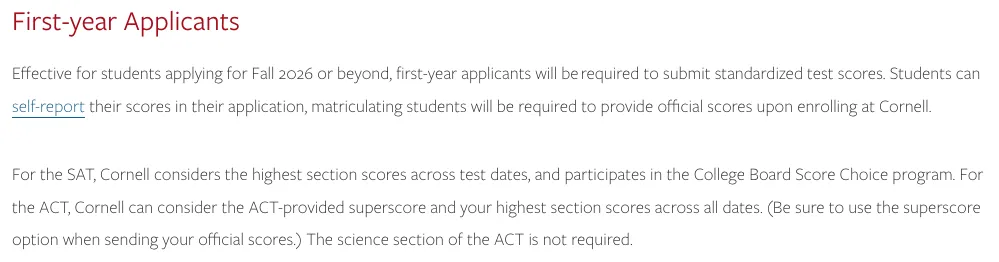
-
Stanford University
-
Johns Hopkins University
-
Massachusetts Institute of Technology
And also:
-
Brown University
-
California Institute of Technology
-
University of Pennsylvania
-
Georgetown University
-
University of Florida
-
University of Texas at Austin
-
Carnegie Mellon University School of Computer Science
-
Dartmouth College
-
University of North Carolina at Chapel Hill (GPA 2.8+ exempts test scores)
-
Princeton University (Mandatory starting from Fall 2028)
Test-Optional Submission
-
Duke University
-
Northwestern University
-
Columbia University
-
Vanderbilt University
And also:
-
University of Chicago
-
Washington University in St. Louis
-
University of Michigan, Ann Arbor
-
Rice University
-
University of Southern California
-
University of Virginia
-
Emory University
-
University of Chicago
-
University of Notre Dame
Flexible Test Score Policies
-
Yale University
-
Harvard University
-
Carnegie Mellon University (College of Engineering, Dietrich College of Humanities and Social Sciences, School of Information Systems and Management, Mellon College of Science, Tepper School of Business)
Test-Blind (No Consideration)
The University of California system continues to adopt a Test-blind policy, no longer considering SAT or ACT scores in the admissions review process.
Source: UC official website
It appears that more and more US universities are reinstating mandatory standardized testing requirements. UNC-Chapel Hill, in particular, explicitly requires students with a GPA below 2.8 to submit SAT/ACT scores, which could be seen as a testing policy with a "GPA bias."
Source: UNC official website
Even among schools that are test-optional, their attitude towards standardized test scores is rather ambiguous, and few truly disregard them entirely.
For students who typically apply to 8~10 universities, having a standardized test score remains the safer choice.
Why Are Universities Reinstating Mandatory Standardized Testing?
Why are US universities eager to restore mandatory SAT/ACT requirements? The reasons have been evident for some time.
The New York Times published a feature on "What Can Be an Application Advantage," mentioning that "Yale admissions officials openly acknowledge that SAT/ACT scores are less influenced by socioeconomic factors than essays and recommendation letters," and strongly questioned the effectiveness of certain essay prompts as fair assessment tools.
Source: nytimes
Standardized Test Scores Better Predict Academic and Career Performance
A study by Opportunity Insights on Ivy Plus universities (the eight Ivy League schools plus Duke, MIT, Stanford, and UChicago) demonstrated:
Whether students perform well in college, gain admission to top graduate schools, or get hired by desired companies, standardized test scores are far better predictors than high school grades.
Source: opportunity insights
Research by Skeptic also clearly indicates that standardized test scores not only predict college GPA but also undergraduate retention and graduation rates, with data showing:
-
The correlation between SAT and college GPA is 0.5
-
The average ACT/SAT score of a university's incoming class highly predicts its graduation rate (correlation as high as 0.87–0.9)
In other words, higher scores mean students are not only more likely to achieve good grades but also more likely to graduate on time.
This is why experts believe that standardized test scores are not the only criterion but serve as a powerful and reliable indicator.
Standardized Testing Enhances the Efficiency of the Admissions Process
Education experts note that reinstating SAT/ACT tests helps improve the efficiency of the admissions process and, to some extent, ensures fairness and transparency.
While some argue that students from higher-income families often have more resources for test preparation, materials such as recommendation letters, extracurricular activities, and personal statements are comparatively more susceptible to subjective bias.
Incorporating standardized test scores into admissions evaluations helps officers identify promising applicants from disadvantaged backgrounds. For example, students from under-resourced areas or minority groups can gain more opportunities by achieving outstanding scores on exams like the SAT.
Source: Skeptic
Growing Number of Test-Takers
Since the gradual return to testing requirements, the number of SAT test-takers has been steadily increasing each year. Even without mandatory policies, last application cycle saw the number of test-takers surpass 2 million for the first time since 2020.
Source: College Board
At Columbia University, which has a Test-optional policy, over 70% of applicants for the Class of 2025 took a standardized test and submitted their scores.
Source: Ivy Coach
Some people complain bitterly about standardized tests, deeming them unfair, yet they secretly compete and still manage to produce scores.
According to admissions data from recent years, even at test-optional schools, more students with SAT/ACT scores are admitted. The so-called "test-blind" stance seems to be just a "politically correct" facade.
Data from USC's Class of 2027 shows that, as a Test-optional university, nearly 40% of applicants submitted test scores, and those who submitted had a higher admission rate than those who did not.
Source: ivywise
Since everyone is submitting scores, why not simply reinstate the requirement? Not making it mandatory only hampers fair competition. Thus, it is only natural that more universities are restoring mandatory policies.
As for test-optional institutions, the Test-optional policy is largely in name only; those who can submit scores still do. It's advisable not to rely too much on luck, as having a standardized test score is more secure.
With standardized testing returning to the forefront of US undergraduate admissions, preparing for the SAT/ACT is not just an option but a necessity.
A strong test score opens up more choices in college selection. With similar high school profiles, a high score can help tip the scales in your favor when seeking admission to top schools.
It is widely acknowledged that US undergraduate admissions are becoming increasingly difficult. CheersYou(清柚教育) advises new applicants not to give up on the opportunity to achieve a solid score. At the same time, the application process is complex, and while standardized tests are important, every component is crucial, so don't sacrifice one for another.
We hope everyone prepares diligently and receives their desired offers in the coming application season!